1
From the backseat of the car, my daughter whispers, “I’m scared… Are you ready?” She is eight days away from turning eight and doesn’t want to get wet. The rain is gushing down, so we count to three, open our doors and umbrellas, and giggle-run toward the entrance.
2
KinoSaito Art Center is located in a weathered-brick former Catholic school in Verplanck, New York. Inside, the floors are pale wood, the walls white, the brown ceiling ornamental and peeling. It isn’t far from our home, and I’ve been here before. My daughter hasn’t. She takes in the paintings on the gallery walls as we wait.
3
The workshop and following performance are presented by KinoSaito’s current Artist in Residence, Miki Orihara. Born and raised in Japan, Orihara was a principal dancer in the Martha Graham Dance Company for many years and is a “big deal” in the dance world —she has drawn a crowd from New York City. My daughter’s ballet teacher is here, too. She waves.
4
Orihara, beatific in her tank top and loose pants, introduces herself and tells us what to expect. We will be learning “Dalcroze’s 20 gestures” as she learned them from her teacher, Japanese modern dancer Nanako Yamada. These gestures link somatic rhythm to emotional expression and influenced both Japanese and American modern dance pioneers.
5
Émile Jaques-Dalcroze was a Swiss composer and educator. Around 1910, he developed “eurhythmics,” the study of music through movement, to help educate musicians, but his philosophies also influenced early modern and expressionist dancers such as Mary Wigman, Hanya Holm, and Rudolf von Laban, who in turn influenced Doris Humphrey and Martha Graham.
6
We learn the 20 arm gestures while sitting, then practice them standing and walking. They are simple and clean movements–empty and waiting to be filled with meaning: arms down, arms up, elbows out, elbows back. The group of about 20 participants moves to a count of 4, then to a count of 2. We form a circle and rotate counterclockwise. We walk in straight lines and try not to bump into each other. My daughter follows closely behind me. 1, 2, 1, 2.
7
Orihara asks my daughter, the only child in the room, which gesture is her favorite. She says #5 (hands on hipbones, elbows out). Orihara smiles, nods, and tells us all to do gesture #5 to create a human sculpture at the center of the room. We can do whatever we want with our bodies, as long as our arms stay the same. Theme and variations.
8
We create our own gestures and repeat them while standing close together. I touch my belly and bow my head, then stand up straight. My daughter bends her knees and touches her forehead, then stands and points to the side. We are a machine. We are making something with strangers.
9
For the last exercise, we all pick a pose in response to Japanese-born American abstract painter Kikua Saito’s final work: Dime Lake (2015), which hangs on the back wall. The blue and green oils slash and drip, and we become it.
10
During the break for refreshments before the show. I ask my daughter what she thought of the workshop, her first exposure to modern dance, and she says, “Good. Fun.” She eats handfuls of strawberries and chocolate-covered pretzels. I want to know what the gestures felt like in her body–Did they light her up, too?—but she returns to the table for more slices of cheese.
11
Upstairs in the performance space, we read the program that was waiting on our seats. Prologue (Tentative Title) Work in Progress. My daughter asks whether the dress on the headless, limbless mannequin at the back of the stage is a set piece or part of the gallery. I don’t know the answer. She swings her legs.
12
The dance begins with Orihara entering in silence. She steps, pauses, steps until she reaches a white wooden chair at the center of the stage. She is wearing a long black dress and a sheer, patchy shawl that echoes the dress my daughter wondered about. Her hands cup invisible water and rise to her lips. Her arms open out to a sharp second position.
13
Two other dancers—Nya Bowman and Ghislaine van den Heuvel—join her, first dancing alone and then all together. The music, arranged by Lief Ellis, is instrumental and modernist. The movement in this first section is undeniably Graham-y: emotional, sculptural, low in the body.
14
The next three sections include three more chairs, costumes—designed by Enne Tesse and Mitsuno Yokoo—and modern-based movement styles, each inspired by an important woman in Orihara’s life. In one section, van den Heuvel performs the space-carving modern dance solo The Cry (1963), choreographed by Japanese-American dancer and choreographer Yuriko, a former Graham dancer and another of Orihara’s teachers.
15
In another section, Orihara and Bowman each perform their own poignant interpretations of a poem Sachiko Yoshihara (a friend of Yamada) wrote about her mother. One audio recording is in Japanese, and the other is in English.
16
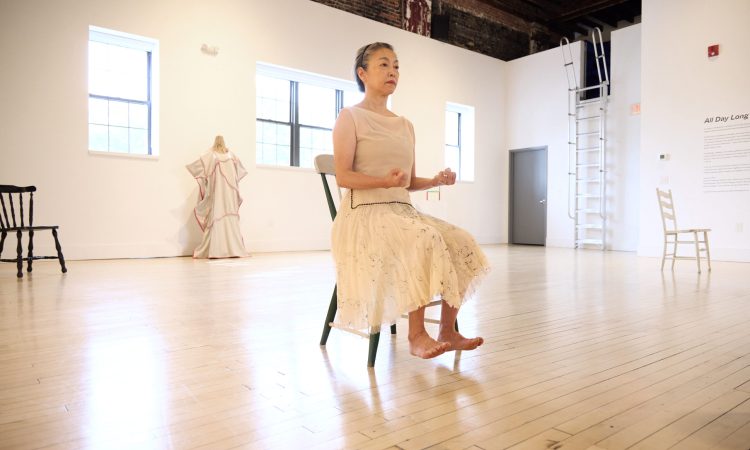
But it is the last section that I find most affecting. Orihara sits rigidly on a chair at the front of the stage. Her clenched fists hover over her knees, and her feet flex inches from the floor. The lyrics of Janis Ian’s song begin, “If I could only hear my mother sing again.” The grief is palpable. My daughter and I stare, mesmerized, as Orihara maintains the pose, the tightness, the holding-in, throughout the entire song. At the end, her palms finally open, her toes touch the floor, and she softens. Someday I too will miss my own mother to the point of motionlessness, and some day my daughter will miss me. But not yet.
17
In the post-show Q&A, Orihara explains she wanted to honor these four women–her creative mentors Martha Graham, Yuriko, and Namako Yamada, and her mother Kishiko Orihara–and move them through her. “And now, maybe, I can let them go.”
18
Orihara’s challenge to Bowman–a former Graham company member and the first Black woman to perform the iconic solo Lamentation (1930)–was for her to unlearn what she already knew about the technique, to come to this material as a blank slate. “But the body remembers,” Bowman tells us. My daughter is curled sleepily in my lap. “The body remembers.”
19
Back in the car, I have so many questions. “What did you think? What was it like seeing movement like that?” She’s quiet, then answers, “I thought…. I want to do it.” I peek at her in the rearview mirror and see she is drawing in my notebook. I ask if she’s making a comic. She shakes her head. “I’m drawing choreography.”
20
Later, after dinner, she is ready to show us what she’s been working on. My family sits in the living room. “Ready?” We nod. She drags a chair into the center, sits on it, takes a deep breath–1, 2, 3, 4–and begins.
Artist in Residence Workshop and Performance, Miki Orihara, KinoSaito Art Center in partnership with La Mama, New York, July 18, 2026