They can do it all: Pennsylvania Ballet dancers, that is. The opening program of the 2015-16 season—the first season that recently appointed Artistic Director Angel Corella programmed—proclaimed the dancers’ capacities boldly. Two of the evening’s selections, both company premieres, were drawn from 2006 Royal Ballet commissions—Wayne McGregor’s Chroma and Christopher Wheeldon’s DGV. These works drew on the remarkable virtuosity of ballet technique—leg extension, complex partnering, and pointe work—but broke with classical balletic form—symmetry, verticality, and fluidity—to absorb contemporary moves, energy, and lines. Ballet has always been a syncretic form; PAB’s “Speed and Precision” program maintains that momentum.
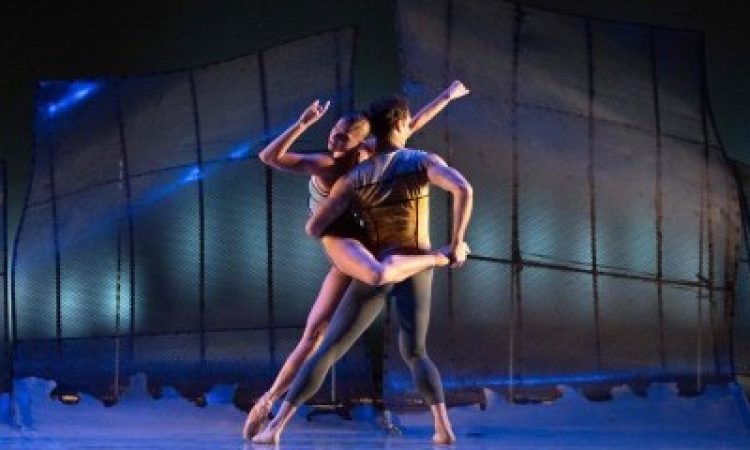
Opening with McGregor’s Chroma, the stage framed the dancers in receding windows of light and dark (set design by John Pawson), supported by Joby Talbot’s percussively thrumming orchestrations of The White Stripes’s music. In the course of six movements, ten dancers tested their range, from mile-high développés, to back curves and arches, to shoulder shrugs, hip rolls, and head circles. It was a dizzying display of the body’s potential, set within the austerely framed geometry of Pawson’s set, lit by Lucy Carter in whites and darks. The hyperactivity of the work’s opening dance sections was blessedly softened in two successive duets that grounded the work’s center: Mayara Pineiro with Arián Molina Soca in their sensitive partnering of touches, lifts, and shaping (her body, mostly, manipulated by him); and Oksana Maslova with Jermel Johnson, each independently (and sometimes together) testing their dynamic expanses and physical range, from head to butt to feet. The group returned, dancing to boisterous music with windmilling lifts and reaches, bringing this stunningly stark work to a close.
Wheeldon’s DGV, which closed the evening, took us out of Chroma’s architectural enclosures to a different world, perhaps a distant planet, far, far away. The roiling forms of Jean-Marc Puissant’s translucent set created an irregular upstage screen behind which the dancers bobbled, lurched, and strutted across the upstage area, emerging forward through a just-large-enough incision to confront us with powerful duets and group encounters that showed off each couple in exuberant commitment to the challenging but playful dance. A wonderful change since Corella took over company leadership is that we are seeing long-time PAB dancers looking fresh and joyous; in DGV, I was particularly delighted with Amy Aldridge’s pairing with Alexander Peters, and Lauren Fadeley’s with James Ihde. But the real star in this work was the set’s weirdly wonderful world, highlighted by Jennifer Tipton’s extraordinary lighting. The minimalist yet insistent music, by Michael Nyman, ran from mildly hysterical to over-the-top, the least successful element in this collaboration (Puissant designed the attractive corset-like costumes).
Smack-dab in the middle of these two twenty-first-century ballets, Corella wisely set George Balanchine’s 1940 Concerto Barocco, to J.S. Bach’s Concerto in D minor for Two Violins (soloists were Luigi Mazzocchi and Dayna Hepler). The music alone lifted the work to an Elysian Field of gracious, courtly elegance, but Balanchine’s reverence for symmetry (and care when breaking it), respect for balletic form (and care when departing from it), and impeccable musicality (and wit when syncopating movement against music) occupied that same high ground. It also grounded the two more recent works in the earlier master’s experiments with contemporizing this classic dance form. I have seen PAB do Balanchine before (they are a Balanchine-derived company, as founder Barbara Weisberger ensured), and I have shivered as the work exposed the dancers’ flaws. This time, I felt fully confident watching the work, as the dancers themselves clearly did, too. That they muffed one complex series of arm accents over bounces en-pointe did not entirely destroy the Apollonian aplomb of the work, and I would bet they nailed it at subsequent shows.
If you haven’t seen PAB since Corella took over the helm, get there.
Pennsylvania Ballet, The Academy of Music, October 22-25, https://www.paballet.org/upcoming-programs