Leah Stein has always reminded me of a lamb. She seems gentle; her silver hair soft and curling, her fine limbs weaving around like embroidery thread, her globe-like eyes that are more receptive than penetrative. Such is the aesthetic of her work, Portraits, performed amongst the galleries at the Woodmere Art Museum: more receptive than penetrative. The compilation of sweet vignettes set in conjunction with the museum’s exhibition A More Perfect Union? Sex, Power, and Race in the Representation of Couples is powerful in its subtlety.
The Kuch Gallery within Woodmere feels holy, perhaps because it reminds me of imagined spaces of limbo between this life and the next; all white, cavernous and infinite, blank, quiet. An amphitheater of a gallery, paintings, photographs, and sculptures wind around the walls on both levels, and standing in the middle of the round room is the only way to drink it all in. The exhibition is multitudinous and manifold and so, so gorgeous. Some of the works are abstract, most are depicting two people or two objects, some are silly and loud while others descend like fog. It’s a relief to see groups of chairs set up facing opposite sides of the space: direction, guidance. My boyfriend and I settle ourselves in the back.
The first duet, Who’s Hand?, is grounded by a large, nonpictorial piece with slabs of mirror reflecting Jungwoong Kim and David Konyk back at us. The simplicity of their movement (standing, facing, walking, collapsing) has a beautifully muffled quality; not literally stifled, but hushed and gentle, like snow. After my initial self-tussle against the assumption that the dynamic here is inherently romantic, I witness the whispered and intensely intimate way that two people can stand next to one another, whether in love, or dancing together, or looking at a painting in front of them.
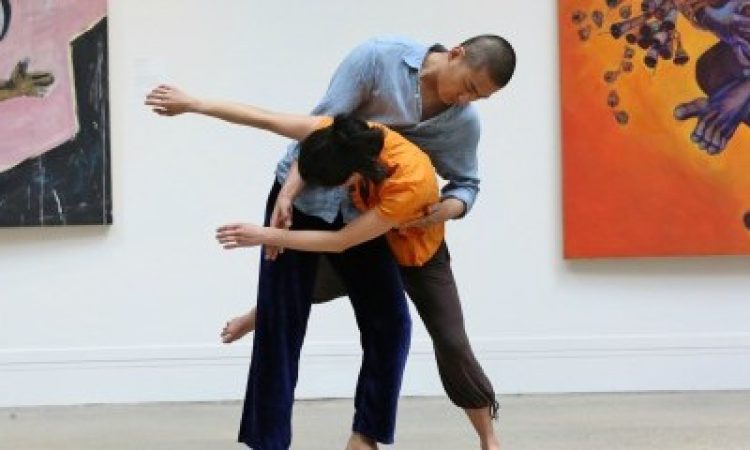
In an environment of overwhelming influences, the greatest strength in the choreography and performance is by far the subtle reveal of it all. In each of the seven pieces that make up the evening, I find sweet moments of connection between myself, the performers, and the works of art: when Megan Wilson Stern* and Michele Tantoco huddle into a rosy embrace in the foreground of Alex Kanevsky’s painting Hotel; when Kim and Konyk slowly circle above our heads in the Kuch Gallery admiring the art as spectators and specters; when Stern and Germaine Ingram find harmony and together-ing (yes, a verb), in their duet Listen; when musician Diane Monroe bangs out of the gate with impassioned jabs at her violin’s strings that contrast Tantoco’s stoicism in their duet, Below the Deck; when Tantoco and Kim swirl and hoist themselves into knots, with Barbara Bullock’s Dark Gods burning like a sunset behind them.
The power in Portraits does not lie in the moments of visual symmetry between the dancers and the art works. Stein’s choreography is more intelligent than merely arranging the bodies in the same way they are painted on display. Rather, I find deep complexity in their journey to such synchronicity, if it is even reached at all.
*Stern is a writer for thINKingDANCE.
Portraits: Duets for A More Perfect Union?, Leah Stein Dance Company, Woodmere Art Museum, May 20th, 2017. http://www.leahsteindanceco.org/portraits
Photographer: Darryl Moran
Dancers: Jungwoong Kim and Michele Tantoco
L: Two Men on Bed, 2015, by Jonathan Lyndon Chase (Collection of Manja L. Lyssy)
R: Dark Gods, 1982, by Barbara Bullock (Courtesy of the Artist)