Samuel Pepys is concerned about his dick. Excuse me, his “yard.” Euphemism or no, we’re all probably concerned by our own yards, be they between our legs, in front of our houses, or the clothing on our bodies. But have those private concerns been read aloud publicly, 300 years in the future? No. Not yet. Except for Sam Pepys’s. His diaries (alongside three centuries of ongoing marginalia, on page and internet), are fodder for Big Dance Theatre’s 17c, currently in a special preview period in Philadelphia’s Fringe Festival.
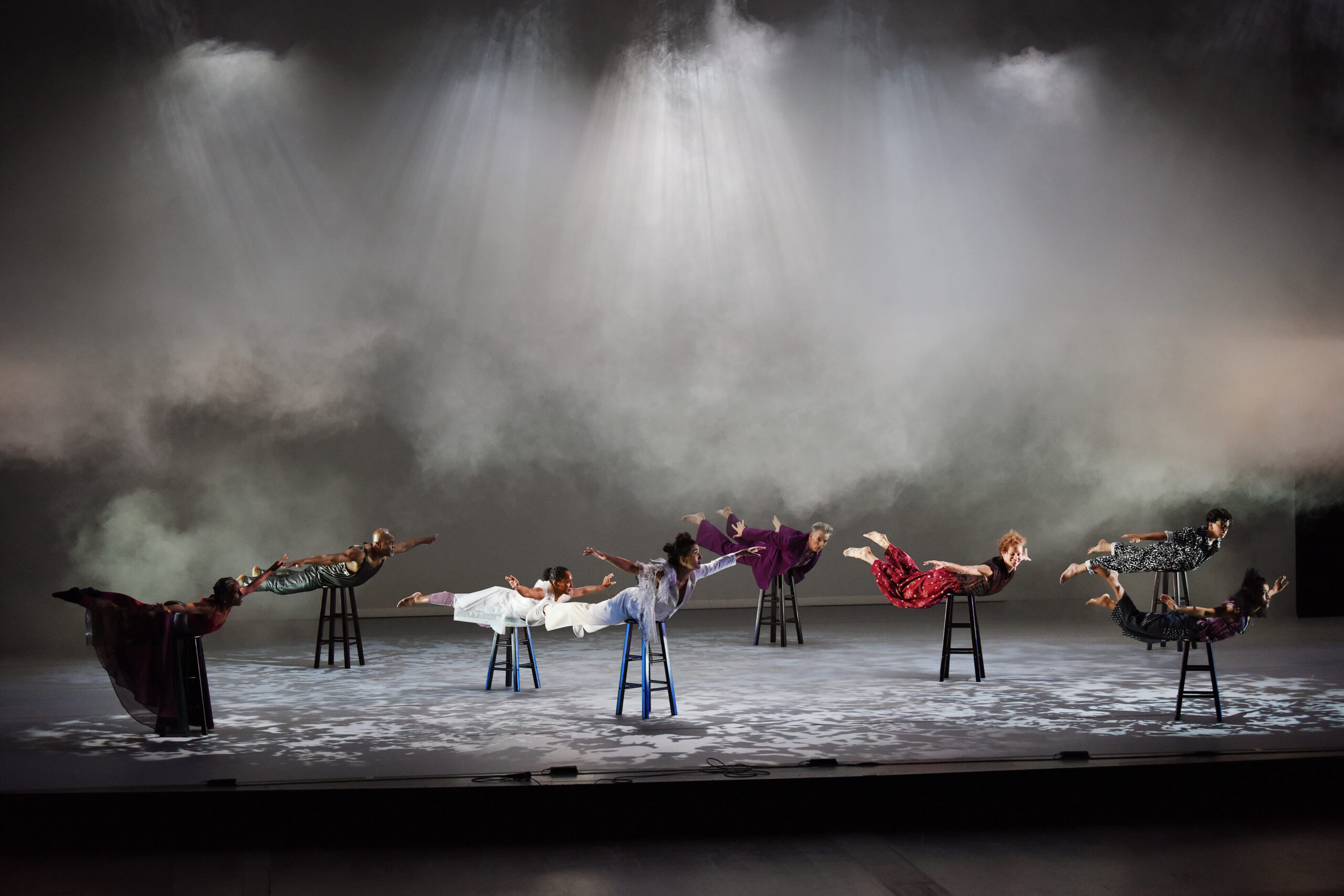
Visually coherent and information-rich, the set (Joanne Howard) and costumes (Oana Botez) collapse time. If a Sims game, a high-concept minimalist web series, a salacious ’80s soap opera, and a seventeenth-century boudoir all brought up a child together it might look like 17c. Florescent colors, floral patterns, and glitter cover the costumes. The lounge chair’s pleats echo the stunningly decadent bed-cube, which echoes the pleated mobile wall serving as the main set piece. The players are both actors and crew, playing a scene in front of the wall, then pushing it from diagonal to flush. The pink and nerdy duo of Kourtney Rutherford and Elizabeth DeMent speak into a camera they control. The players act in their own creation—a formal echo of Pepys, meticulously rendering his own life via writing.
17c, co-directed by Annie-B Parson and Paul Lazar, however, is less daily, less myopic and linear, more prismatic—a constellation of material laid out over time. I’m unclear, sometimes, what to grab onto. Except, of course, that long monologue, expertly inhabited by Paul Lazar, placed front and center stage—a structural centerpiece amidst a delicate and complex panoply. An onslaught of self-narrative, a string of Pepys diary entries about buying his wife’s emotional security, his feelings for and fondling of their maid, his guilt and pleasure in his betrayal. A man gesticulating on a lounge chair, fake fire at his side, big wall flush up behind him, annihilating the room’s depth. In the shadows, the ensemble live-underscores his remarks.
Why does this seem to me the nucleus? Why not the play within a play by Mary Cavendish, the obscure radical feminist writer? Why not the presence of Bess, Sam’s wife, embodied by the supple DeMent? And what about that magnificent erotic call for the dance master from earlier in the show? Or Cynthia Hopkins, whose voice in the closing ballad instantly transforms the room from everyday to mythic? These presences shine a strong, not entirely flattering light on Pepys. And while we can now see these other lights, his is the yard they light up.
17c, Special preview Performance, Big Dance Theater, FringeArts, September 7-9, http://fringearts.com/event/17c/