Settling into my seat at the new Proscenium Theatre at the Drake, I read the program for New Paradise Laboratories’ Hello Blackout!, directed by Whit MacLaughlin, with music composed by Bhob Rainey. It starts with a glossary: Matter. Music. Speculative Materialism (citing Quentin Meillassoux). Probability. Blackout. Horror. Right-brained Vacation. I jot my first reviewer-note: Pretentious. Hmmm, hold that judgment.
We are graciously told that, once the show starts, we will not be able to leave—or, if we absolutely must do so, we will be escorted out and on no terms permitted to re-enter (safety concerns). Sounds threatening. The musicians enter, tune, strike a chord. Blackout number 1.
A true blackout. When have I ever encountered utter darkness? I lean into my husband, in the next seat. I want to feel something solid, if my eyes can’t do the holding—any holding. As stage lights rise, five figures in black coats are spaced across the stage. Blackout, chords, light: the group congeals. Blackout, chords, light: heads bob. Blackout: one sinks to the floor. At unexpected moments, a ball thwacks the stage-right wall, exploding in glittering confetti. Viewers gasp. Within five minutes, an audience member has signaled the need to leave and an usher pin-lights her out. We won’t see her again.
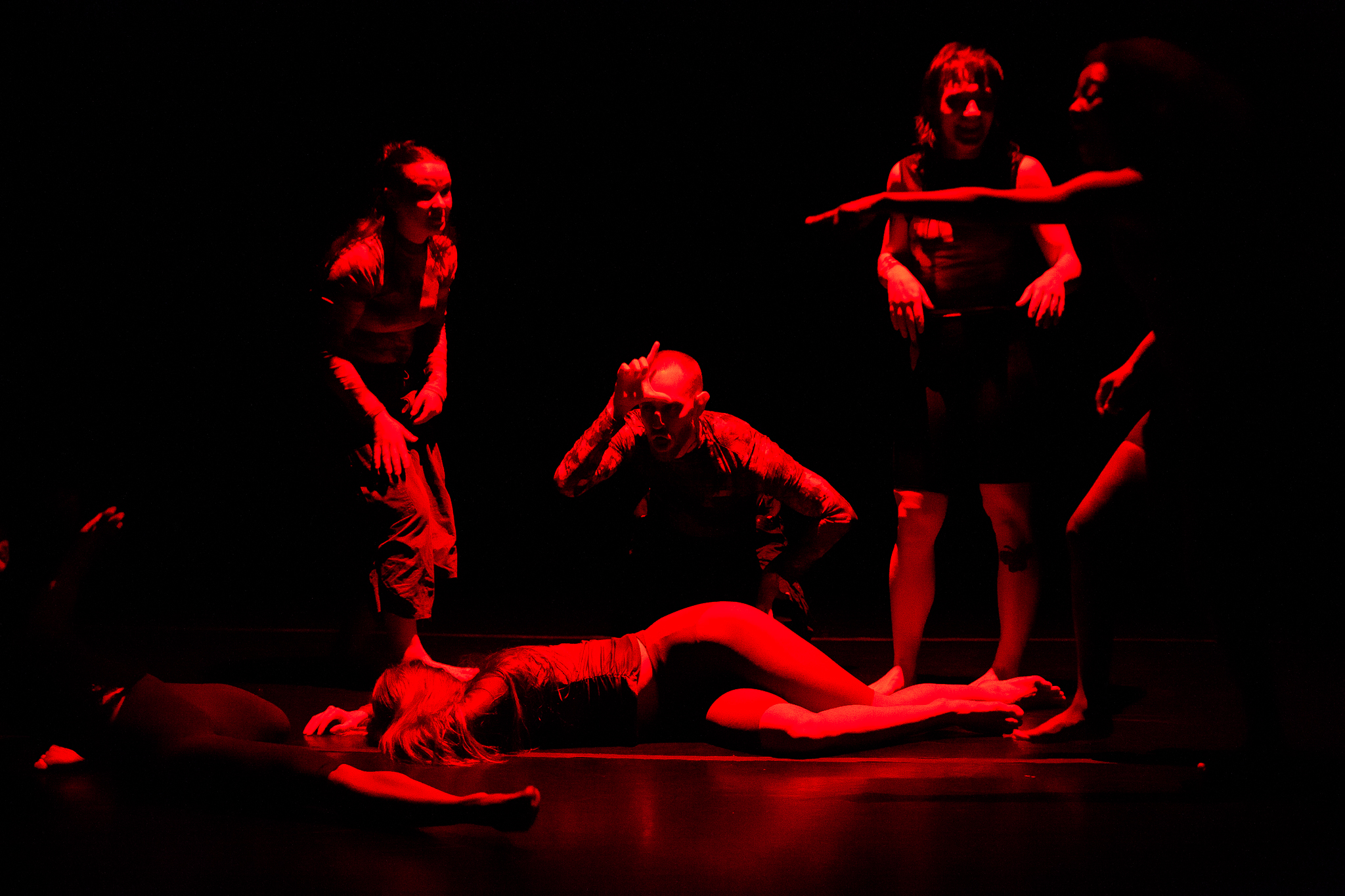
An angled doorway juts a sharp rectangle of light onto the stage, becoming the birth canal for the creatures’ evolution, shocking them into speech (“Holy tamoli!” “Coffee breath”) or action (one sits on a chair that scoots through the door, all five shoot it up as the enemy in an imaginary war-game). The five coats twitch in jagged gestures, puppetlike. One at a time they remove black half-masks, becoming that bit more human. The musicians (violin, viola, cello, bass, and bass clarinet) mark the action sharply, as do the light changes. I find myself drawn in: the actors are fine—tight, clear, committed; the music matches the abstractions of set and lights; and there is frequent, ludicrous humor.
Midway-ish, after a blackout, the actors reappear in baroque-and-bizarre costumes, a family in “a strange alternative” past.* One has become a father-king, seated on an ornate throne, attended by his elegant wife (who had earlier coughed up a series of eggs into the king-actor’s coat pocket) and three children. Dad-king drills figurative holes in their heads to read their minds, disgorged in solo and group turns that move from dog stories to disquisitions on gravity to Beatles’ tunes. The music retreats from my awareness, going less far than costumes, set, text, or action to shift state from abstraction to narrative. Throughout, however, the music, blessedly unamplified, remains a sensitive presence, never drowning out the staging or assaulting the audience. Still, the “story” is obscure, absurd, nonlinear, although I pick up moments of recurring text, movement, or musical riff from the first act’s abstract flashes.
Somehow, we know when it ends. Most of us have made it through. I’m glad I stayed.
___
*The film O Monsters, a “companion” piece to Hello Blackout!, also featured this family, “in a strange alternative present,” but I was, alas, unable to make a showing.
Hello Blackout! The Proscenium at the Drake. Sept. 9, 10, 16, and 17, http://fringearts.com/event/hello-blackout/