Pairing acknowledged “ballet legend” George Balanchine with “legend-in-the-making” Alexei Ratmansky, Pennsylvania Ballet presented a ”Russian Suite” of classical purity, nonstop dynamism and dramatic caricature.
Starting the show, Balanchine’s pristine Raymonda Variations (1961, music by Alexander Glazounov, the Pennsylvania Ballet Orchestra, here and throughout the program, under the baton of Beatrice Jona Affron) exposed every line and whiff of the musical and terpsichorean flow. This was breathtaking in soloist Brooke Moore’s suspended turns and balances in Variation IV, but uncomfortable in Moore and Francis Veyette’s tense partnering, with supports more critical than courtly. A few of the demi-solo variations showed slips in timing or landings, but this lovely ballet as a whole established the classical tone to which the two later works could be compared.
The program’s centerpiece, Ratmansky’s Jeu de Cartes (2005, music by Igor Stravinsky) is a choreographic coup for Pennsylvania Ballet, the first company to perform the work after the Bolshoi. Bold, fast, dense, and colorful, Jeu powerfully contrasted with Raymonda’s pale pinks and soft grays, elegant symmetries, and clear classicism. Jeu’s costumes shifted from purple to gold in the course of this work for fifteen dancers, who performed against a white wall punctuated with boxes, passageways, ledges, and ramps. Groupings shifted quickly as dancers raced, wandered, rolled, and shuffled on and offstage. Before my eye could grasp one arrangement, it melted and transformed—a deck of cards shuffled by a master, a flip-book thumbed at break-neck speed. Attentive to Stravinsky’s ever-shifting meters and accents, the dancers phrased their leaps and landings, swooped their legs and arms, stretched or measured their jumps and poses, highlighting the complex sonorities that drive the work.
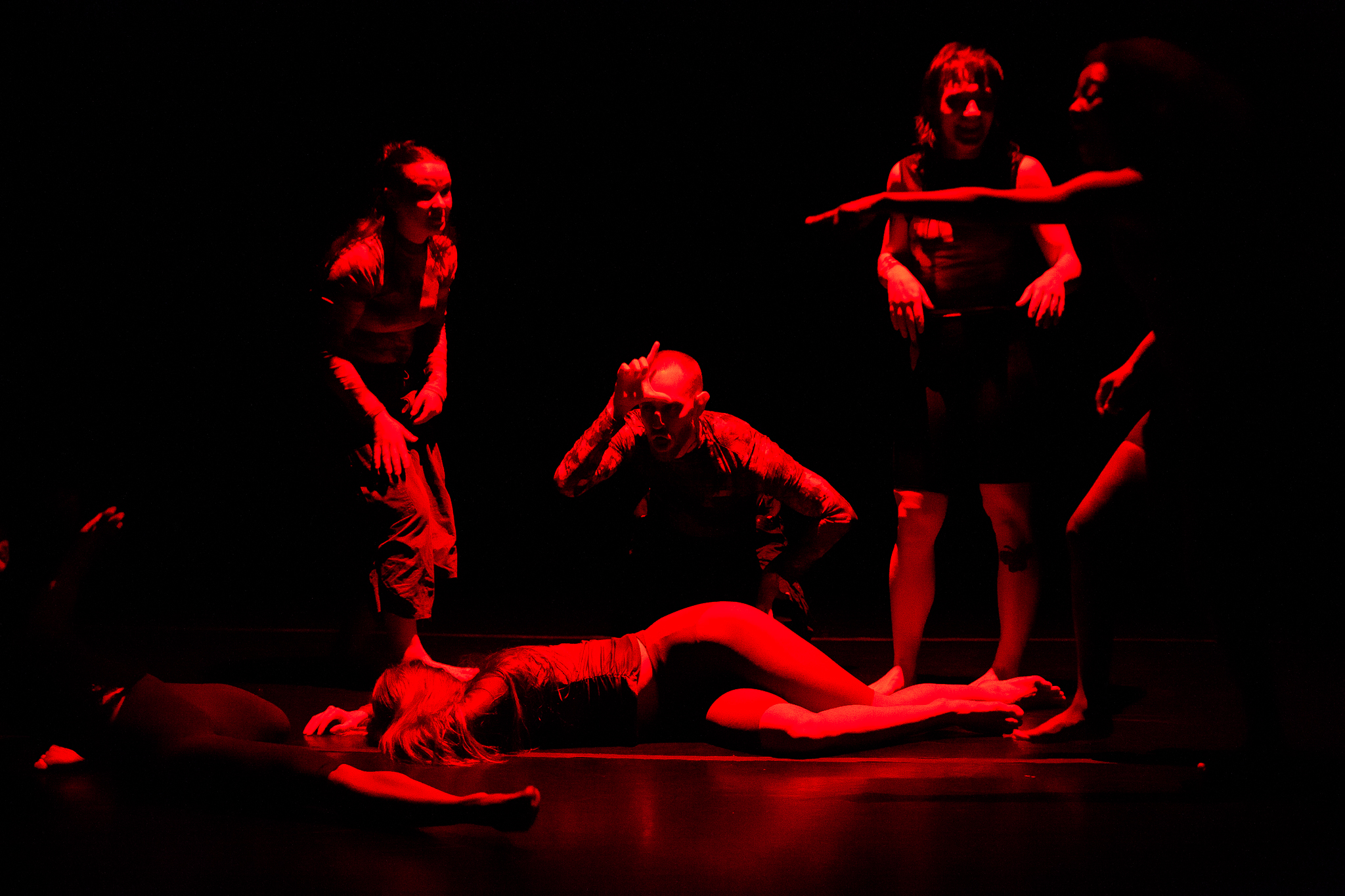
Unlike the clarity of Balanchine’s unfurling classicism, Ratmansky pulled out—like card tricks—disconnected themes. Shadowy figures lurked among the giant geometric set pieces, spying darkly on the dancers center stage. The commanding Arantxa Ochoa threatened a covey of suitors like a tarantula whose angled legs might sting whomever she touched. Despite Ratmansky’s insistence, in a program note, that “there will be no cards in the ballet,” jokers came to mind when three purple men lurched, leapt, and angled their limbs in odd juxtapositions or later when four men flung and supported one another like battling knights. In the midst of a busy dancing group, a man knelt and mimed card-flipping—a manic solitaire-player compelled to finish his game no matter what chaos swirled around him. Ultimately, all dancers—sweat-soaked—punched out a truly WOW-finish: golden legs aloft, the whole deck flung out in perfect symmetry, Ochoa a crowning centerpiece. Suddenly, Ratmansky brought us back to a world of balance and panache, a nod to the Balanchine ballets preceding and following.
Slaughter on Tenth Avenue (1936, music by Richard Rodgers, arranged by Hershy Kay) was a delicious closer. Dramatically clear, cartoonish yet touching, the work drew the best from the Ballet’s dancers: full-out acting, expert Charlestons, and over-the-top characters. From Lauren Fadeley’s lovable Stripper and Andrew Daly’s double-take on Hoofer Ray Bolger, to the three-blind-mice Policemen (James Ihde, Jermel Johnson, and Lorin Mathis), the company, like the audience, had a ball.
In the classic elegance of Raymonda and playful drama of Slaughter, I savored Balanchine’s technique, clarity, and musicality, all of which served as revealing foil for Ratmansky’s sting, zest and dense dynamism.
Pennsylvania Ballet, “Russian Suite: Ratmansky & Balanchine,” at the Academy of Music. October 20-23, 2011. No further performances.