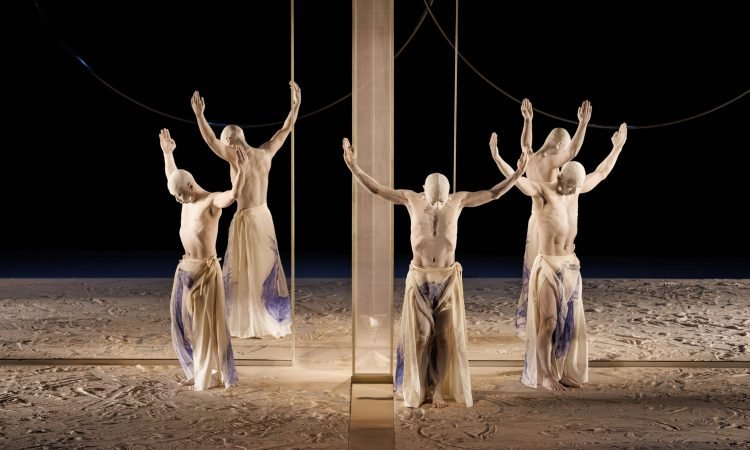
Six men gently raise their arms upward, their fingers fluttering like the wings of delicate birds. Suddenly, they drop into deep crouches, their arms encircling the air as if cradling a small ghost. Each man wears a simple hakama around the waist, exposing sinewy limbs and a torso completely covered in white powder. All hair has been shorn from their heads, divesting them of individuality save for a single flower dangling from each man’s right ear, its color bestowing a subtle variation to their otherwise haunting uniformity. In TOTEM–Void and Height, movement exists inside a space beyond time.
Founded in 1975 by Ushio Amagatsu, Sankai Juku performs butoh, the Japanese dance theatre form created by Tatsumi Hijikata and Kazuo Ohno. Emerging in the wake of the nuclear bombing of Hiroshima and Nagasaki during the Second World War, butoh’s founders sought a radical new form of expression, a “dance of darkness” that explored taboo and revelled in the grotesque, rejecting the refinement of traditional Noh in favor of something more countercultural. Sankai Juku is part of butoh’s second wave of interpretation. Amagatsu’s artistic vision feels quieter and more elemental than the dance’s earliest performances where Hijikata would tear off a rooster’s head, or Ohno would crush a live chicken between his thighs.
The company’s name means “sea and mountain workshop,” implying a performance laboratory investigating the fundamental properties of the natural world. Connections between humans and the earth, between integration and exploration, is on vivid display in TOTEM, Sankai Juku’s final work. Finished shortly before Amagatsu’s death in 2024, it is nearly impossible to not view the piece as elegiac. Melancholy thrums throughout the 75 minute performance though silent howls of despair only appear in the final moments before blackout.
In their powdered white makeup, the all-male company (Seminaru, Sho Takeuchi, Akihito Ichihara, Dai Matsuoka, Norihito Ishii, Taiki Iwamoto, Makoto Takese, and Satoro Ito), embodies an almost celestial level of restraint and control. When the men tilt their faces up to the sky, they appear to be on the threshold of some kind of epiphany. Multiple dancers enter and depart slowly like passing clouds. Whether walking vertically or lying on the ground, their bodies tune to nature’s hidden music. Sometimes, the men open their mouths. It’s as if small portals have opened into the void; briefly, their expressions seem overwhelmed with despair, or mirth, or terror. But most of the time their faces remain tranquil. They haunt the atmosphere. In TOTEM, it is as if Sankai Juku is performing a private ritual to which we are privileged to bear witness.
The decor is minimal and harmonious, the stage design inspired by Natsuyuki Nakanishi’s installation Quartet, Touching Down on Land and Touching Down on Water X. A narrow, transparent tower stands in the center of the stage, forming an axis for four large squares with smooth surfaces which surround it. At first, the dancers step elegantly in between these squares with reverence. But when the ensemble eventually steps onto them, they disturb their pristine surface. The squares are covered in dirt. The walking has made them filthy. Harmony has been muddled by footsteps, the earth upset by falls to the floor, by frolics, by the linear and semicircular pathways of these ghostly bodies. Particles of soil cling to their skin and alter their clothes as TOTEM unfurls.
Sankai Juku allows room for each component of the performance to stand on its own.. The soundscore by Takashi Kako and Yochiro Yoshikawa encompasses a range of sounds, from prolonged acoustic strings and the sound of the ocean to long periods of silence, but sonically little relationship exists to the dancing. The performers move equidistant from one another along a diagonal, or trace the same exact lines around the squares’ peripheries. Visually, Amagatsu often has two dancers doing identical choreography–internally rotating their arms, or lying laterally on the dirt floor, or pointing their fingers straight upward. The choreography offers the ability to see the entirety of humanity, revealing multiple perspectives at once, often in alternating states of struggle and pacifism.
Two giant rings suspended on the back wall also illustrate time’s passage. Over the course of an hour, they slowly cross from one side of the stage to the other like the phases of twin moons. Momentarily, they line up perfectly in the center in a fleeting eclipse. In the foreground, the dancers move in eerie unison. Like these two moons, Amagatsu spent over half a century straddling two worlds: he maintained a clear lineage within butoh while also developing his own distinct voice and forging new ground. TOTEM – Void and Height is a powerful final statement from this master, carrying forth a form which through practice, understanding, and attention refuses easy definition.
TOTEM–Void and Height. Choreographed by Ushio Amagatsu and performed by Sankai Juku, NYU/Skirball Center, November 5-7, 2026
Note: The writer studied with Kazuo Ohno in Yokohama, Japan in 2000.