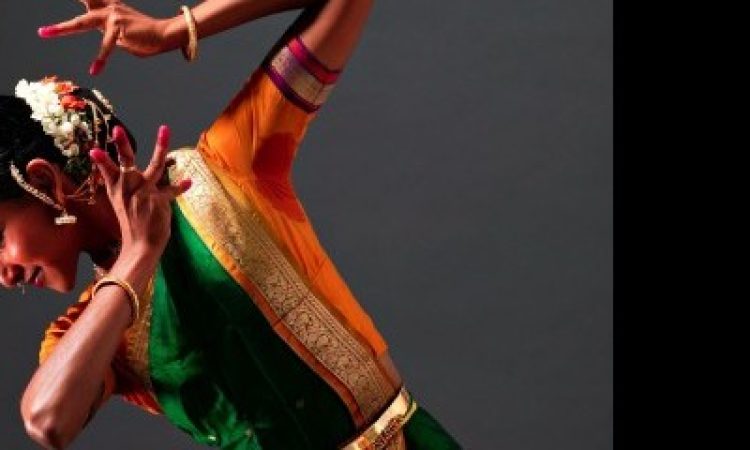
The Annenberg Center for the Arts inaugurated its Asian Roots Series with an evening of classical Indian dance, conceived and performed by Shantala Shivalingappa, accompanied by a 4-piece orchestra including flute, percussion, strings, and vocals. Born in India and raised in Paris, this “child of the east and west” has been hailed by critics for transcending culture. A star pupil of Kuchipudi, a classical dance that emerged in 15th century South India, with inspiration from folk forms, Shivalingappa has also worked with the likes of Peter Brook and Pina Bausch, and is devoted to bringing the form to “western” audiences. While Saturday’s program was decidedly traditional fare, the gift of the evening was a feeling – ephemeral in its evocation yet enduring in its impact – of a bridge across time and space, where history and culture are support rather than barrier, and the differences that separate us momentarily dissolve.
The curtain opened to reveal the musicians seated in a straight line towards upstage left. Their hands moved through prayer position to the recitation “namaste,” (“I see the divine in you”), setting the tone for an evening where reverence and recognition intertwined. A voiceover announced that the first piece was a prayer to the Goddess of the Arts, then played out on flute, a low veena thrum, percussion, and chant. The evening followed this regimen, a voiceover introducing each of the following five pieces. Expanding upon the program notes, the voiceover was a welcome reminder and a deliberate offering, an invitation to continue the journey by clueing the viewer in to key details of musical structure, choreographic style, and content.
Outfitted first in a sari of deep red and gold, its front plunging into an accordion-like skirt whose pleats spread continuously in seamless grande pliés, floated open like a tiny parachute in weightless jumping turns, and exhaled to close with each poised stop, evoking movement in stillness – Shivalingappa was a breathtaking balance of power and equanimity. A master of precision, her capacity to isolate the tiniest of joints seemed an illusion. The magic of this dexterity was heightened by the hot pink nail polish shooting off her fingers and toes, the soles of her feet and her finger pads, extending the exacting manipulations of each appendage out into the crowd.
Integrating abstract dance with narrative encoded through facial expression, posture, and mudras, Shivalingappa embodied characters of Hindu mythology and concepts of Indian culture. In Rasalila, her face told an ever-evolving tale of courtship, presenting Radha and Krishna as coy, shy, daring, boastful, seductive, surprised, and more, with a mere tilt of the chin or shift in glance. In Talamelam, the musicians swapped rhythms back and forth, playing on vocal and percussive beats to a frenzied peak. Joining in, Shivalingappa’s feet matched the rhythms perfectly, dissolving any sense of “lead” or “follow,” until she mounted a brass plate and swiveled from one end of the stage to the other, finally hovering at the stage’s edge, not an inch from the lights as they extinguished.
In Shiva Ganga, she became the powerful Shiva, who creates the world through dance, and the pliant Ganga, Goddess of the river Ganges. As the backdrop went black, the black marley shone like water, accentuated by sinuous undulations that crept up the dancer’s arms. Both charmer and snake, she gained Shiva’s consent to flow into the earth, rippling to the floor in circular waves, only to float over the surface as if in a loving benediction.
That Saturday’s program also included pre-show Indian fare and post-show sparkling cider to toast the Center’s 40th anniversary transformed the evening into a festive occasion. This reflected the spirit of the show, where tradition was served up as offering, and the result was an encounter, an instant of transcendence.
Shiva Ganga, Shantala Shivalingappa, Annenberg Center for the Performing Arts, November 5. No further performances.