The opening night of BalletX’s Fall Series 2011 provoked curiosity in me about what defines a ballet as contemporary. Is it the movement vocabulary or the choreographic structure? Is every ballet made in the 21st century considered contemporary or is the work defined as such if we see a ballet choreographer challenging his or her comfort zone? The three pieces on this program showed different takes on that definition.
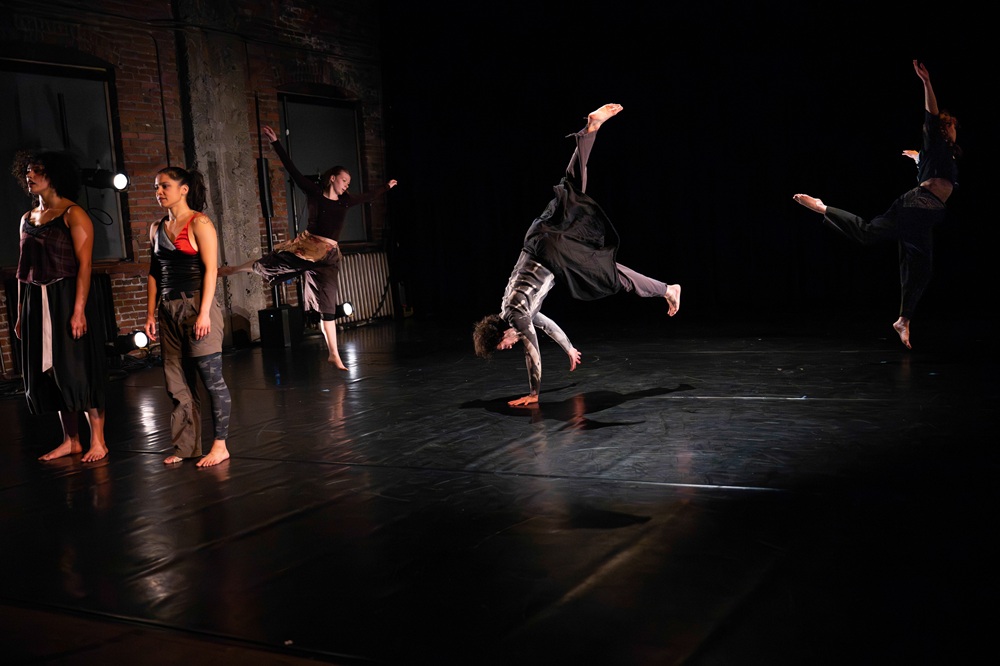
The evening started with Loni Landon’s Two Ears, One Mouth. The dancers, dressed in men’s’ pants and black socks, used unlikely parts of their bodies to support, lift, hold back, or throw themselves upon each other. Clearly Landon was influenced by contact improvisation. The dancers of both genders moved with fierce physicality: an aggressive duet between two men dissolved into a duet with a woman and man in which glimmers of tenderness appeared between partnering sections that were nearly as aggressive as the men’s duet. Moments of stunning physical virtuosity melted into simple walking.
The choreographic structure was surprising, with round edges. Sections dissolved into each other. Solos and duets slipped into large group dances. Familiar phrases emerged in unexpected moments. This roundness created a rolling quality that hurtled forward, never letting the audience pause to catch its breath. I imagine that Landon is familiar with Merce Cunningham’s work, which decentralized the proscenium stage. In Cunningham pieces, no point in space is any more important than another. Cunningham’s approach created work that was less presentational than traditional ballet, and the manner in which these dancers related to space and the audience appeared to have integrated Cunningham’s ideas. I drew great pleasure from engaging with a piece that combined the discoveries of postmodern dance in America and Europe with the high athletic neuromuscular demands of ballet training. To me, Landon’s piece was the most contemporary of the night because of how it integrated these discoveries.
The second piece, Alex Ketley’s Silt, stood in stark contrast. The poorly edited sound design, the way the musical and dance sections began and ended in sync, and the liberal use of unison, created a rather predictable piece. The men always partnered the women, usually supporting them with their arms. The gender roles, as well as the presentational nature of the entire piece was more in line with traditional ballet. This is when the question of the definition of contemporary really arose for me: other than flexed or sickled feet, and the cocktail-dress costumes the women wore, I had a hard time finding anything in the choreography that might be considered contemporary. So why was BalletX, which defines itself as a contemporary ballet company, performing it?
The last piece of the evening, Jackson Sounds, was choreographed by co-artistic director Matthew Neenan. Beforehand a five-minute video introduced the process of creating it. Students at Andrew Jackson Public School shared pieces of music they’re influenced by with composer Robert Maggio, who then created a score. The students offered interpretations of the score: movement ideas and vocabulary, which Neenan then took back and set on the company. The resulting piece aimed to capture the spirit that filled the halls of the school; one that appeared overwhelmingly playful.
If Neenan was a filmmaker, he was zooming out of and into specific scenes that may have happened in the school. Throughout much of the piece, the entire cast of ten was onstage; I am deeply impressed by Neenan’s ability to move large numbers of dancers around. The stage never felt crowded and the formations rarely felt formulaic. Narrative rose out of and sank back into abstraction in the same way that different constellations of dancers came together and moved apart.
However, the music Maggio composed felt suspiciously Aaron Copland-esque. Do the halls of a school at Twelfth and Federal really sound like early 20th-century American frontier? I was also surprised and just a bit disappointed that the broad diversity of dance styles that (according to the introductory video) the students brought to the process weren’t more apparent in the piece’s movement vocabulary.
A new undertaking by BalletX, called “Expand the Experience,” may have been the most contemporary element of the night. During the first intermission the Conestoga Angel Precision Marching and Drum Corps busted into the theater, completely re-energizing the space. Later, R. Eric Thomas told a story about meeting Patti Labelle. These two interludes, like a delicious sorbet between courses, were a welcome interruption to the formality of a ballet concert.
Fall Series 2011, BalletX, Wilma Theater, November 16-20. No further performances.