When Gwendolyn Bye applies for a grant to reconstruct a historic modern dance, she always faces the question: “Why is it important?” Her response is direct. “If history wasn’t important,” she says, “we wouldn’t have museums. Why is preservation important for art and not for dance?”
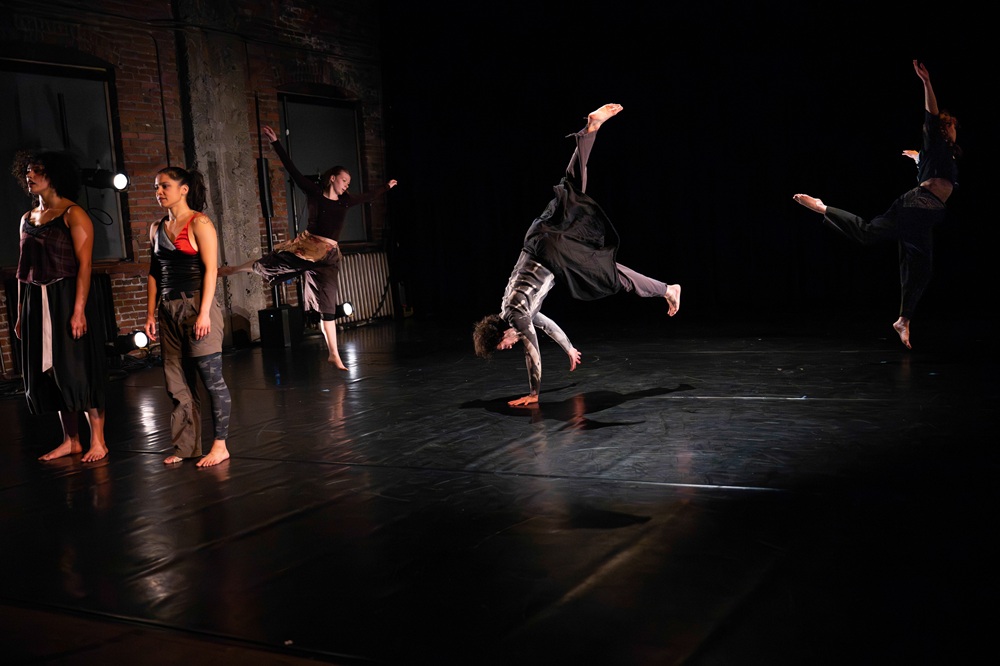
Since 1987, Bye has been reconstructing the hidden gems of modern dance, piecing together long forgotten works by legendary choreographers such as Mary Anthony, Jose Limon, Anna Sokolow, and Pauline Koner. Her company, Dancefusion, then performs these works to shed light on the richness of American modern dance history. “That’s the focus of my mission, to preserve a neglected modern dance past and create a living archive,” Bye says. “Dance has to be living and to be shown to an audience as it was intended.”
Some people might argue that dance can be preserved well enough on video. But too often these are fuzzy reproductions, catching flat images of what was textured and vibrant movement. Even clear digital recordings cannot capture the dancers’ connection with the audience or the audience’s visceral response to the performance. Lapsed time, the gulf between when the recording was made and when recording is viewed, also affects the authenticity of the experience.
Rachel Kantra Beal, a Dancefusion company member since 2006, agrees that historic works need to be relearned and performed in order to stay alive and relevant. “By actually doing the material,” she says, “you gain a true three-dimensional understanding of the work and its source, how it was innovative in its own time.” Dancers benefit from inhabiting this work and audiences gain a better understanding of how this modern dance looked and lived at its inception. Yet no one expects a perfect replica; dancers today have different bodies and different training than those of the original cast members.
And without video or some kind of written notation, it is nearly impossible to know the exact choreography and atmosphere of a piece. “The best way is to have someone present who actually danced in the work,” Bye explains. “The body remembers. You put on the music and the body starts moving.” In that sense, dance reconstruction presents challenges similar to that of an archeological dig. Choreographers and dancers search their memories and allow their muscles to uncover steps that were created and performed years before. Yet there are often missing pieces and the suggestive imagery of photographs then helps to re-imagine these gaps.
Dancefusion, with support from the Pew Center for Art & Heritage, presented a 2006 symposium and video documentary about Women of Troy addressing issues such as these. Worth seeing is the accompanying essay by Linda Caruso-Haviland: “Digging up the past: Some thoughts about preserving or reconstructing dance works.”
When Bye staged Anthony’s Women of Troy (1954) here in 2006, Anthony and one of the original dancers, Donald McKayle, came to Philadelphia to teach what they remembered. The choreographer spent hours in her small hotel room remaking the parts she had forgotten and using photographs of the piece to help inspire her movement. Though Bye had the original costumes in hand, she had no music – just a very old rehearsal record with the underlying rhythms. She then brought in a composer to re-score the piece. “That was tricky,” Bye admits. “Reconstructions sometimes turn out to be recreations.”
Creating new dance is the flip side to Bye’s mission. Her company is committed to presenting older works alongside commissioned pieces to demonstrate the past’s influence on the present. “I’m a strong believer that we must know our dance history,” Bye says. “We must have a point of reference in order to move forward.” She uses Pablo Picasso as an example: Before he drew cubist forms and abstract shapes, Picasso knew how to draw the perfect face and form. His radical style stemmed from pure, classical technique. “Once you understand the history,” Bye continues, “you’re ready to go off and create something of your own. That’s what modern is about. Without that springboard, it can be shallow or lacking knowledge.”
Bye’s company serves as that springboard. Dancefusion educates through their performances, illustrating how dance does not have to be new to be edifying and vital. And unlike video and notation, they preserve and reinvigorate forgotten historical works. That is why, as Bye explains in each funding proposal, these reconstructions are important.
Dancefusion performed an excerpt from Mary Anthony’s Gloria (1967) on December 11 as part of their holiday celebration and plans to present the entire work in September, 2012, at the Live Arts Festival/Philly Fringe. Dancefusion is also seeking to perform Anthony’s Threnody (1956), recently reconstructed for the 2011 Philly Fringe, in New York City and elsewhere.