Between 1982 and 1988 the top three longest-running Broadway shows of all time, The Phantom of the Opera, Cats, and Les Misérables, opened and offered girls and boys from the Northeast who weren’t enthralled by sports a club of our own. As my sister and I blissfully waited outside countless stage doors to fill our Playbills with autographs, something entirely different was going on below 14th street and way uptown. Bill T. Jones had just formed his dance company with partner Arnie Zane. Building on ideas first introduced by the Judson Church pioneers in the 1960s and informed by his identity as a homosexual, African American man born to migrant workers escaping Jim Crow, Jones has contributed immensely to the field of contemporary dance. In the last three decades his work has received much attention, including a denouncement by the Vatican in 1992 and a Kennedy Center Honors in 2011.
At some point during Jones’ artistic ascent, I left Broadway fandom behind to explore less popular forms of culture and entertainment. In 2010 and then again two weeks ago, I was lured back by the spiritually charged and rhythmically complex music of Fela!. Since the new hit show was co-conceived, directed, and choreographed by a man whose work I now understood to be essential to the evolution of live performance, I set my expectations high. What came next was the discovery of one man’s story so powerful it made me forget I was actually sitting right back where I’d started.
Jump to 1970s Nigeria: corruption, repression, and brutal acts of violence under an oppressive military dictatorship. When music pioneer and political rebel Fela Kuti coined the term “Afro-beat” to describe the hybrid sound he’d developed, a new vehicle for expressing rejection of the nation’s ruling party took hold and spread quickly throughout Africa and Europe. Influenced by Western greats ranging from James Brown to Frank Sinatra (with lyrics translated into Pidgin English in order to reach a wider audience), Fela’s music has been celebrated by many across the globe, particularly jazz and funk devotees. He inspired a generation of Afro-beat musicians, including the Brooklyn-based Antibalas, who perform all of the music live on stage in this overtly political and biographical musical.
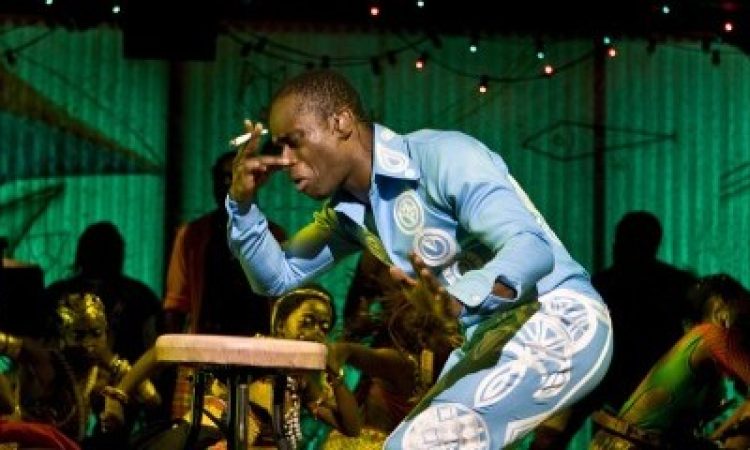
Throughout its tour, theater critics have argued that, although the overall energy of Fela! captivates with non-stop drumming and explosively virtuosic singing and dancing, the story of his life is portrayed with a number of missing facts and “lacks suspense.” These reviewers may have missed the opportunity to notice that Jones approached this work with the same tools he uses in his less widely consumed projects. What did he borrow from experimental dance? In Fela! there’s a juicy starting point, but thanks to Jones we’re not bound by the order of a script or a set of facts. Instead, the most hard-hitting, visceral moments of the show emerge with their own logic. The repeating theme of Fela smoking a joint while directly addressing the audience grounds the wildly pulsing musical numbers. Through a sobering slide show of minimal text and mugshot-like portraits of his household posse, we learn the vicious details of a “Mosquito” raid, including the unjust killing of Fela’s role-model and activist mother. Still, the contract between audience and performer in Fela! is that they are not in an American theater in 2012, but inside the Shrine, Fela’s nightclub in Lagos, for a final hoorah before his entourage flees Nigeria and all of its strife forever.
Attending Fela! in Philadelphia, a city where 25% of the population lives in poverty (10% higher than the national average), I found myself surrounded by over 2,700 fortunate others, sharing in the most participative Broadway musical moment I’ve ever experienced. We have just been urged by Sahr Ngaujah (who plays Fela with remarkable audacity and— it’s been said— striking similarity to the real man) to “Stand up. Think of your pelvis as a clock. Now cock your hips towards 3 o’clock, 6 o’clock, 9 o’clock. All together now…” We circle our hips inside the old opera house and respond to his calls: “O-ree-gee-nal no art-ee-fish-ee-al-ee-tay. Now you…” Fela! asks us to feel—not just watch—what we’re seeing.
I celebrate Fela! for ushering Broadway into a new era. Though much of the show’s aesthetic appeal derives from elements of African American church and dance (call and response, participation, folk ritual, and story-telling), Broadway has taken its time finding a way to deliver these altogether to the masses. I see this as a sign that dance and theater are closing in on one another in mainstream culture, and the art of the future desires, and deserves, boundary-blind audiences.
Fela! at the Academy of Music. March 20-25. See www.felaonbroadway.com for future touring dates and locations.