Branches are the dead parts of the tree, its skeletal remains—the tree’s losses from wind, disease, or from an encounter with a pocketknife or handsaw. Branches can also be used to build.
The Painted Bride’s stage is hung with branches. They form a diagonal path among the rafters, an altar downstage; two large ones frame a space in the opposite upstage corner. Dancers enter in the dark, carrying branches, balancing them.
In his introductory note to Beyond the Bones Revisited (2002/2012), Kun-Yang Lin offers sources for the original iteration of the piece: the events of 9/11, the death of his father, his own diagnosis of a brain tumor. All involve sorrow and resilience, but the tragedy of 9/11 is different in its reach, in the number of people it affected. Lin’s evocation of that public grief stays with me as I watch the 70-minute piece. I wonder, and I remember. Did we really grieve together? I felt communion in the aftermath of that blue day—gathered with grad school friends around a television watching the towers fall over-and-over in a media-saturated loop as my two-year old circled the apartment comforting the adults, and then we him, and ultimately each other. Was that moment of shock and sanctuary an illusion?
Sometimes, it seems as if it were.
Beyond the Bones is divided into ten sections. Distinct movement-soliloquys are separated from one another by the larger dynamics of a chorus—a community of dancers—referred to in the program as “Seekers.”
Guest artist Rhonda Moore performs the first embodied monologue in a mask by Hua-Hua Zhang. She is a mute and recurring narrator whose subtle twitching, trembling fingers, and bell-shaking signal a need for close attention to small gestures and their impetus. No amount of outward show will reveal the emotions at work here—they arrive with difficulty and most powerfully when the dancers’ movements are in some way impeded. Moore’s mask and, at one point, a trailing gown the color of graphite she winds around her ankles both limit her movement and allow something else to emerge—a character both wise and child-like, sorrowful and quizzical, a witness to events and, finally (mask removed and carrying a living vine), a participant in them.
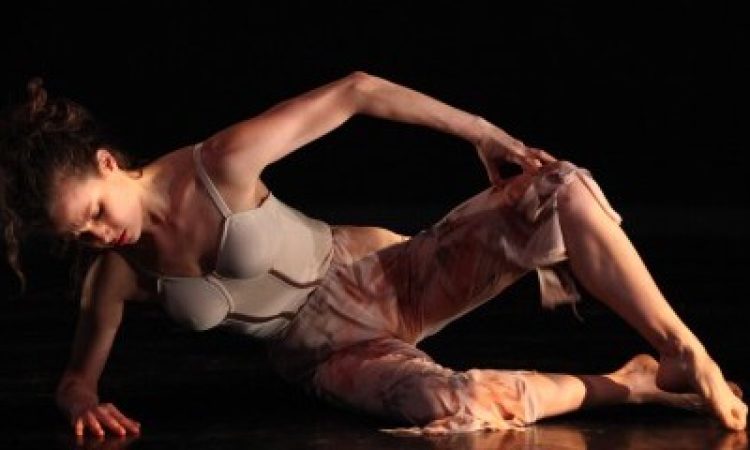
Jennifer Rose performs, a dog bone held tightly in her mouth. She is rage. She hurls herself across stage, but her tremendous physical control complicates this depiction of one of the five commonly recognized stages of grief. She is anguish—bound, clenched—exploding sporadically and sometimes with scalpel-like accuracy, but her suspensions are short-lived, off-balance as they are. She is a compressed coil: she springs, falls, and is wound again.
A blind duet has Jessica Warchal-King and Eiren Schuman groping and churning past one another as they edge toward the audience, physically connected but also isolated in their co-dependent struggle. Olive Prince appears in a crumple of blood-red tulle in the far corner, a bride of grief, eventually giving birth to herself, pushing through a narrow opening in the net, rising and exiting both the garment and the stage.
The company dances between these more personal, wrenching sorrows, lifting and supporting one another through phrases that often end in tableaux, their fuller movements contrasting and occasionally lessening the impact of sparser sections. Near the end, they arrive on stage in variations of nude-colored dancewear that reveal the individual lines of unique bodies. They perform in simple unison. Stripped of branches, of tattered fabric, of facial affect, they are exposed. This moment of vulnerability is when I realize what grieving with others might look like— nakedness.
The score of the work is as rich and varied as the sections: the piece moves through piano, vocals, electronic tones, Tibetan bells. The dancers vocalize; they shout, shriek, and growl. At the very end, live singers process down from behind the audience, wandering the stage before joining the dancers in a circle, hands clasped, the lyrics invoking beauty. The song offers the desired resolution after an hour of strife, but the fragmented structure of Beyond the Bones leaves my initial question unanswered—as it must.
Is it possible to recapture the unity that bloomed so briefly out of tragedy a decade ago, or have we squandered that moment? The dancers laid their branches upon the downstage altar. But I wonder what might be taken beyond the theater, what—beyond memorial—art has to offer in response to the unthinkable.
What might have been, what still might be, built from such bones? Beyond the Bones Revisited (2002/2012), Kun-Yang Lin/Dancers, Painted Bride Art Center, March 29-31.