It began before it started. The windowless foyer flipped time; its single lamp projected our shadows on a wall. I browsed flyers and eavesdropped on hushed conversations. Someone pointed out we could probably speak in our normal voices. We were given instructions, asked for offerings, promised their return. Random belongings shifted hands—a sippy cup, a keychain, an agenda, and more I couldn’t see. They invited us in.
Inside, a white chamber pulsed with sound, hexagonal honeycombs of light floated on the walls, and women in white performed tasks and dances. Most of us sat on the white mattress and cushions in the center on the floor. A couple of us stood. We all shifted and moved to follow the action encircling us at situation: becoming.
One walked at a snail’s pace, eyes closed, meditatively rolling rocks in the palm of her outstretched hand. Another balanced on a wooden seesaw. A third delicately popped and locked from a bench to the floor and back. A fourth crafted origami that had something in common with the lights changing shape around us.
They approached and told us: “remember, there is no ending.” Because they asked nicely and we understood, we passed the message along, smiling, self-conscious, curious to see what would happen next.
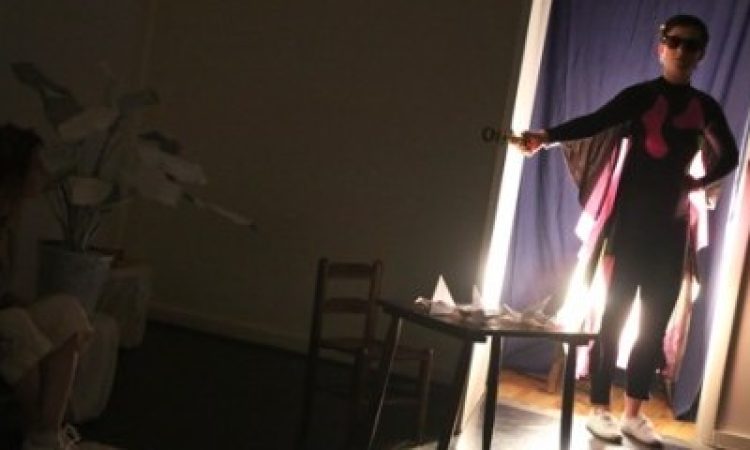
Words written backwards. A bunny suit. A pink taffeta prom dress duet with a skull. Sunglasses and oven mitts. A black-winged unitard, traded for skivvies and the bunny head. Opera and the scent of baked goods. Carrots, chopped on site. Potting soil. A serenade at close range.
Megan Bridge was fierce, Zornitsa Stoyanova mysterious, Annie Wilson a sustained eruption.
I’m not sure what it all meant; I was told it didn’t matter. I loved the way they moved. I was certainly never bored. I took the instructions to heart. Even as I accepted the drink, ate the potato chips, chatted with performers, I was hesitant, half expecting more.
Outside, the sky was piercing, cloudless, Tucson blue. A dark man pushed a shopping cart of trash bags past abandoned buildings and empty lots. I wondered at his treasures, the transformation of neglect into character. A sign on the gleaming new high school prohibits hoodies. Trees flowered against the unlikeliest of backdrops.
“La vida es sueño,” someone once told me in a place so distant (geographically and otherwise) it often seems more dream than reality. Experimental art is a luxury, sure, but it’s also like those trees, pushing up against surfaces and expectations, asserting life; incongruous, beautiful, unpredictable. Important, even; for life, too, can be stranger than a dream, and it is good to be reminded of this. I carried these thoughts with me Sunday afternoon, happy to afford such pastimes.
situation: becoming, , thefidget space, May 3-5, 8pm; May 6 at the Center for Performance Research, New York. http://www.thefidget.org/upcoming/index.html