A door opens and one woman emerges. “Tonight, I’ll be playing the role of Jack.” Amanda Rattigan speaks to us from the white box theatre space on a late winter’s evening. A red high heel peeks out from the other side of the space, followed by the donner of the shoe.
“Hi Jack! Hi Jill! Hi Jill! Hi Jack!” Sydney Donovan greets her other half, and she is greeted in return. The salutation rallies back and forth, until we don’t know who served this greeting or who is who. This is the point, or at least one of the many themes brought into conversation in OmenThrice’s program notes for the premiere of Jack/Jill & the Hill. These notes relate that, “The work traces the meeting point between the divine feminine and masculine energies within us all. It explores the tension and harmony between grounded discipline and intuitive flow, action and stillness, control and surrender.”
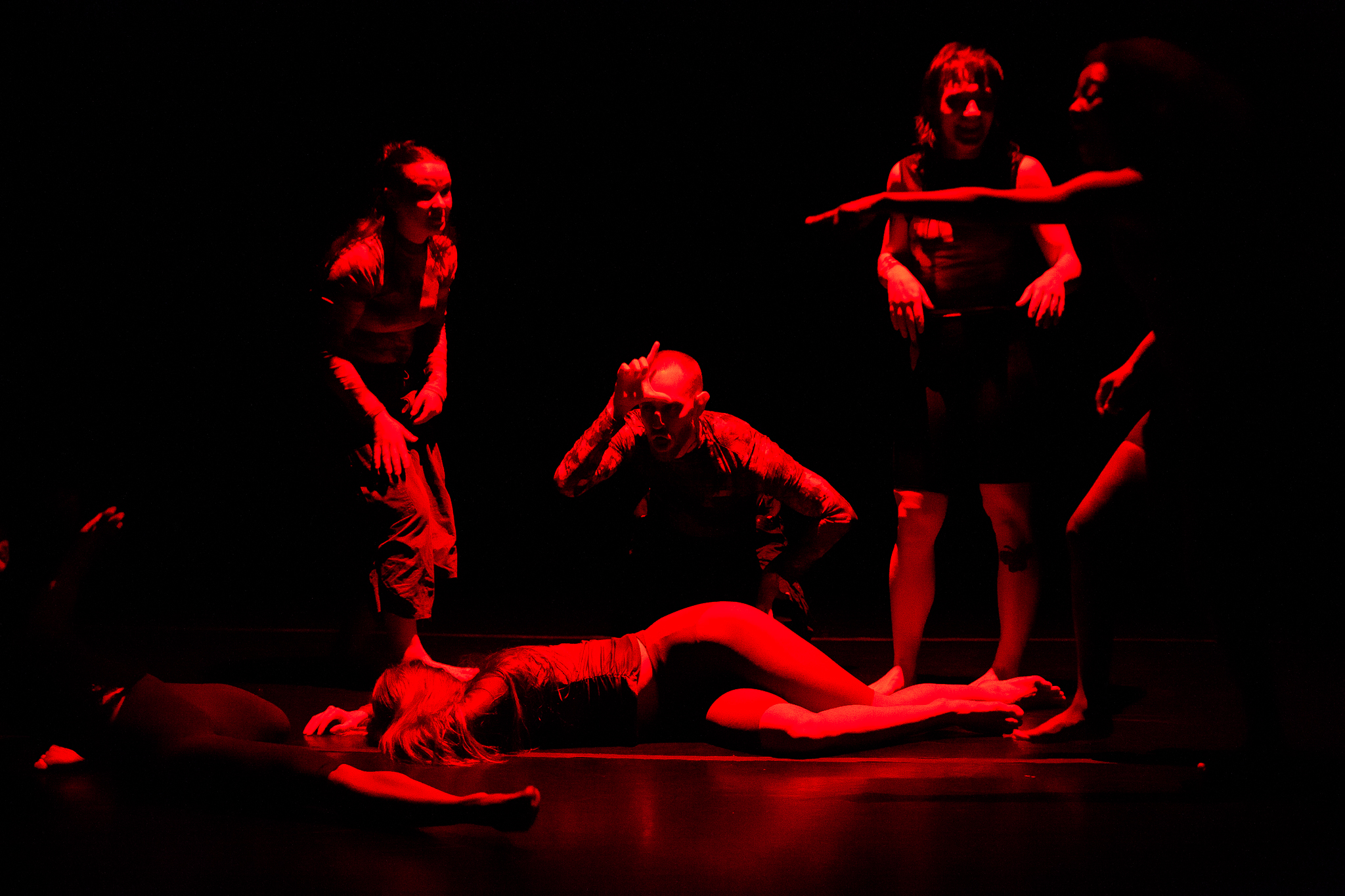
The performers reimagine the journey toward the infamous pail of water which the characters from the cautionary nursery rhyme set out to fetch. The dance which accompanies their vocal proclamations (“Oh alas! Jack and Jill chose the wrong path.”) is a kind of urgent, mortal trudging. As their heads squeeze close together inside the frame of a wooden box they tell us through the small aperture, “Jack is brave as a lion…never afraid to show his love. Jill is naughty and headstrong.”
Donovan and Rattigan take many opportunities to illuminate both a desperation to please and a desire to prove their worth. In their search for balance between these extremes, they shout, “We’ll be the best girl in the world!” and “I can bear as much as a boy.” The duo delivers a macho spirit as they chug their water from large mugs. “Ready Jack?”
Their red galoshes may as well be combat boots, as organ music accompanies their impassioned gestures, ranging from blowing phantom daisies to tossing moist earth creating a playful rollick in the rain. They inhale deeply, drinking from one of the red boots. One performer rubs her heart and seems to say, “Take it” as the other eats it up.
The performers juxtapose play and pleasure with burden and obligation throughout their metaphorical journey up the muddy hill of their imagination. Their “hot cheeks and throbbing heads” are as crimson as a basket of apples as they playfully bump their bums together and peek through their legs at one another. Making pinky promises into secret handshakes between their skips and extensions, the duet rambles on and on, bringing intentionally childlike impulses together with grownup grit. Donovan and Rattigan tumble, romp and shout as they seem to be pulled toward an ominous conclusion. They shout that these are “the saddest and the hardest [times] their little lives had ever seen” and finally the generous abandon with which they moved their flesh through space has quieted.
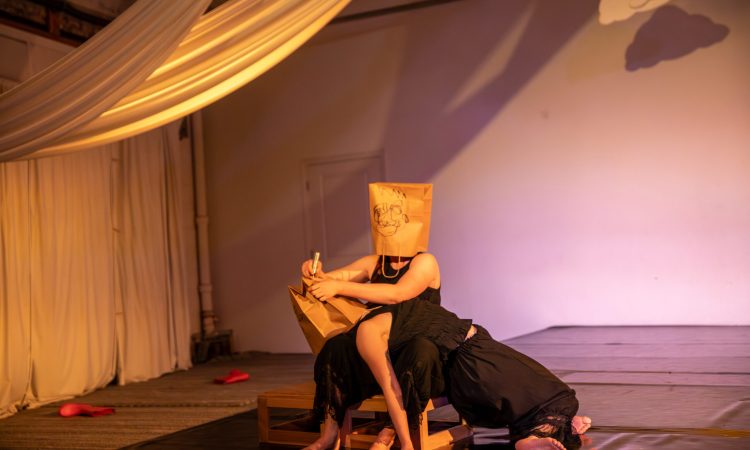
The performers illustrate their sad times, drawing emotionally charged faces on brown paper bags over their heads, (After Jack’s fall, in the original rhyme, Jack mends his head with vinegar and brown paper.) The tenderness with which Donovan and Rattigan create these images is almost a healing ritual, while also paying homage to the original verse. By the end of their eventual climb to the top of the hill, they paste the paper bag portraits to the wall—a crowning symbol of their union.
Throughout the piece, the dancers make a hand triangle symbol, holding it out to us from multiple levels, a trinity uniting body, heart, and mind. The triangle also appears as an inverted hill shape, reminding us that to climb up, we must often reckon with the eventuality of going down.
In the final image, Donovan and Rattigan sit atop a hill of wooden boxes, connected by a thin red thread. They seem ready to leave the rest of the world behind. At this meditative peak, the red thread seems to feed their own connection. They finally appear free. The lights go out as they jump down —not a death, but a crossing of a threshold.
Jack/Jill & the Hill, Sydney Donovan, OmenThrice Dance Company, Philly PACK Theatre, March 6-8, 2026.