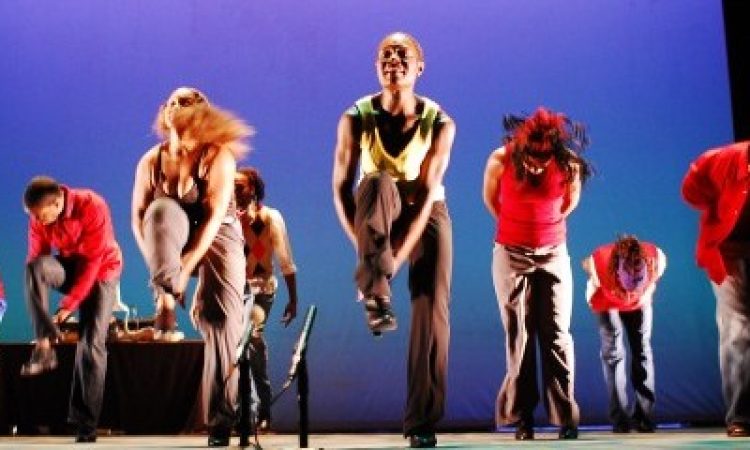
Recently, I took my sons – ages 7, 9, and 12 – to see free dance at the Mann Center. We watched two of the five performances offered as part of the Young People’s Concert Series. The Rock School (not to be confused with The School of Rock) performed a smorgasbord of works on July 26th, and Step Afrika interacted with a boisterous crowd on August 1st. On both days, busloads of camp-goers from all over the city and a few parents with children in tow arrived, found seats under the massive shell, and waited to be edified.
Our lines of sight were great and the sound terrific. Still, both groups of dancers seemed very far away through the constant din of a thousand antsy kids with too few counselors insisting on basic theater etiquette. Despite the general mayhem (think sweltering early June pep rallies in your middle school gym), the students were enthusiastic and more receptive than I anticipated. I blame So You Think You Can Dance.
My own kids were also floored by the talent they witnessed—both visiting and local. (I know this because I collected the journals they wrote afterwards, along with permission to share their commentary.) Of the dozens of students performing from The Rock School, two male soloists especially impressed my sons. One danced hip-hop and the other a solo from Le Corsaire, and both were technically masterful.
Koen (7): That kid had an epic robot.
Simon (12): The one who danced to dubstep… he moved in a way I didn’t think was possible. He could move his feet and not move his head. And the boy in white, he not only did a ton of pirouettes but also huge jumps.
Koen: I thought that was rare… the boy dressed in white.
Bishop (9): That soloist was amazing! He was almost literally flying, he jumped so high…
Unfortunately, the hour-long show was briefly marred by a group of teenagers seated behind us who thought the open-air venue meant they could discard their “indoor voices” while offering critique. My twelve-year-old was particularly upset that they “would not stop talking” and that they were making fun of dancers who were “just kids.” I agreed but could think of no way to speak to them that would not escalate their own small performance.
The following week we returned to see Step Afrika perform and teach the audience a bit about the poly-rhythmic and highly-synchronized movements of step dancing. The style became a staple in African-American sororities and fraternities during the last few decades of the 20th century and spawned at least one movie franchise. This group of seven recent graduates, Greeks all, had the crowd judge a boy-girl competition, stand to learn a phrase or two themselves, and help keep the base rhythm during extended sequences.
Most of the young audience eagerly participated in the stand-up-at-your-seats movement and the call-and-response, but later, some of the rhythms and commentary were drowned out by the rising noise level. The venue was too large and diffuse to create the anti-disruptive hush more intimate theaters sometimes manage to impose by sheer force of architecture. The kids—mine included—were most enthralled during Step Afrika’s ladies-and-guys dance-off (which the women won, btw).
Bishop: One of my favorite parts was when we had to negotiate about which group was better. If you ask me, they were both extreme.
Simon: They were both phenomenal, each doing a separate step routine, and then, when they brought the groups and their abilities together, it was even better.
My youngest could not get over the dancers who also did percussion (he is currently taking lessons himself). Koen’s comment: “When the boy was drumming, another boy played too. They were an epic duo.”
“Epic,” it may be clear, is the word of the summer at my house, and I have to admit I adore hearing it applied to talented and giving dancers as well as to video games and too-short beach excursions. The Mann provides a service to thousands of kids who might not see live performance regularly or at all. Whenever it got loud, or I heard an adolescent dig directed toward the stage, I turned my attention to other reactions—by far the more prevalent—whoops of admiration, roaring applause, the rapt faces of my sons, and the imitative movement of (especially younger) kids leaving for their buses in strings of matching t-shirts. A little stomp, a turn, a bladed arm, a tossed-off jeté: signs of appreciation in the bones.
Young People’s Concert Series at The Mann Center, The Rock School—July 26th, Step Afrika—August 1.