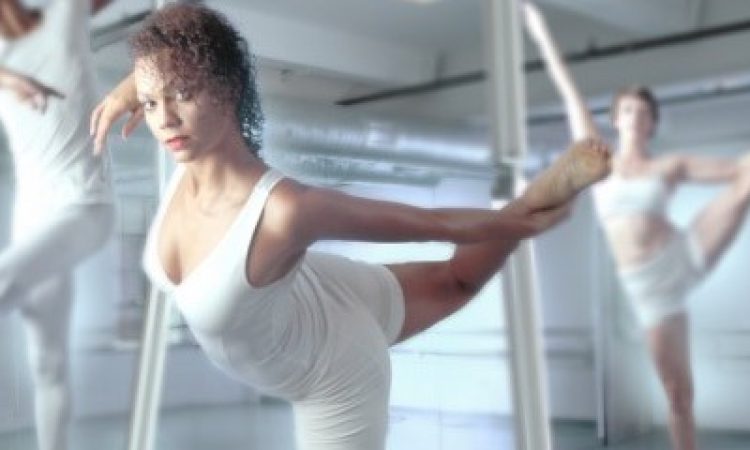
Visiting a rehearsal for Science Per Forms, which premieres at Christ Church Neighborhood House this week, was not entirely unlike other studio visits I’ve experienced: dancers stood around waiting for instruction, collaborators conferred about next steps, there was a whole lot of stopping and starting. One thing made this rehearsal a little different, though: the robot arms dangling from the ceiling.
Carbon Dance Theater invited me into the rehearsal studio one afternoon, in preparation for leading a post-show discussion on opening night of their new work, Science Per Forms. Director Meredith Rainey founded the company in 2009. “Creating work that is rooted in classical ballet,” Carbon often collaborates with theater directors, other choreographers, dramaturges, and dancers who contribute to the creative process. In Science Per Forms, Rainey teams up with anthropologist/choreographer Marcel Williams-Foster, whose performance works investigate the complexities of human interactions.
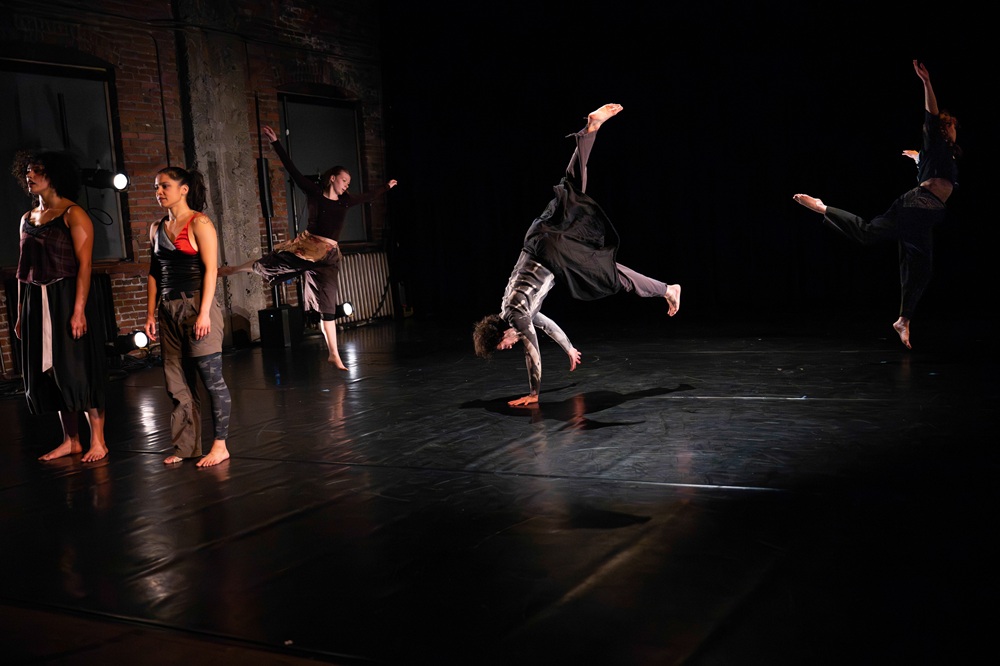
In rehearsal I watched Rainey “choreograph” movements for the robot arms, which were then programmed and recorded by collaborating scientists. The dancers performed their own sequences in relation to the robots, which moved independently, the dancers not controlling the robots’ movement or responding to it. Danielle Currica twitched and shuddered, Annie Wilson ducked and kicked. In addition to the programmed robots, Science Per Forms incorporates the hacked Xbox Kinect, a gaming interface that uses a built-in camera to create a depth map; the player’s position in space can then generate data from the map. In gaming, that data is used to control bad-guy killing or bowling, but in performance the information gathered from a moving body can be mapped to interactive video and sound. In order to integrate all this technology, the company is working with Georgia Guthrie, director of Philadelphia’s The Hacktory (whose tagline is “repurposing technology, making art”), as well as roboticists from UPenn and Harvard, to “examine the ever-evolving role technology plays in contemporary life.”
“Technology is always telling you how to talk to it, it’s always teaching you its language, far more so than vice-versa,” says dancer Annie Wilson. Her observation of how technology has shaped Science Per Forms resonates with a broader set of interests, and this is where Williams-Foster comes in. An anthropologist who studies human behavior, he also sees how technology influences that behavior. Feminist theorist and philosopher of science and technology Donna Haraway claims that we are all already cyborgs: our relationship with technology is so intimate that it’s impossible to tell what the boundaries are between human and machine. Haraway’s ideas, and in particular her Cyborg Manifesto, were conceptual starting points for Williams-Foster.
Cyborgs and ballet dancers are no strangers, metaphorically speaking. Each engages the interface of humans and “technique” or technology, two terms derived from the Greek “techne,” which has no modern equivalent in English but can be related to art, skill, and craft. In the case of both cyborgs and dancers, technique/technology has a physical/material element (metal, plastic, muscles, joints) as well as a cultural/symbolic one. The balletic body is often held up as an image of machinic perfection. Most dancers practice regular movement patterns to strengthen, stretch, adjust, and “tune-up” their instruments, striving daily for optimal performance. As Haraway reminds us, it’s in our cyborg nature to measure, calculate, and calibrate all sorts of things, from what we eat to how many steps we should take each day.
Strictly speaking, cyborgs are combinations of humans and machines, while robots are just machines. But these robots underscore the slippery nature of such distinctions, pointing to larger questions: If I don a pair of Google Goggles, do I become a cyborg? Or do I only become a cyborg at the point of bionic contact, like when the technology is actually burned as a microchip into my retina? As Haraway suggests, it begins to get confusing.
When I visited rehearsal, Rainey and Williams-Foster were working with two different groups of dancers in adjacent studios. They came together to confer on logistical points or confirm decisions, but for the most part worked separately. They spoke briefly to me about this–at the beginning of the creative process, the two choreographers wanted to challenge each other and step out of their comfort zones. For Williams-Foster, this meant trying to choreograph steps. For Rainey, a former principal with Pennsylvania Ballet, it was about digging deeper into the ideas behind the work. As opening night loomed, the two decided, for efficiency’s sake, that doing what they do best would probably be, well, for the best.
Science Per Forms, Carbon Dance Theater, Christ Church Neighborhood House
October 25, 27, & 29. Tickets: http://www.brownpapertickets.com/event/277149