Sunday, 11:30 a.m. in Lancaster, PA, gathered for our field trip, Dancing Around the Bride, Philadelphia Museum of Art. Bus won’t start. Get our cars to drive instead. Bus battery arrives. We take our chances, jump in, lurch through traffic. The museum— yellow, Grecian—perches ’round the curve.
How did we chance on this blinding warm day in spring-like Philadelphia in autumn? Over the Schuykill, in the building, up the stairs. Music.
Player-piano plunks John Cage’s witty score. No one’s on the bench; I can see him. Works by Marcel Duchamp, Jasper Johns, Robert Rauschenberg funnel visitors ahead.
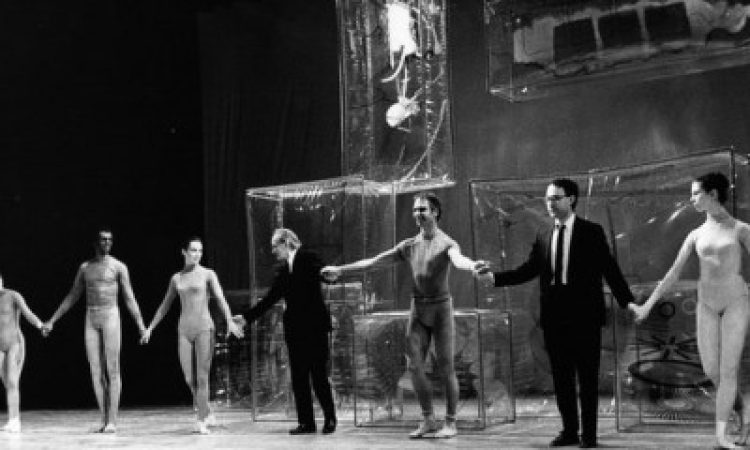
Here, the Main Stage, flanked by canvases, constructions, and installations, pillows from Johns’ set for Merce Cunningham’s Walkaround Time suspended above. No chance to pour over them, though: a dancer floats in, ghostlike, steps on stage, lunges across the white floor—footfalls now amplified, reverberant—tiptoes and points. Limbs slice space. She walks off, unscathed.
Quiet applause. Should we?
Dare I look away, stroll the walls, leave the gallery, file behind the row of raised seats? When might she—or they—appear next? But I do look, with half a mind, at Johns’ gray canvases sporting hangers, hooks, cans. At Rauschenberg’s bright colors splashed on fabric, newspapers, planks, and that charming little make-up mirror. At Duchamp’s neat dismembering of bodies, of motion, of myth.
By chance I peak around a corner; they’re dancing. Or not. She sits in perfect fourth position, he kneels on his left knee, a second woman in wide, straight-legged stance. Quietly, they change poses. Lovely. Whispers. One more shift to unhurried lunges, tilts, balances, and bends. They melt off.
Another room of stuff: small sculptures, contained collages: a chess theme. Shall I lurk here? Might I miss—yes, a dancer flits across the stage, a bird poised, flitting, watching, whirling, and off.
Philippe Parreno’s soundscape slips vocal, mechanical, pianistic frames around dancers and panels, sculptures and scores. Not too loud, the piano there, also playerless, performs in allotted time-spaces.
There’s woman 2. She tilts and skitters sideways right and left. Fast footwork front-side-back—sped-up barrework, point-flex-bend—then, tilt and exit.
Two Johns panels, both titled Dancers in a Plane, feather colored strokes against gray canvases, each framed by rows of forks, knives, spoons. Across, way over in the north-end galleries, I chance upon other pieces dancing around the Bride: Cage’s neat scores, Duchamp’s nudes descending shattered large glasses, videos reeling Cunningham’s dances. Race back to the stage.
He’s on the floor now: wildly tilting, torqueing, bounding, brushing. Poised, he paces a bit, and departs.
She is tiptoeing with an open umbrella neatly balanced. First position, tendu, passé, hop, toe-walks. Charlie Chaplin, by chance? A partner enters, lifts her, moves her, leaves. Undisturbed, she finishes her pattern, quietly closes the umbrella and exits.
He returns to dance a section of Travelogue, beside (not in front of) its original set by Rauschenberg, which I now see nods to Duchamp’s Bicycle Wheel. Leaping, scurrying, he crosses the stage, then pauses, arches deeply back. Big hitch-kicks sink calmly to crossed-legged kneeling. He rises, takes off in wide-winged springs.
Short on time now, the bus still working, better jump in and race back home, to that world west of the river. I vow: this won’t be my last chance to live in the delight of the Bride’s world. I’ll look back at these deeply delightful artists who pushed us forward, to now, beyond.
Dancers on Nov. 11, 2012: Jennifer Goggans, Daniel Madoff, and Krista Nelson in excerpts from works by Merce Cunningham. Dance curation: Daniel Squire.
Dancing Around the Bride: Cage, Cunningham, Johns, Rauschenberg and Duchamp, Philadelphia Museum of Art, Oct. 30, 2012–January 21, 2013. http://www.philamuseum.org/exhibitions/765.html