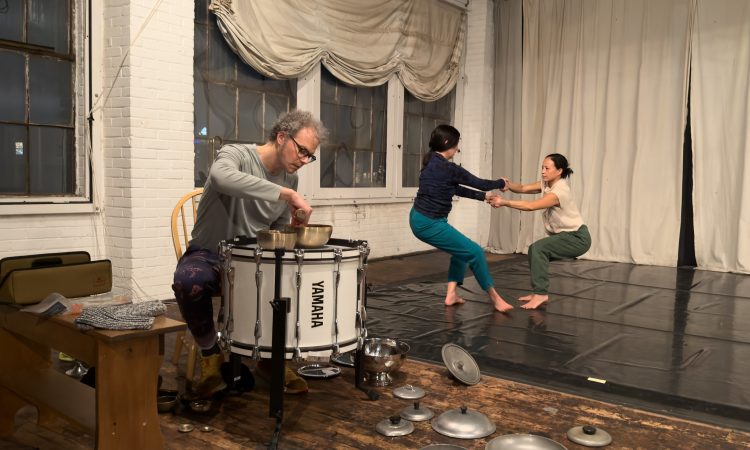
I ascend three flights to Fidget Space, a post-industrial living room/studio/performance venue with mismatched couches strewn about a creaky wooden floor. As dancers warm up on a strip of black marley lined with instruments, a big drum surrounded by metal bowls catches my eye.
Loren Groenendaal and Flandrew Fleisenberg, co-founders and producers of H-O-T, introduce the structure of the evening: four pairings of dancers and musicians decided on only minutes before. Originated in 2013 as part of the Impermanent Society at the Old Kensington Mascher Space Co-op, H-O-T is back after a six year hiatus.
The first quartet is a comic and noisy experiment in clashing styles and pot lids. Groenendaal moves through modern dance forms at a galloping pace while Seven Tackes oscillates between an almost Hip Hop groove and post-modern gestures, exploding directly from a breaking spin into leap frog jumps. Fleisenberg slides a metal lid across the window glass, making a pitchy scrape that sends shivers across my skin. At times, Tackes watches Groenendaal and visibly decides to mirror or contrast her, syncing up with her repetitive arm swings or slicing an outstretched arm to interlock with hers. In such moments of collision, Goenendaal leads codified Contact Improvisation lifts and rolls and Tackes skillfully obliges, but appears more at home pulling his baker hat over his eyes than body surfing. All the while, AJ Khaw slams piano chord progressions that remind me of Tom and Jerry, catalyzing or echoing the dancers’ cartoonish crab walks, rolls, runs, and even a moment of air guitar. The negotiation of the dancers’ movement languages prompts the question, what do the producers mean when they say “improvisation” and how do differing genres of improvisation factor into their curation?
In contrast to the opening act, the trio between Bob Rainey, Kayliani Sood (dance), and Aabeizer breathes patiently. From her stance in the unlit audience, Sood waits for the musicians to begin. Rainey riffs a spell on his sax. Aabeizer turns his homemade instrument, and it gurgles like the belly of a tree. Sood moves in decisive and traceable pathways, repeating detailed joint folds and level changes and often pausing to gaze diffusely toward the downstage left corner. They respond to, prompt, and compose concurrently with Aabeizer’s fable-like thrums and Rainey’s poetic punctuations. In one moment, Sood finds a penny on the marley and, visibly amused, rolls it in an arc across the stage, where it collides coincidentally with Aabeizer’s toes. In perhaps the most crystallized composition of the evening, they grab a stool from the audience and set it between the musicians. She sits down, closes her eyes, and tilts her head as if to ask the musicians, “what do you think?” They take her invitation and speak. Without a predecided improvisation genre, is it luck or rigorous presence that this trio shares a compositional language?
The quartet between Kimya Imani Jackson, Mauri Walton, Abram Taber, and Max Glazier conjures 2001: A Space Odyssey, and all the error buttons are going haywire. Glazier scrapes his drum with bent wires as Taber drones on his electric bass. Walton is a UFO propelled by her own curiosities, while the rest stay tethered, feeding off each other’s thrashing and droning. Jackson shoots sparks from her fingertips, her spine twitching as a vibration convulses her from inside. She grasps her hands into a fist, spears them into space, and plunges them into her gut again and again as the musicians rage. She seems to be reckoning with something in real time, and her fierce presence and willingness to surrender to the musicians’ intensity causes my throat to swell with emotion. It’s a spiritual exorcism. Who’s screaming? Taber opens his mouth wide over his bass, and I learn later that he’s using a contact microphone against his throat to amplify the vibrations of his vocal chords. What makes improvisation performance? What makes it ritual?
Everyone takes their time arriving on stage for the last arrangement. The dancers and musicians sound together: breath, whistles, hums, song. They fade between duets, simultaneous solos, momentary trios. It’s like a neighborhood gathering in the town square. In one divine moment of unplanned choreography, Sood and Tackes embrace and spar upstage, seeming to refuse their need for each other, while Groenendaal, Jackson, and Walton stand shoulder to shoulder and back up step-by-step toward the audience, thirty fingers wiggling overhead. When there is so much agency to make choices, what or who moves each performer? Who is the audience to the performers and why improvise in front of an audience at all?
When Groenendaal and Fleisenberg return to close the evening, I ask them, “Why is it called H-O-T?” They don’t answer directly, but say that it’s neither an abbreviation nor a spelling. They rile the audience into shouting together, “H-O-T, hot! H-O-T, hot!” “So hot you’ve got to spell it out!” concludes Groenendaal.
H-O-T Series of Philadelphia, Loren Groenendaal and Flandrew Fleisenberg, Fidget Space, April 25, 2026