Incubators—spaces where experiment and new directions in creativity are nurtured—are part of the back-story of dance. In Philadelphia the longest standing and perhaps most productive of these spaces has been the Susan Hess Modern Dance Choreographers Project, compelling generations of choreographers, since its beginning in 1984, to critically interrogate their work and depart from their creative comfort zones.
Over a Chinese lunch, I discussed the current 2011–2012 Project choreographers and their process with Hess, a diminutive bundle of ebullience and nonchalance. She remarked, with only a half smile, that her project was “great torture” for the choreographers she selects. For the current crew of Bronwen MacArthur, Gabrielle Revlock and Raphael Xavier, along with the visiting mentor for the Project, Ralph Lemon, Hess conspired, “to get the dancers out of a performance-perfect setting—to see what they will reach.” To Hess, it’s about risk taking: “there is nothing that can’t be done, nothing is censored, but it’s hard to get the choreographers uncensored.” She added, “it’s also about the practice of challenging oneself to seek an internal line and see where it leads.” When Lemon met the three choreographers to give them their first task to explore, he participated as an equal, unhinging the mentor hierarchy. He volunteered to go first, undressing to his briefs for his showing. Pushing one choreographer to the limit and beyond, according to Hess, Lemon had her take a small segment of a work shown and repeat it for a painfully exhausting 15 minutes. He asked another, using text, to skip every third word in her script.
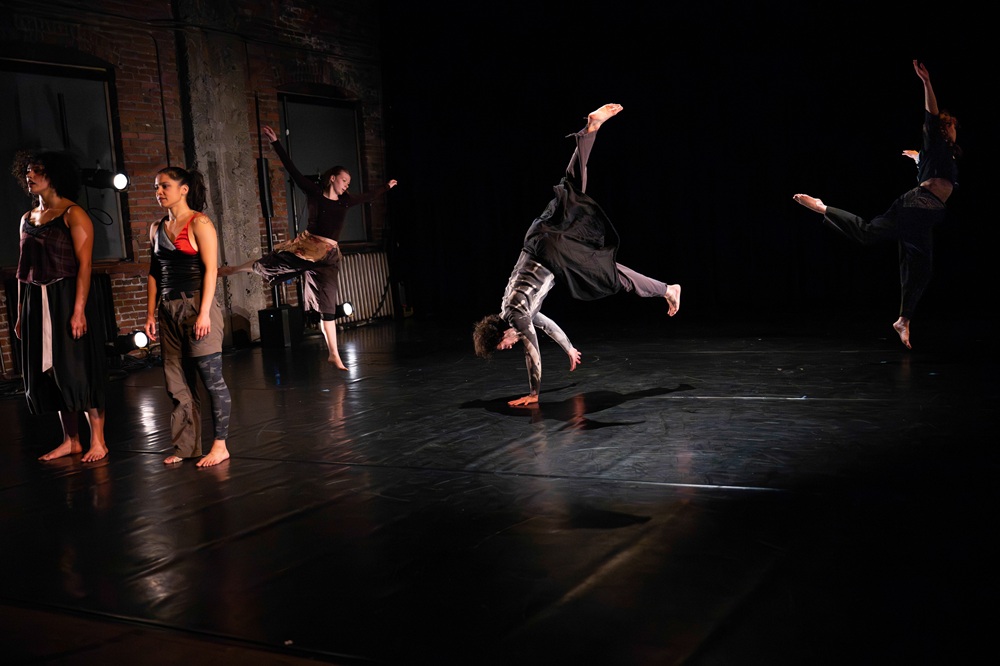
Evidence of the Project’s impact was most legible for me on MacArthur, whose last work of lyrical, harmonious symmetries and unison dancing I had seen in October at Christ Church Neighborhood House. In the new solo, Tunnel, MacArthur explored a series of captivating and visually seductive movements of torso and arms; they all spoke unharmoniously of quiet turmoil and disquietude. In her first section she slowly calibrated upwards degrees of weight shifting, turns, and gestures of hands and swings of arms. Her lips moved to speak a silent language that her body also mysteriously expressed. In a mesmerizing section she proceeded upstage on a diagonal through a repetitive series of swings of her left leg and left arm, countered by a shallow circling on the floor of her right leg. She turned apparent hemiparesis in her body into elegance, and, when nearing upstage, added with surprise the dissonances of flapping arms and head alternating left and right almost in disassociation from her body.
Revlock’s leap into risk-taking was an intergenerational quartet, Can Be Found, a work in progress with herself and the versatile David Konyk, joined by the older, non-professional dancers Beverly Agard (Revlock’s mother) and Carol Purfield. Both Agard and Purfield had had their performance debuts in Sylvain Emard’s Le Grand Continental in this September’s Live Arts Festival (where Revlock was an assistant rehearsal director and performer). I wondered whether this new work of Revlock’s might have been influenced by that project of about 150 non-professional dancers performing rehearsed choreography together.
The two generations of dancers playfully interacted with each other as the older dancers stamped out percussive rhythms with their feet and led Revlock and Konyk in an improvisation to the music of Al Green. As Revlock and Konyk performed an energized duet, the two women, now seated upstage, enacted a variety of hand gestures suggesting an equally engaging amalgam of activities from word processing to cooking. At one point both Revlock and Konyk nestled up and around the statuesque Agard, like elves discovering a new creature. Although the work is still wanting in structure and direction, Revlock has tackled with humor and invention the intriguing challenge of rendering the dance space more ageless than it was before. She added to the program, albeit only on a computer screen, the video, turn out, turn up, which she choreographed this past year for Dances Made to Order. The film’s editing and cutting enhanced the appeal of Revlock’s whimsy and offered close-ups of her extraordinarily cinematic face.
Raphael Xavier set his work, Ego Number 5, on Leanne Grieger, who demonstrated the conflicts and confusion of attending to a concurrent multitude of ideas in one’s mind as seen in the three or four dozen yellow post-its that speckled the floor around her. Grieger’s studied absorption, vocal outbursts, and frenzied twisting of limbs across the stage became a one-note work too tied to the literalness of its conception.
Each evening of the Project’s performances ended with an improvisation called Scrambled Eggs where Grieger, Konyk, MacArthur, and Revlock found on stage randomly scattered sets of instructions each had written for a performer to pick up and then execute. Like a palate freshener, both evenings provided surprising delights for the audience and, one can only imagine, for the performers as well, a pleasurable release from the tortures of the Project’s past two years.
In Performance presented by the Susan Hess Modern Dance 2011-2012 Choreographers Project, at The Performance Garage, Dec. 1-2.