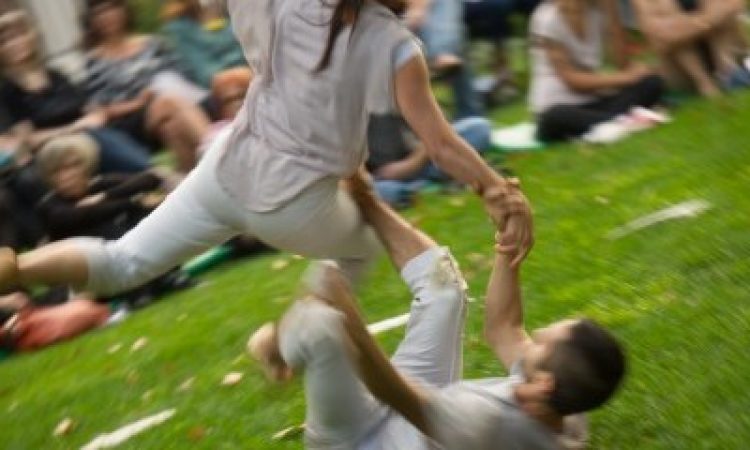
Time—as concept, construct, and reality—was engulfed in layers of questions and musings, artifacts and objects, sound and movement in Tempus Fugit/Time Flies. For the exhibition at Philadelphia’s American Philosophical Society [APS], artist Antonia Contro juxtaposed her own visual and audio art with select works and objects from the society’s collections—some items dating from well before founder Benjamin Franklin’s day. To add yet another layer of reflection, the APS commissioned Nichole Canuso to create a dance-based work in response to Contro’s exhibition. In turn, Canuso collaborated with dancer/video artist John Luna, sound designer Michael Kiley, and costume designer Tara Webb, to create Return, Return, Departure. I caught the last performance on December 8 at 3:30 p.m., and wished I had followed the work through its trajectory across time and seasons, beginning with its first performance in August. At a panel discussion after the show, APS associate director Merrill Mason expressed her hope that this last performance would take place amid falling snow, inspiring me to picture the dance in summer, in early fall, in late fall. Why would this matter? Because the dance takes the audience out into the garden at Fifth and Chestnut Streets, in Old City, where we are acutely aware of nature’s times: the day moves forward as we watch, and the seasons change the garden. But now I’ve jumped ahead in time. The performance actually starts indoors, at Contro’s exhibition in the APS. Nine windows, each named for a musical term (a tempo, sognando, adagio, nocturne, canto, crescendo, coda, arioso, and aeon), house a selection of historical artifacts, juxtaposed strategically with Contro’s works. Adagio, for example, contains a model of Mont Blanc (ca. 1805), a piece of petrified wood collected around 1924, a gold nugget from the 19th century, and Contro’s collage Nord/Sud (Tribute to Amundsen) and her clay/wood shoe titled Le Alpi.Coda, on the other hand, has but two items: an invitation to Charles Darwin’s funeral and Contro’s Ala, with fleeting images of a butterfly winging across a tiny screen. On the floor of the exhibition space are two rows of natural objects: on one side, clipped flowers of all colors, and on the other gray-white stones, among which Canuso is lying, facing a small video camera. On the walls above her are videos of the dancers, of stones, and of the garden we will later see. A museum guide asks us each to choose a flower and a stone and to proceed across the street to the enclosed garden, where large flat rocks mark a path diagonally across the grass, recreating the bed of a stream that once flowed there. We are instructed to place the stones on a patio and to press the flowers into a book. I think of ancient stone altars marking holy places, and of the stones I leave periodically on my parents’ graves. I think of Stonehenge and Japanese gardens. I think of family Bibles in which someone once left a pressed flower. Canuso and Luna sit facing each other from opposite points in the garden. Connected by their focus, they dance toward and apart from one another. Luna’s limbs float as Canuso attempts to restrain him; both fall, roll, rise, and reorganize. They flow between and around the stream bed rocks, and later move these into varied patterns, miraculously balancing some in piles, while others tumble apart. Subtle arm and hand gestures—rhythmically aligned to Kiley’s supportive score—become full-out reaches, lurches, orbits through the garden. As they roll across one another, sink, touch, rise, and repeat, we hear the chimes of nearby church bells, the honking of car horns, the twitter of birds—even in mid December. From running to crawling to rolling, they melt supine into the muddy grass. A hawk swoops overhead and the dance is over. Nightfall isn’t far away.
Tempus Fugit/Times Flies and Return, Return Departure at the American Philosophical Society. Last dance performance: December 8th. Exhibition closes on December 30th.