Miller Rothlein’s (MIRO) recent show Double Bill featured two pieces from their repertoire. Both works set dance and gallery installation work against one another, investigating the tension that exists within that convergence. generate.degenerate provoked buzzing ideas about the body as subject vs. the body as medium and technical setup as environment vs. technical setup as performer. Those questions arose as much from the venue itself, The White Space at Crane Arts Old School, as they did from the environment MIRO so meticulously crafted.
A white space it is. The audience sits close together on one freestanding unit of bleachers, a beige pillar to the right and another beige pillar(-of-a-woman), Amanda Miller, on the square performance platform directly ahead. generate.degenerate begins, and I wonder: “Just how close to an installation or a sit-back-and-watch-kind-of-performance is this going to be?”
The performance makes me feel both far and near: phrases of full body movement mix with performative tasks and stark simplicity.
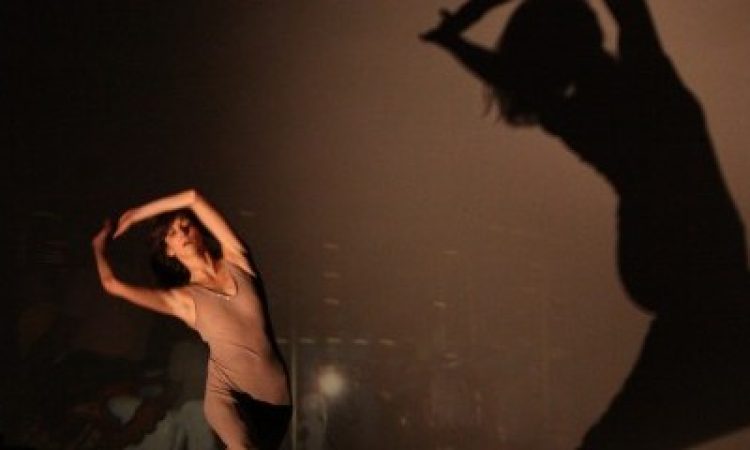
It is enough to watch Miller delicately place the record player’s needle down as if performing brain surgery on a field mouse. The task is refreshing. Its repetition transforms each section’s beginning into an intimate installation. She gets moving and articulates her long limbs; she lunges, arabesques and turns. Her delicate hands move softly as if taking the temperature of the air, and later twist into claws. She walks in circles and makes eye contact with every person in the audience. Suddenly, the piece asks us to watch differently, but its transformative umph is anesthetized by Miller’s seemingly rehearsed reaction. Unable to drop the pretense of the performer – no easy task in this ecology – she evades the beauty of doing nothing. When she stuffs photo slides into her mouth until they accumulate to a whole stack, there is no slobber, no struggle, no awkwardness.
generate.degenerate is painterly. The space around Miller feels alive. Not a solo, the piece includes performers/technicians Zachary Svoboda and Tobin Rothlein pedaling stationary bikes on either side of the audience. The bikes whir, creating a subtle soundscape that surfaces when the records fade as the wind-up Victrola putters out. The bicycles power the only lighting source for the piece (a few simple lights attached to their handlebars). This self-generated lighting design (by James Clotfelter) moves and shifts the space, which in turn, partners Miller. The partnership feels cutting-edge, an intriguing and complex proposal. However, Miller’s choreography and the bicycle powered video projection create too many layers. The richness of the experiment somehow inhibits the sensuality, immediacy, and stripped down nature of the partnership.
Amanda Miller describes herself as a “painter, inside a ballerina, inside a tattooed time bomb wrapped in a pink ribbon” on MIRO’s website. It makes perfect sense, then, that the second piece, Self Portrait, is inspired by Frida Kahlo’s journals. The space pops as soon as the lights (now two overhead projectors) click on. With the jam-packed busyness of a Mexican altar, the performance space is covered in fresh flowers. Mementos from Miller’s life hang from pointe shoe ribbons that drape the stage from floor to ceiling in gentle curves.
Kahlo was ahead of her time. What I know of her history and body of work is that she espoused an unapologetic “take me as I am” attitude as well as a commitment to reinventing herself in the face of tragic illness, dramatic circumstances, and piercing desires. Through her paintings she demands to be looked at–in the moment, and in the next moment, and in the next. Her work chronicles transformation and re-interpretation. Kahlo is provocation embodied. Miller stands gazing outward, her silver heels—dainty yet dangerous—crushing a few buds. As she walks slowly forward, the flowers twitch beneath her. I think to myself, “I am going to love this piece!”
But what unfolds feels guarded. Miller is limited by the environment, a time bomb never quite giving itself permission to explode. Rothlein draws on a transparency with colored markers, sketching viscera onto Miller, both subject and live canvas. The projected shadow of the marker and its tip are phallic. I see Rothlein as Diego Rivera (Kahlo’s husband and a celebrated muralist in his own right) and think, “Boy, what a dick.” The shadow slashes Miller’s anatomy and she plays coy. She removes her blouse. I see a lacy bra on a slender woman. I see red gashes projected upon her flesh. I am a woman. I see a woman as the subject of a man’s art, gaze, and power. I see Miller as a muse; I see her as a ballerina. I look to her and her portrayal of Kahlo, but I can’t seem to locate the dark underbelly of these gendered problems.
The visual set-up is raw, in the moment: the lighting and stage-scape breathtaking and seamless. I smell the flowers. I hear the squeak of Rothlein’s marker. His doodles become ever more extreme. He scribbles her whole body yellow (by now she wears only lingerie) before erasing it all with a wet paintbrush. Miller crawls about, drinking and spilling glasses of water over herself. The action is erotic but safely sexualized. Kahlo’s paintings, with their depiction of bone, organs, and blood seek to get beyond providing the viewer a “cold shower,” not offering a waking-up but instead a digging-in or digging-down. Despite the intimate objects hanging around Miller, the piece ceases to feel personal or experiential. I am ready for a big mess, for Miller to relinquish her controlled sense of beauty. I want her to roar. I wonder where Frida Kahlo is hiding in this piece. I want an explosion.
Double Bill, MIRO November 1st-4th, The White Space at Crane Arts Old School http://www.millerrothlein.org/