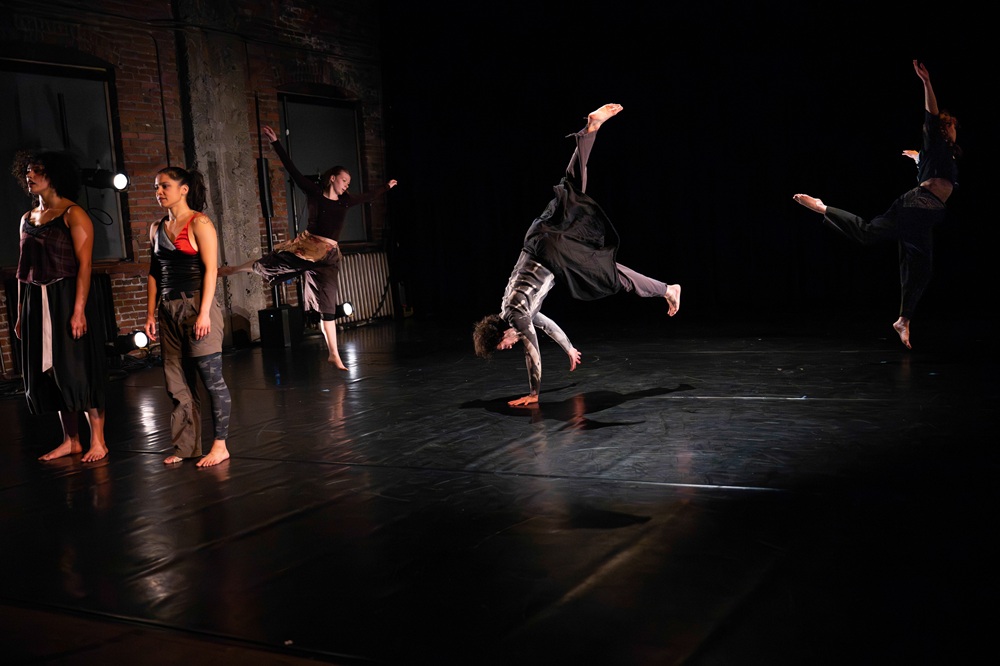
A river of continuity and renewal, Philadanco, now celebrating forty-three years as a company, rolls on, preserving classic choreography and nurturing young performers and dance makers. This season’s works include Milton Meyers’ celebration of Alvin Ailey, a Philadelphia premiere from Matthew Rushing, a fresh rendering of a George Faison classic and Ronald K. Brown’s mesmerizing vision of past, present and future.
The concert, Black is Back (…what is Black Dance anyway?), serves as a repository for outstanding black choreographers’ works. My favorite, Brown’s Exotica, is an excerpt from a longer work, Lessons. It creates a space where time is fluid. The velvet costumes and puffy Afros harken to the early 1970s. Bass and techno rhythm bumps against an old recording of the spiritual “His Eye is on the Sparrow” bumps against African drumming bumps against contemporary world music. The dance evokes the practices and ways of people who inhabit these times and cultures. Insistently, the house beat returns, pushing the dancers to keep moving on.
A motif the dancers repeat is a quick pattering of feet with legs in a wide position, low to the earth, while their arms sweep in a long, smooth horizontal arc. As they make one of their exits they touch the floor and then their foreheads, a gesture of respect from African dance traditions. There are affecting periods of stillness, and slow, slow walks, contrasted with driving, pulsating sections. Action is dispersed to different areas of the stage simultaneously as the dancers attend to one another with quiet empathy. The energy builds at the end as the dancers alternate aerobic repeating jumps with straight on marching, looking directly out at us. I feel them advancing onward through time.
The other works on the program reflect the company’s stream of influence from Alvin Ailey. Echoes by resident choreographer Meyers abstractly combines images and movement inspired by Ailey and marries them to the roiling drive of John Adams’ modern symphonic score. Three women reach straight overhead to the sky, then pull their cupped hands under solar plexus, upper spine curving over the hands. As couples, men dance behind women, facing us and surround the women with their larger size and open palm hands. They synchronize mambo hips and feet, then switch – like changing channels – to angular modern ballet spiking into space. The dancers exude an “I’ve got this” spirit, smiling with pleasure, taking on the quick transitions, ready for more.
Faison’s classic, Suite Otis, a crowd pleaser created in 1971, bubbles over in joyful celebration of the great Otis Redding. Full of elegant tidiness in staging and efficiency of gesture, the choreography seamlessly weaves technical demands with savvy portraits of real men and women flirting and fussing. They playfully strut their stuff with high kicks, telling gestures and, balletic leaps. Faison adroitly spins rich stories within the span of each brief song.
A tall, queenly woman stands facing away from us in a brilliant blue, green, yellow and red gown, creating a vision that makes the opening night audience gasp. This is Rushing’s version of a suite of dances in homage to the compelling singer Nina Simone.
With his dramatic opening, Rushing places the diva center stage, initiating the action. Dancer Elyse Browning lives the role, opening her arms to the sides with palms to heaven and slowly turning to us with the carved face and bearing of an empress. The work finds its emotional and choreographic center in the darkly tinged duet Don’t Explain, superbly danced by Roxanne Lyst and Justin Bryant. They breathe and let go, surrendering to each other, and then tearing apart. Rushing finds his voice in the contrast between simple, pedestrian movement and surges of lifts and complex patterns performed with a weighty sense of destiny.
Philadanco manages to consistently progress in their repertoire with a gleam in their eye and an appetite for more dances. I think of Lindsey Holmes in Suite Otis as she repeatedly contracts deeply into her belly, then reaches out with waist, shoulder, arm, extending endlessly into space. She repeats this familiar gesture from the Ailey vocabulary lunging in different directions, one woman radiating from her physical center to the four corners of the world. For a moment I’m in a timeless place with her. Through her journey from inner to outer world, the choreography catches fire and transcends a historical retelling. The spark that she exudes, evident in other dancers as well, is a Danco strength. They achieve a fusion of the dancer with the dance that takes us from Faison to Meyers to Rushing to Brown with integrity and clarity.I go back to Brown’s afro-centric time warp with hope. He harnesses the verve of the Danco dancers together with their technical prowess and deploys these gifts into a complex web of meaning – a river moving through time.
Black is Back (…what is Black Dance anyway?), Philadanco, Kimmel Center Perelman Theater, December 7-9, 2012.