The concert began with a moment of silence. While many had likely come from church, the board member reasoned that there is “never enough prayer.” He asked that we pray not only for the victims and their families, but for the shooter as well. For here was someone who had lost his way, and quite possibly his sense of connection to anything larger than himself. If Carols in Color does anything so well, it is to remind us of this: no one need be an island; we are a community.
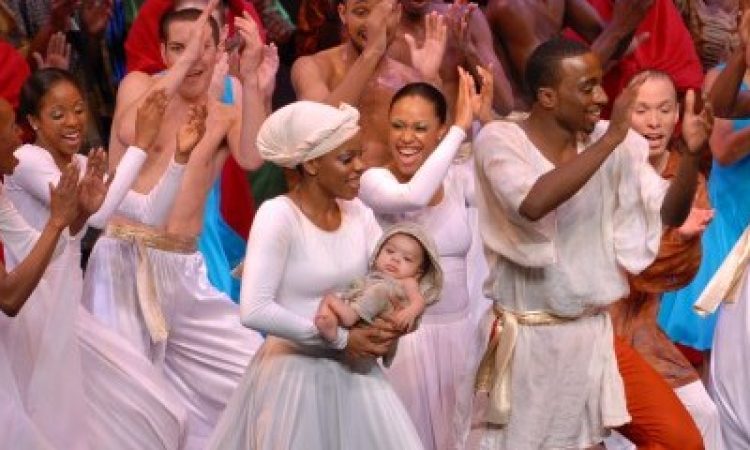
Carols in Color has been a Philadelphia institution since 1992, when Leon Evans, founder of Eleone Dance Company, adapted Langston Hughes’ Black Nativity, transforming the play into a holiday dance musical. Based on the Gospel according to St. Matthew, it presents the story of Christ’s birth through narration, dance, and gospel-style Christmas carols. The production is a showcase for Eleone’s dancers, as well as their pre-professional and student companies, Eleone Connection and Eleone Dance Unlimited, as well as the Eleone Dance Theatre Chorus.
Eleone’s website describes their movement as “contemporary modern dance that’s passionate, spirited, and totally urban,” but it would be disingenuous to laud the choreography of Carols in Color as anything other than homage. Far from contemporary in my mind, the dancing was reminiscent of movement I’d seen and executed myself (with awe at the time, more years ago than I’d like to admit) at a studio where Alvin Ailey and his troupe of beautiful black dancers watched over us like a veritable holy family from a framed photo centered above those endless mirrors.
This is not to reduce Eleone, but rather to acknowledge their connection to one of the most admired lineages in the history of American dance. (Both Artistic Director Shawn- Lamere Williams and Executive Director Sheila Ward studied at The Ailey School and each has worked with Philadanco, a stylistic cousin). It is also to say that the choreography was both pleasing and tired. There were innumerable attitude turns, sweeping then wrapping contractions, layout extensions, even a couple of preparations to turn. The first half of the show was impassioned and emotional; furrowed brows, twitching limbs, and shaking fists abounded. The second half was a joyous celebration, set in motion by Niesha Cherry’s mind-blowing voice. Belting Go Tell It On the Mountain, Cherry brought us to our feet as Mary (the formidable Dara Meredith) and Joseph (Jah’meek Williams) walked through the crowd celebrating their newborn baby Jesus (Walter McGhee, Jr.). Also noteworthy was William Burden as Gabriel. A rake of a young man whose lithe limbs seem to stretch into the heavens, Burden is more watery spirit than matter.
Seated in the rear, a thick pile of papers to grade under my notepad, I ached to leave them behind and to move. I knew this movement; remembered how good it felt; felt it myself. The audience agreed. Indeed, they reveled in the spectacle and interacted with the performers throughout–clapping, shouting, and whooping at the extensions, leaps, and moments of unison. I thought about how rarely this happens at the modern/ contemporary dance works I generally attend, where these days you are just as likely to be courted by the performers as antagonized, provoked, offended, or outright ignored.
–––––––––––––
Over the past four years, I have taught hundreds of college students in my anthropology classes that there is no such thing as race; that, genetically speaking, it does not exist. Socially, however, we all know it is very real. Race–skin color in the U.S.–has profound implications on our lives. I say all of this as preface and somewhat embarrassed admission that I felt conspicuous at Eleone’s show. I don’t presume that everyone had come from church, though I wondered if they looked at me and knew that I had not. Seated alone in the back, furiously scribbling away, I stuck out amidst the boisterous crowd of almost entirely darker faces. Of course, we need look no further than our president to poke a hole in the divisions between “black” and “white.”
This did not feel like my community, dance or otherwise, yet Philadelphia, Ailey, and who knows what else links us. And I was welcomed, embraced, even, for a couple of hours. This crowd of strangers brought me back to own past, reminding me of the beauty of miracles, the comfort of faith, that prayer can take many forms. I hadn’t even realized what I’d needed was to pray.
Carols in Color, Eleone Dance Theatre, William Penn Charter School, December 15-16, 2012.