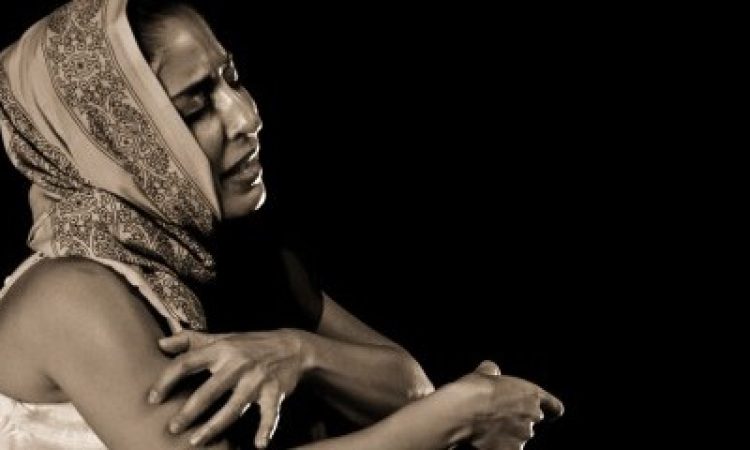
“Maaaa…” her voice bends the note to the echo of a recorded sitar. I expect more drawn-out syllables, not an English sentence. “Maaaa, maaa, maa….why, why, Ma why can’t I?” She accumulates her words like a Trisha Brown movement phrase as she pulls down the top part of her sari to reveal a white, ruffled tank top and her bare midriff. She sings, “Ma, why can’t I wear a tank top?” She pops her rib-cage forward and gestures to her armpit. “It’s just an armpit.” The audience chuckles. It’s not that armpits are that funny – it’s that, half expecting a North Indian song, we are surprised we’ve landed here, watching an American girl ask her mother why she can’t wear a tank top.
Sheetal Ghandi’s virtuosity lies in her expert navigation of this multi-disciplinary performance – acting, singing, and dancing, all with equal talent. In a series of non-linear scenes, she plays the characters of Bahu-Beti-Bewi (Daughter-in-law, Daughter, Wife), taking as her inspiration the music of women in North India as well as her Indian family members. Through humor and multi-vocality (both in terms of the characters and their languages—English, accented English, Marvadi, and Gujarati), this one-woman show poignantly comments on the sacrifices made by many Indian women.
A wife. She begins in a spotlight, singing while she sweeps up feathers. She tries to press them to her body. Her fingers flutter. She stands with arms like broken wings, moon-walking to the rhythms of a recorded tabla drum.
A niece. She integrates the rhythmic words (or bols) of kathak as she marches on her heels. “Auntie rolling one hundred roti’s. The perfect life. Ha TigDa Na, TigDa Ha.” She shakes her hands. “My Auntie is the perfect wife. Ha TigDa Na. TigDa Ha.” She shrugs her shoulders.
A grandmother. She walks hunched over and speaks in a thick Indian accent interrupted by hiccups – reminders of someone she once loved. With her sari wrapped like a black veil and tied around one leg, her steps stutter. She offers advice on finding a husband: “Your arms are looking too muscle-y. Who will want to hold your hand?”
A daughter. She plays hide-and-seek with her father, counting 1 to 8, fingers gesturing to the diagonal; moments later, she winds herself tight in gold fabric that stretches half the length of the stage, protesting, “Why did you marry me off so young?” We see the broken wings again at the very end of the performance as she spins out of control, falls to her knees, gold sari and red veil over her head—hundreds of feathers falling from the rafters.
Sheetal Ghandi, based in Los Angeles, is the third of the visiting artists I’ve seen in Philadelphia this year who deconstructs classical Indian dance idioms. Ananya Chatterjea presented her activist work using odissi as a departure point. Hari Krishnan set his (often gender-bending) contemporary bharata natyam choreography on local artist Viji Rao. Ghandi draws not only from her kathak practice but also from modern and West African dance. Moreover, her value of narrative and stage elements is likely a product of her experience performing with Cirque de Soleil and on Broadway. She exemplifies what author Melanie Bales, in The Body Eclectic (pp. 10–21) refers to as “eclecticism,” a hallmark of postmodern and contemporary American dance.
The meaning of Ghandi’s performance seems easy to grasp, but this doesn’t make it less provocative or less postmodern. In the discussion of “resistive choreographies” in her book, Butting Out (p. 132), Ananya Chatterjea defines postmodern dance not as dance that dismisses meaning, but as dance that can disrupt, intervene, and reconfigure the meaning of cultural practices. Ghandi reconfigures a dance form that was once suppressed by colonialism – layering it with rhythms, aesthetics, and voices – to empathize with Indian women across time and space. Her body, the site of resistance, asks us to question our world. Bahu-Beti-Bewi (Daughter-in-law, Daughter, Wife), Sheetal Ghandi, Bryn Mawr College, Goodhart Hall, March 22, 2013.