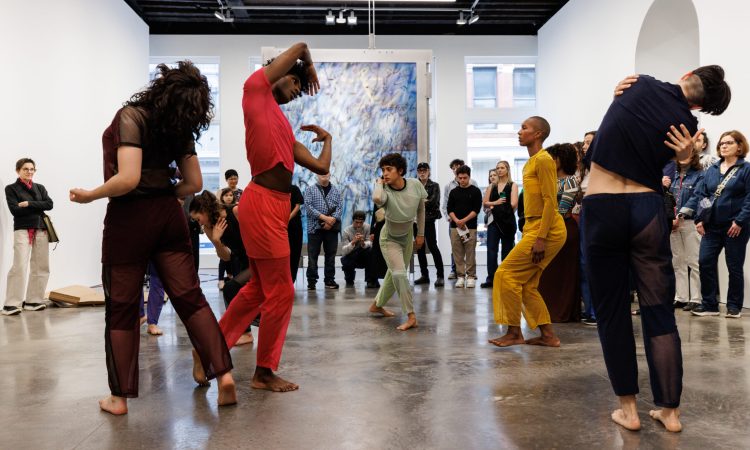
I am inside the Marian Goodman Gallery in New York City to see John Jasperse’s newest piece, Wandering. It’s difficult to see anything because so many people are standing in front of me. I eventually glimpse parts of the dancers, their limbs slowly reaching up and rotating in mid-air as their torsos remain draped across the edges of the granite steps. For a few seconds, I worry that the entire performance will be like this.
My concerns are quickly assuaged when a blue-clad dancer, Cynthia Koppe, approaches the crowd directly in front of me, causing a wedge of empty space to open up. I glimpse the other dancers rise off the steps and disperse into the next room, where Julie Mehrertu’s newest art pieces are on display. The audience is now given a choice on where to go and what to look at.
Wandering is an invitation to participate. Sometimes this means crossing through the space while this talented ensemble of seven embodies exquisite phrases of unconventional movement. Jasperse often has their bodies celebrate weight and gravity, sensual contact, and functional touch. Jace Weyant and Andrea Soto add a bare mattress to their duet in one room, allowing their bodies to fall safely as well as support each other’s flesh using unusual surfaces. Meanwhile, in another room, Mak Thornquest pushes up against a wall just inches from a leaning audience member. Thornquest, inverted, slides down the wall and suspends themselves against its surface using a shin, the outside of their leg, and other parts of their body. The audience member becomes part of Thornquest’s solo, and part of my pleasure at watching them. Wandering heightens one’s awareness of how we see, and brings the act of perceptual decision-making into greater conscious relief.
And then there’s Mehretu’s art! In Jasperse’s vision, each painting is an active participant within the performance. The rich colors of her pieces, populated with lines and dashes in multiple directions, echo the busy-ness of the dancers’ activity throughout the Gallery. And while both the dance and the art are abstract, both are eerily emotional, too. These images and movements touch the heart, without the mind quite understanding why.
Mehretu’s work serves to animate more than merely a frame. From time to time throughout Wandering, Jasperse has his dancers pause and gaze in a specific direction, as if urging the audience to stop with them to look at her latest exhibition, “Our Days, Like a Shadow (a non-abiding hauntology).” Later, when we go to the second floor, the dancers pace in circles between two rooms of new paintings, giving us time to acclimate and look upon our new surroundings. Static and moving art fuses even more with Catherine Kirk, who intentionally performs behind a piece suspended from the ceiling. Most of her body is hidden behind Mehretu’s semi-translucent image, so I can only see Kirk’s delicate hand or foot gestures outside the steel edges of the frame – beautifully blurring living with artificial form.
The costumes by MX Oops cleverly capture this dialogue between various types of perception and material, too: the dancers wear a solid color form-fitting layer beneath a transparent mesh, creating a kind of sheath. The composers Hahn Rowe and Will Johnson translate these ideas from eye to ear: we see Rowe mix and manipulate pre-recorded electronic percussion on a laptop while also playing an acoustic violin or beating a handheld drum. On the third floor, populated by Mehretu’s “black paintings”, Johnson is layering samples of songs and speeches, as well as belting out his own heartfelt vocalizations in real-time. The sound, the imagery, the exquisite movement: a heady brew nudging us all towards transcendence.
Jasperse’s choreographic language is rich and varied, especially when his dancers move low to the floor or engage in complex partnering sequences. At times, thinking a duet must be improvised, as there is so much fluttering detail, I then see it repeated verbatim with two others, again and again. This physical imagery is recycled across various floors of the gallery, providing yet another chance for audiences to see the art, or watch the dance, or go back and forth between the two. Wandering is a “choose-your-own-adventure” in multidimensional space.
In the piece’s stunning conclusion, the dancers slither and writhe face down on the floor within a fixed sequence before exiting one by one. It’s a mesmerizing moment, capping a compelling evening of deep reflection and engagement with different kinds of work and artistic expression. And as soon as Wandering is over, I yearn for this beautiful piece to begin anew so I can travel with it again and again.
Wandering, John Jasperse Projects, Marian Goodman Gallery, May 20-23.