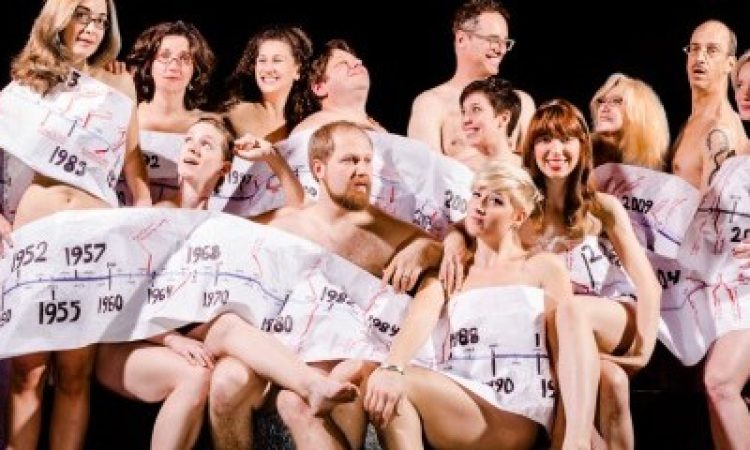
The word courage was my takeaway after viewing Saturday night’s performance of THAT TIME, an improvisational collaborative event featuring Tongue & Groove Spontaneous Theater with special guest dance company, RealLivePeople(in)MotionImprovising. The audience participated by writing responses to the question, “If you could go back in time to any moment in your own life’s story, where would you go and why?” They tacked their Post-it note answers onto a time-lined board at the rear of the stage, giving the actors and dancers material for the improvised skits that were to follow.
The action started as the actors selected a Post-it from the time-line and, along with the dancers, lined up in two rows across the stage: actors in front, dancers behind. Carol Moog’s nimble harmonica accompaniment provided texture to the evening’s ever-shifting dramatic scenes. As the actors recited lines from their chosen Post-it, a call-and-response format unfolded with Moog, actors and dancers interpreting the lines through music, dialogue and movement.
In one of the evening’s many scenes, two actors created a grandmother/ granddaughter relationship, communicated by means of instant messages read aloud. They quickly established the tension between generations, stimulating audience laughter in response to the familiar foibles of modern-day communication. In a skit that reminisced about a handsome boyfriend, two of the dancers demonstrated what a set of ample pecs might look like by molding one body onto the chest of the other. A spelling bee scenario inspired a visual gag as the dancers spelled out words with their bodies. And in yet another scene, a solo actor began his riff with a line about Mr. Machine, a toy popular in the 1960s. The inanity of the skit progressed as the actor bravely incorporated the detail of a hike up a Mexican mountain. I’m not sure if this reference was part of the text or the actor’s own addition but it became clear that the trudge up the Mexican mountain with Mr. Machine wasn’t playing to the audience so well. I’m sure I’m not the only one who wondered how this was going to end up. In the end, the actor was freed by an out-of-character confession that the hike took place not in Mexico but in Machu Picchu. This heroic admission brought on much-needed laughs for the audience and a much-needed conclusion for the actor. I find these near-failures to be what makes improvisation so delightful; it’s risky business. We as the audience get to live vicariously through the performers’ struggles because, in spite of the routines of our daily lives, we are all, at some level, making it up as we go.
With the fearlessness of skydivers and the skill of bricklayers, the performers launched themselves into the plucky task of spontaneously building something coherent out of the resources they had. What emerged was a series of vignettes—some successful and others not so much. I recognized that my excitement for this format was based on the voyeuristic thrill of tracking the development of the material at hand. Would the parachute open, saving the landing, or would it hit like a ton of bricks? My conclusion: with enough courage, every fall can find soft ground.
The Tongue and Groove Spontaneous Theater with Special Guest RealLivePeople(in)Motion, Innovation Studio at the Kimmel Center
April 20.