While attending the World Dance Alliance-Americas (WDA-A) conference in Vancouver, B.C., at the beautiful Scotiabank Dance Centre, I began thinking about all the facets of myself I was able to bring together there. Having recently graduated from an MFA program, I’ve been deeply enmeshed in “job search” mode. While searching, an odd characteristic of the dance world revealed itself: I may know my colleagues’ artistic work and movement “languages” intimately, I may know them personally—their likes and dislikes, their partners or families, their inside jokes—but, even with people I consider my friends, I often don’t know what they do for a living. Yes, we are all professionals. We get paid for our work (most of the time; some of the time). But to pay the bills, most professional dancers or choreographers I know have outside jobs—teaching, arts administration, bartending, office work, web design and so on—and that side is often hidden when we are in the studio or on the stage together. How many other “sides” of our lives are hidden?
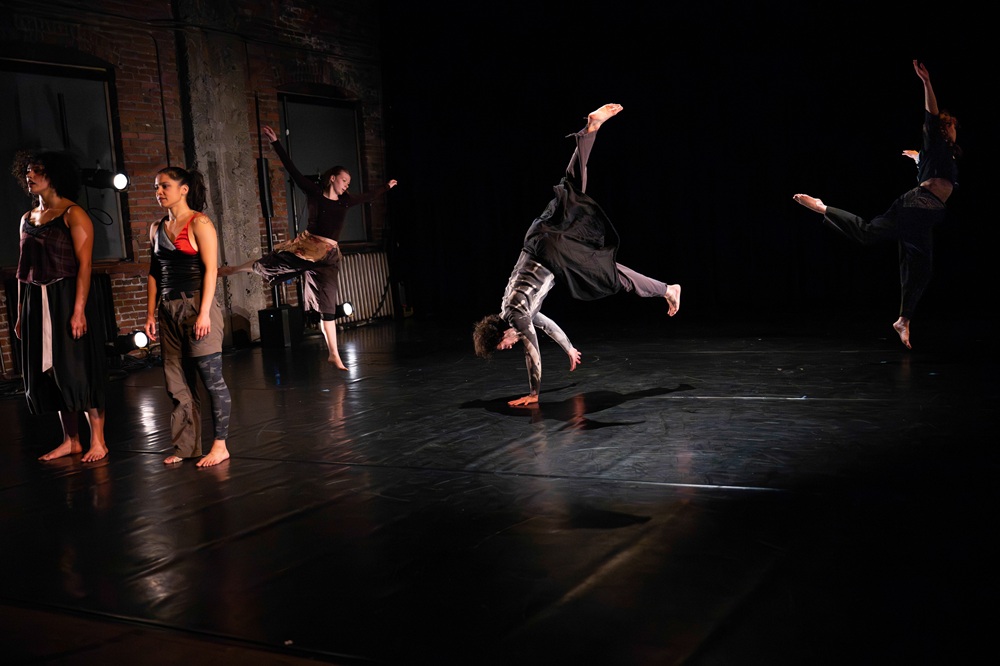
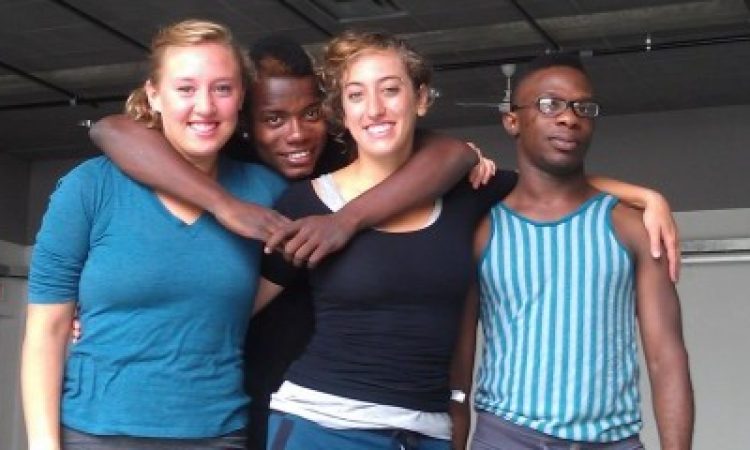
The WDA-A invited me to attend the conference both as a scholar, sharing my research on somatic memory and audience engagement, and as a choreographer, directing one of three “choreography labs” offered in the course of the week. For the lab, I choreographed on a small but committed group of dancers, pictured above, who ranged from students to professionals, and we tried to distill a year-long process into ten hours of rehearsal. (Left to right in the photo: Arianna Dunmire, Omari Anderson, Shoshana Moyer and Oniel Pryce.) While I was there, I was also able to be a dancer, performer, educator, writer, editor and critic. (The WDA-A conference joined forces with the concurrently held Dance Critics Association conference, allowing attendance at both events for the same cost.)
The week-long affair opened with speeches urging attendees to connect, to meet people and discuss our passions. In many of the “networking” meetings—where groups within the organization focused on education, presentation or sustainability—we were reminded again and again that WDA-A is a member-driven organization. Unlike some other large organizations, like NDEO or Dance/USA, WDA-A is volunteer-run. If members were passionate about an idea, administrators said, WDA-A could give us the platform to make it happen, but the organization could not do the work for us. Already some of these passions are coming to fruition: for example, this year, the first volume of the academic, peer-reviewed Journal of Emerging Dance Scholarship was published, in response to members’ earlier initiatives.
Sessions on offer focused on everything from working toward a genre-encompassing definition of jazz dance to training higher-education dance students to write critically. Other topics I sampled included dissolving the binary between improvisation and choreography, exploring feminist pedagogies, engaging with responsive technologies in choreography, joining street dance with somatics, disseminating methodologies toward physically-integrated dance education, and investigating the future of technology in dance teaching practices (hint: ultrasonic airborne holograms).
I took classes in technique, choreography, improvisation, and somatic practices. I shared my research and questioned others’. I attended evening concerts that featured technical, theatrical works; improvisation; cultural forms; modern dance; and more, from solos to large group pieces. I choreographed on a small but committed group of dancers who ranged from students to professionals, and we tried to distill a year-long process into ten hours of rehearsal. I conversed with other critics and artists about the practice of writing about dance. I networked, with students and seasoned professionals, from all over—from coast to coast in the USA, Canada, the Caribbean, Guatemala, Argentina and beyond—including India and the UK.
The conference offered theory next to practice, rather than just the ideological backing behind our work. In doing so, it allowed me to represent my fullest dance “self”—all of the ways in which I engage with the field. I left feeling refreshed, full of inspiration and information. Then I realized: I had gotten to know many of these dancers by their faces, passions and scholarship. We danced alongside each other, created phrases, embodied one another’s movement. This is how, as dancers, we come to know our peers physically. Sometimes we don’t know much about those we move with, maybe not even a last name or how they pay the bills. But we do know each other in an intimate, visceral way to which those outside the dance world are not privy. And that is something that connects us as a field across geographies, interests, training and experiences.
World Dance Alliance – Americas Conference 2013, World Dance Alliance – Americas, Scotiabank Dance Centre (Vancouver, BC), July 29 – August 4.
Editor: Lynn Mattluck Brooks