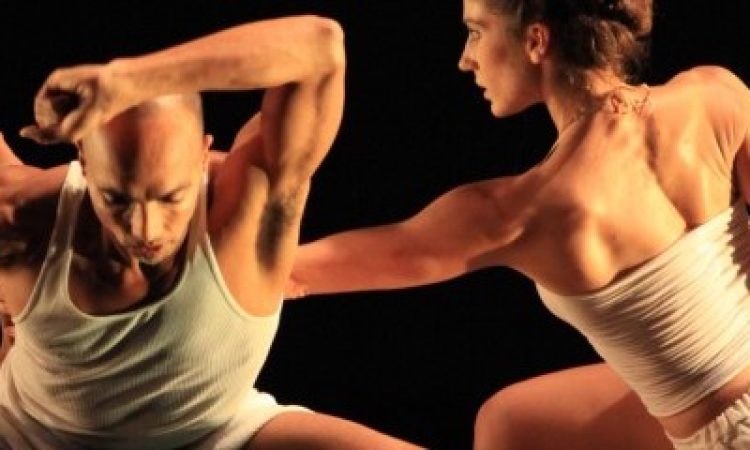
I was riveted. Eve Gentry’s Tenant of the Street (1938) held me breathless as Carrie Ellmore-Tallitsch, of 360° Dance Company, pushed her deeply curved body through the space of Mandell Theater’s stage—her arms taut, crossed, punctuated by fists; her legs angled, weighted, digging into the floor. The machine and transportation noises that accompanied this dance, the stretched-jersey apron and head-wrap that clothed the soloist, the simple pool of light that followed her agonized progress coalesced instantly as Ms. Ellmore-Tallitsch held the floor. The dance’s structure—crystalline, inevitable—burned its way into my mind like a T.S. Eliot poem: it had to be the way it was and no other. Her body moved in clear segments: legs, then arms; head, then torso. Pull to floor, crawl, kneel, push, look, rise: defiant. Rise, fall, reach, claw, go, retreat, go, keep going somehow. And she carried me too.
How can works from 75 years ago still read so strikingly? 360° Dance Company’s reconstruction of Jane Dudley’s Time Is Money (1932) brought the depression-era protests of left-leaning American modern dancers before us, the poem accompanying the dance tying us to the assembly-line factories that drummed their workers to pulp as they slowly starved on inadequate wages. Its protest, danced with meticulous commitment by Martin Lofsnes, was palpable, but time-bound, while Tenant, also of that era, transcended that time, for me at least. Similarly time-bound but delightful was Dance Fusion’s presentation of Pauline Koner’s Concertino (1955), which brought Koner’s close collaboration with José Limón much to mind: lovely ladies danced in medieval-ish dress, attuned to the baroque music’s every nuance of phrase, rhythm, and mood. Angled gestures, suspended torsos, frieze-like choral lines, pitched attitudes, elegant hops, and expansive reaches uplifted me much as Limón’s movement often does—kinesthetically, musically, and in structural elegance.
Each company on this shared program also showed new work. Dance Fusion presented Anna Troester’s That Which Is Left Unsaid (2013) and 360° Dance gave us Near Dark (2012) by the company’s artistic director, Martin Lofsnes. Troester’s work intermixed pantomimic and contemporary gestures (listening to an iPod, talking on a cell phone, checking a watch) with kicking, leaping, stage-eating dance phrases, sometimes shaped by various placements of chairs around the stage. Lofsnes’ choreography, on the other hand, was chiseled, tightly edited; he’s clearly not only danced the works of the early modern dance classicists (he danced with both the Martha Graham and Pearl Lang companies), but learned from them.
DanceFusion & 360° Dance Company, Program 2 (Philly Fringe Festival). Mandell Theater, 33rd and Chestnut Sts. September 7, 2013 at 3:00 and 6:00 p.m. fringearts.ticketleap.com/celebrating-dance/