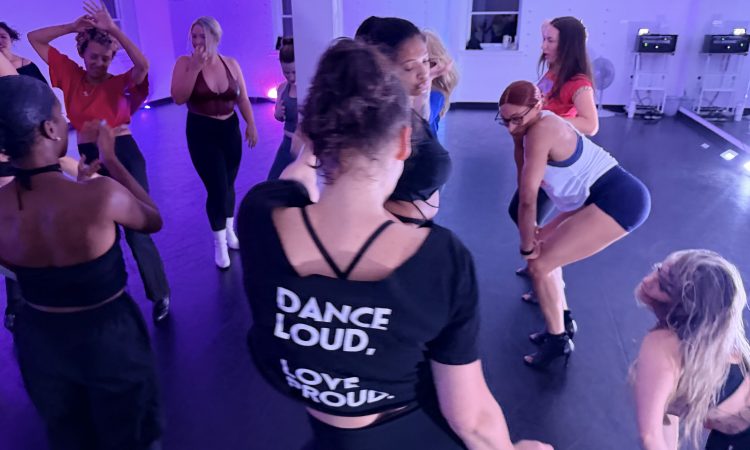
There is a particular kind of religious experience available only to dancers wearing six-inch stilettos and knee pads. It is 9 p.m. on a Monday at Powerhouse Dance, a South Jersey studio whose mission is to help adult dancers “connect with the most powerful part of themselves” while finding joy and building confidence.
That sounded good enough for me, so I signed up for Heels, a commercial fusion style that blends jazz, hip-hop, contemporary, Latin, and burlesque, all performed in, yes, high heels. It is sultry, physical, and technically demanding, requiring balance, core strength, sharp lines, and a willingness to put your back into it.
For an enhanced experience, I highly recommend ass-tight neon-colored booty shorts (thank you, Shane Gillis), and whatever else makes you feel like the hottest, most untamed version of yourself.
The room is full of dancers, and it is time to dip it, pop it, twerk it, stop it. Tonight, we are dancing to Ne-Yo. Our teacher drops to the floor on all fours. We do the same.
Make no mistake: this is technical shit. In Heels, technique and theory are all there, but the language is entirely different.
The teacher does not say, “Arm one, hand two, head three.”
She says, “Titties—one. Booty—two. Coochie—three.”
The knees soften, the hips loosen, the pelvis releases, and the back joins the conversation. There is choreography here: musicality, counterbalance, shifting weight, floorwork, strength, and control.
From the outside, it looks like an organized sexual awakening. But, reducing Heels to a late-night sexy dance class misses something about what is happening in the room.
During tonight’s lesson, we review that a booty pop comes from the back and the knees, not the booty itself. (You’re welcome for that tip.)
The teacher demonstrates. We watch.
“Like this?”
“No. More from the back.”
“Like this?” Someone goes for a good, earnest twerk.
“Lower.”
“Yesssss!” we cry.
“Come on, mama!”
The dancer next to me looks at me. I look at her. We are on our hands and knees, attempting to determine whether the count is ass on one or booty on one.
Or is it both?
“Like this.”
We watch.
“Again! And make sure to pop on the word ‘Sprung.’”
We do it again, and our booties pop on the word “Sprung.”
And somehow, the thing that looks fluid, sensual, like quicksilver, becomes a series of very specific mechanical instructions: hands here, knees there, chest lifted, spine articulated, pelvis released.
What I appreciate most is that there are no spectators sitting around the perimeter deciding who is “attractive” or “good.” The dancers are the audience, but we are dissecting counts and choreographic sequences. We watch one another. We study the movement. We steal ideas. We laugh lovingly at one another. We try again.
Then the teacher stops and points to a dancer.
“Do that again.”
We give her the spotlight, and, oh, does she do it again.
“Queen!”
“Yesssss!”
As she moves, we pour into her, and she pours right back into us. She goes harder. We get louder. She takes a risk, we meet her there with cheers.
If this isn’t church, I don’t know what is.
And somewhere in the middle of all this, I remember a girl named Nasya I went to art school with twenty years ago.
It was high school. I sat in a theater for a dress rehearsal. As I watched from the audience, I heard the dance teacher tell students onstage to fill in the end of the song with freestyle dancing. So, they began to improvise. Most of the dancers were doing what you would expect from trained high school performing arts students: pirouettes, high kicks, little leaps, jazz arms, or whatever. We were improvising, but within the general boundaries of “dance” as a lot of us knew it.
Then, Nasya left the boundaries entirely.
I saw the whole thing, including the looks on the faces of the four white dance teachers who ran the dance department.
In front of them, Nasya rolled and dropped into a full and unapologetic floor split, then proceeded to bounce her ass off the ground. She was easily clearing a foot. Her legs stayed straight. Knees locked. Toes pointed. Her glutes and hamstrings fired, lifting her hips several inches off the floor and dropping them right back down.
She was bouncing up and down in a split.
The entire theater howled in shared jubilant revelation.
We looked at each other, then back at Nasya, barely able to contain ourselves.
This was not the type of school to embrace twerking in the splits. Ballet was the dominant language of our dance education. The dance department at the time used classical ballet as the measuring stick to determine level placement for students. It had little to do with raw talent.
And here was Nasya, in a perfect split, bouncing her ass off the floor. I knew an athletic miracle when I saw one.
***
Suddenly, I understood why that moment had stayed with me for twenty years.
It wasn’t only the move. It was what the move did to the room.
With one move, Nasya challenged the dance education I had been given and its demands of physical compliance. Dance could be more than a performance, more than a body arranged for someone else’s approval. It could be a protest. A form of ownership. Its own form of liberation.
That was some powerful shit, and whether she realized it or not, a small but glorious act of rebellion.
I didn’t have these words for it then. I only knew that something extraordinary had happened.
I never forgot that moment, and for twenty years I wanted to be bold enough to do the Nasya.
For some reason, I picked eight months pregnant, in South Jersey, wearing six-inch heels, as the moment I was finally going to try.
I am hurting everywhere, but I know this body. I have spent years training it as a ballet dancer. I have learned to lift my chest, pull in my stomach, turn out, point my feet.
Then there is the rest of what I have learned: Be sexy, but don’t ask for attention. Be strong, but don’t be intimidating. Be maternal, but don’t disappear. Be visible, but not too visible.
My hands are now on the floor. In my stilettos, with a belly full of baby, I throw my legs into a split, and I do the Nasya.
My fellow dancers erupt.
“Yesssss!”
“Queen!”
“Come on, mama!”
Not because I am doing it well; I am not.
They cheer because I went for it.
That is the part I keep coming back to: the exchange.
The choreography of womanhood requires a lot.
But tonight, nobody asks us to make femininity tidy. We are sexy. We are free. And, most importantly, we get to do this safely.
Another dancer takes her turn, giving us her boldest move. Then another. We know what to do.
We cheer. We whoop. We scream.
When it is a dancer’s turn, nobody tells her to tone it down. We don’t tell her it’s too much. We tell her to go harder.
I’m smiling a real smile. In this moment, my body is totally mine.
And all around me, a room full of women, femmes, and mothers screams.