Seamlessly, Cavidad leads me into an altered experience that feels timeless, science-fiction-y…
The Fleisher Sanctuary – a warm-bodied space of soaring antiquity – is now a loaf-shaped tomb, defined by two wheeled banks of florescent lights at either end. Three women in black robes are aligned like buttons down the backbone of the sanctuary floor, their upswept hair carefully rolled into futuristically fashionable designs, lace turtlenecks adding to the coolness of their carriage.
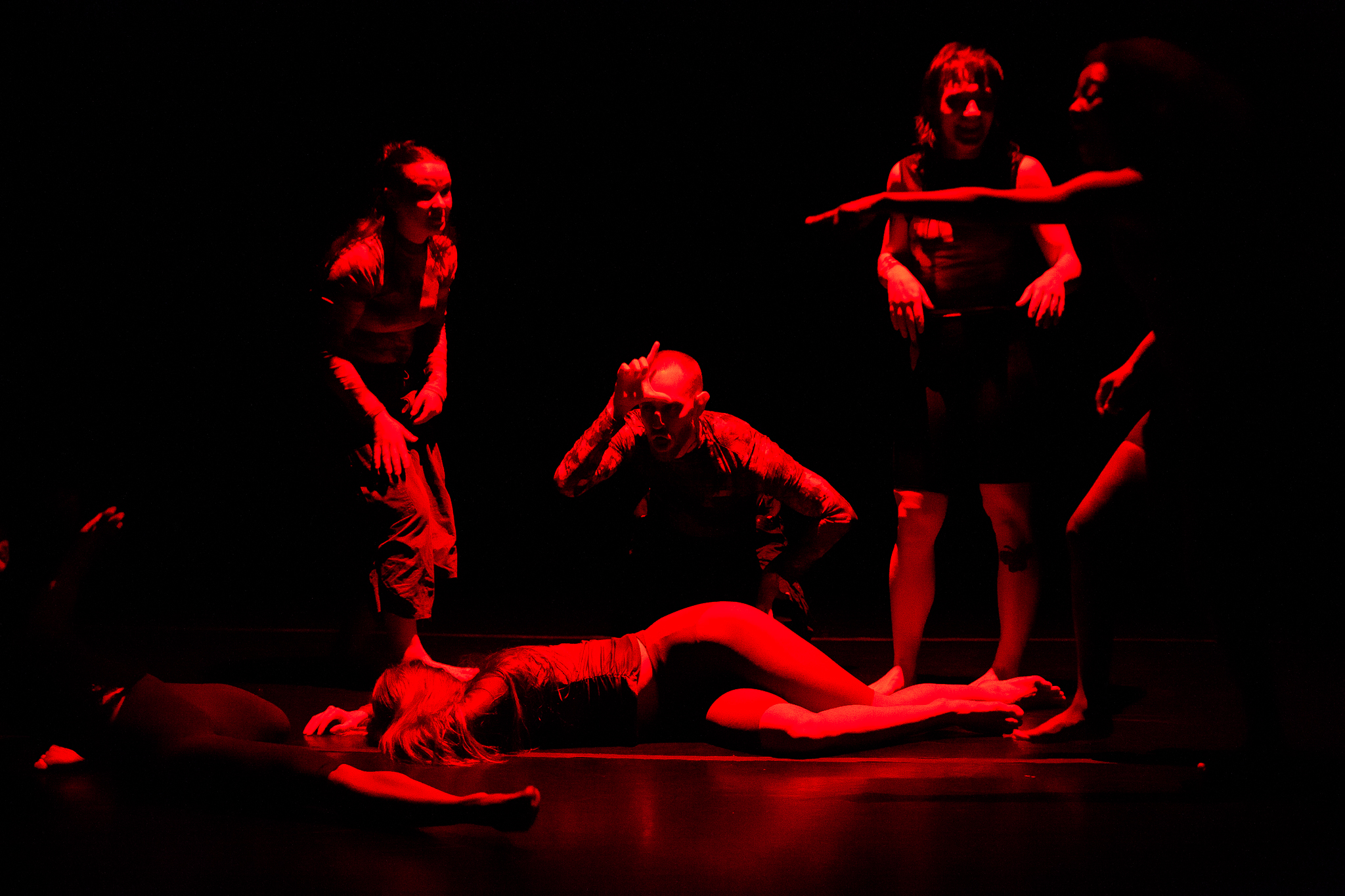
Are they preparing for a ritual, with their solemn concentration and strange shifts of neck and head, or have I entered a rite already underway?
Two men are sliding around the edges of the sanctuary, peering at details, eventually drawn like bugs to the huge lights. Seamlessly, the “dance” is happening. When did it begin?
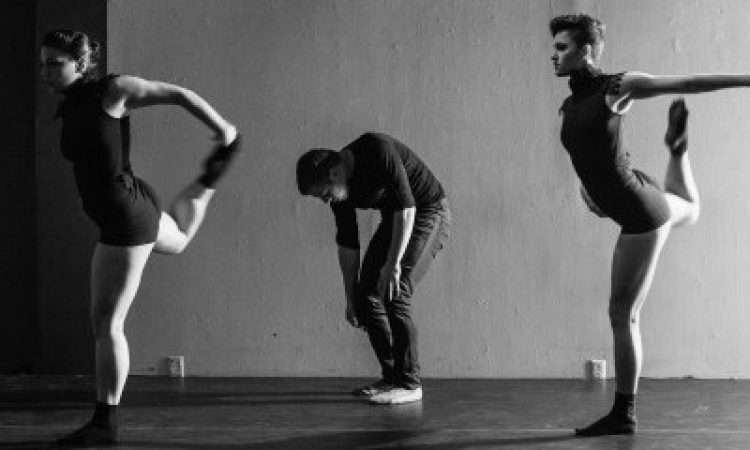
The men and women seem differentiated by attire – the women very “costumed” in black jodhpurs with lace insets — science fiction priestess attire — while the men look 20th century casual.
There’s some strong male/female attraction buzzing through the piece, but it never loses its cool feel. The dancers come together in various combinations, relating, but keeping their distance, investigating — then separating. In one duet, dancer Matthew Ortner lightly touches his female partner’s back, and she falls backward in a smooth hinge from the knee as he lowers her to the floor. Their reactive rhythms during this combination make me breathless. The piece is filled with these moments. In the men’s duet, Ortner and F. Scott Stampone devour every bit of space, skidding across the floor to land on their backs, pausing there and giving me a chance to breathe with them. The naturalness of their bodies in this moment speaks to the high degree of skill all of the dancers bring: the technical demands are relentless but the dancing isn’t overly mannered.
In Cavidad, Enza DePalma creates a fully-realized vision of an alternative reality – sound and light being two of the strongest elements she deploys in coordination with a distinctive choreographic voice. The score by Co-Artistic Director and dancer Sephanie Crousillat skillfully builds atmosphere, using a deep drone and other electronic sounds in addition to warm acoustic elements.
Along with the dancers already named, Ali Castro also created indelible images with her performance. For me, in this piece, the how of the dancers became deeply enmeshed with the what of the choreographer. And this integration makes Cavidad seamless on another level.Cavidad, Enza DePalma, Fleisher Art Memorial, September 13 & 14 at 7 & 9pm, September 15 at 7pm, www.fringearts.com, www.enzadepalma.com