New Street Dance Group’s ChORDED Motion bound its dancers in tangled ribbons, pearls, and strings of thought. Choreographers and co-directors Shannon Dooling and Krista Armbruster tied together the six works on the program with threads of anonymous poems, spoken aloud between dances.
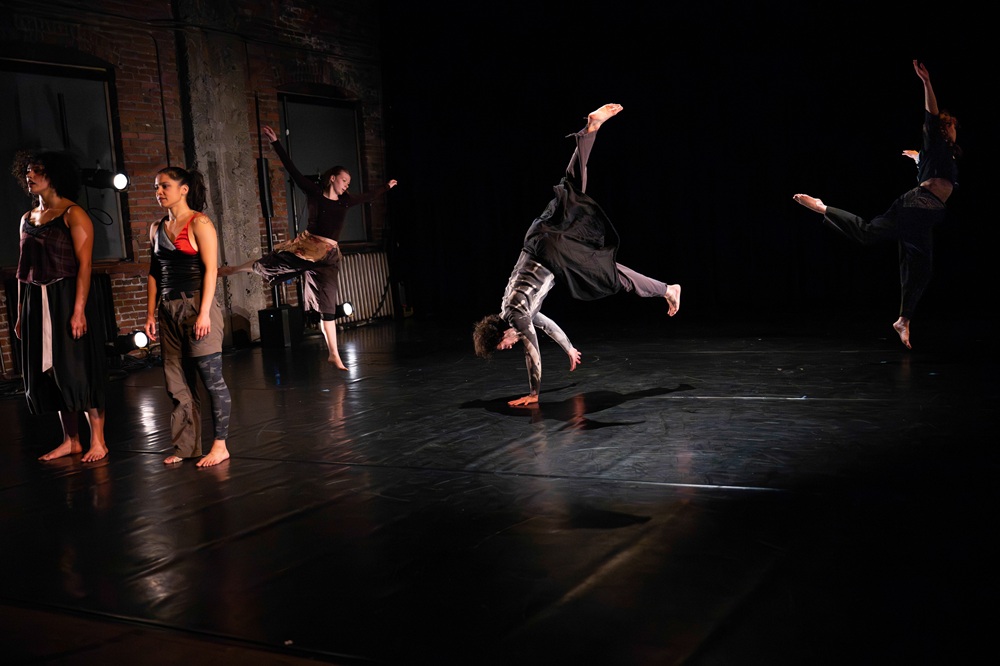
The performance began with a flare as the featured string quartet, the Cambitas Quartet, furiously pulled music from their instruments. On the stage behind them, five thin elastics were suspended from two bases, creating a structure that I soon recognized as a musical staff. Three dancers in black—musical notes—explored the negative space between the cords, at first avoiding contact and then teasing them apart. They twisted and tangled, manipulating the cords into unexpected shapes as they danced around and through the staff.
The string quartet only performed twice during the program, but the richness of their music was refreshing and engaging. The dancers, however, lacked a complementary harmony; occasionally I was distracted by the unclear intentions in their shifting eyes.
Dancers darted back and forth in front of the musicians, matching the tremolos from the strings. I initially saw these runs as relating to the musical vigor, but their sporadic timing soon led me to believe they were “crossovers”—a method for the dancers to quickly get to the other side of the stage. I questioned the choreographers’ intentions during these transitions, wishing they had considered more creative ways of adjusting to the unusual space.
The First Unitarian Church of Philadelphia was a unique venue to choose for dance: with a small raised stage in the back and larger space below, it effectively created an “upstage” and “downstage.” When used well, as in Superluminous, the stage structure created a zoomed-out depth perception. Peering through the couples in the foreground to the pairs on the stage, my vision became awash with space engulfing leaps and quick spirals to the floor. Grateful for the front row perspective, I enjoyed the varied use of the space, but I was aware that the audience seated in the pews behind couldn’t see the majority of the action.
Throughout the program, the choreographers successfully integrated themes of binding and tangling with sound, text and movement. Yet I couldn’t shake the feeling that the performance could have been better adapted to the space. The choreography included pirouettes, slides to the ground, and sharp changes in direction—all in bare feet and legs, and I soon became aware of the carpeted floor. I wondered, “How many rug burns will these dancers go home with?”
ChORDED Motion, New Street Dance Group with the Cambitas Quartet, The First Unitarian Church of Philadelphia, Sept. 14.