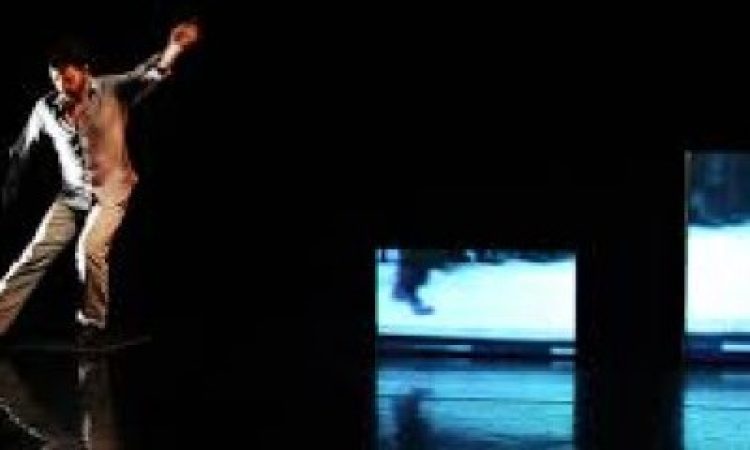
If one moment could convey the essence of Colin Dunne’s Out of Time, it would be this: Dunne, having danced for an hour and sweated his way through four shirts, stands motionless. Fiddle music with a propulsive beat acts on him as if from the ground up. His feet, itchy to move, do, but almost imperceptibly. That motion travels up his legs and torso, as if through a volcano, bursting finally into a full-bodied, space-eating dance—the culmination of his performed essay on his relationship to the traditions of Irish dancing.
This essay, in a string of separate chapters with occasional spoken text, tells a story of loving and expanding on a contained and proscribed form. It’s rendered effective not only through Dunne’s dancing, which you could hardly call anything short of brilliant, but also through the efforts of a skilled sound designer (Jamie Flockton) and set builders (Colin Barclay and Mike Burke). When Dunne sits to put on shoes, he mikes his feet and the resulting beats and swooshes are shaped with what sounds at times like a wha-wha pedal or with echoing effects and pitch changes. It’s feet as symphony.
And what feet! Like tapper Savion Glover whose precision and fleetness seem a force of nature, Dunne hammers flawless rhythms. Speaks them too: “Bangers and Sausages, bangers and sausages” (a way to hear 6/8 time). The fluidity in his upper body and buoyancy in the lower legs once they strike the floor is especially surprising (picture a rubber ball’s rebound after hitting ground).
Film clips are projected on an ingenious white structure that begins as a square platform, opens out into a long rectangular surface, then stacks into a tall slice of a shape. In the clips, traditional Irish dancers duel it out, dance in tandem and garner the applause of robust and knowing audiences. Finally we see the same films projected continually and large, on the back cyc, as if Dunne is being rejoined by all his forebears.
Continuing to dance after beginning as a child prodigy and young adult star —Dunne won his first World Champion title at age 9—is not simple. For the mature artist to find his own way in relation to this form he chose, or that chose him, involves moving away and re-embracing it with a wider sense of possibilities. As with Jean Butler, another star of Riverdance who is exploring where contemporary and Irish dance meet, Dunne’s investigations show the fertile ground that’s opened out when combining the rigor of a deeply developed traditional artistry with a roving, inquisitive body and mind.
Out of Time, Colin Dunne, Painted Bride as part of FringeArts, Sept. 19-21. http://www.livearts-fringe.org/festival/2013/out-of-time.cfm