I have a theory about “good” dance–one that transgresses genre and aesthetic preferences. I love that feeling of physical engagement, mirror neurons firing and feeling the movement in my own body as I see it expertly executed from my seat in a dark theatre. Yet most of it, despite my in-the-moment engagement, washes over me–or passes through me–and is forgotten down the line. I see so much dance that it is not possible to retain it all. For me, good dances are the dances that refuse to leave. I wager the “good” ones are those that are so fully cohesive they stick with us despite all of the other information coming in and going out of our over stimulated systems every day, every week, every year.
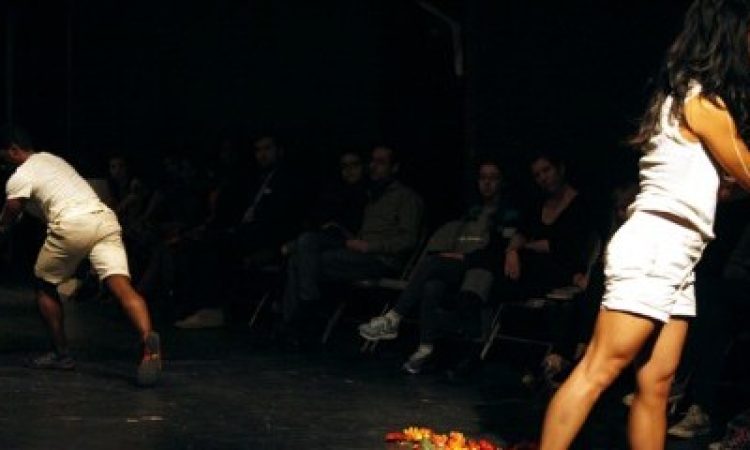
Upon entering the dark, intimate AUX space for Meg Foley’s first “Dance it Out” (a new series she is curating), the crowd made chatter from their seats along the sidelines of a room adorned with a diamond of red-orange daisies and rusty railroad-tie nails meticulously laid out in a row upstage. Soon, performers Michelle Tantoco and William Robinson entered, wearing white tops and light khaki shorts–their black sneakers in stark contrast to their attire.
Adjacent to each other, they began “rocking out”–dancing arrhythmically and full-bodied, like two people immersed in the crowd of a nightclub. Their dance was punctuated with two-fingered gestures—air-quotes, come-hither, taking one’s own pulse. Sounds of the street interjected as the two made their way downstage with slinking hips and flung elbows. Two white lines drawn from their shoulders to their extended index and middle fingers traced the front and back of their arms. Body rolls initiated at their ribcage, pelvis, and sternum rippled. As their speed increased, the pair jutted to and fro wildly, their trajectory led by their two fingers. Now supine, they pushed to off and clonked back to the ground repeatedly, struggling to keep their bodies aloft. A slow retreat–snaking hips, two fingers again. Then, a series of athletic leaps, burpees, pushups before a stillness. The performers hit, kicked, and sliced the meticulous lines of flower blossoms and nails sending them strewn around the space. The two paused in a statuesque pose, arms aloft, biceps flexing, the sound of fireworks providing a backdrop.
Here, Shannon Murphy’s Parade of Traces, I sensed something visceral and physical. The work was so aesthetically driven–long lines, pointed toes, and very clear gestures–amidst sloppy writhing and clunky bodies dropping to the ground. Because of the foregrounding of that visceral movement, I wondered what the mussing of the meticulously laid out set meant for the body. While I marveled at the dancers’ abilities, perhaps because it felt like they were executing movement (rather than living within it), I couldn’t quite grasp the connections. Reading the program notes post-performance, I saw that Murphy asked audiences to notice the environments that “get left behind.” She inquired, “What do they do that lasts forever?” I found myself asking the same question–will I remember the flowers, the gestures, their rolling hips, or those body slams? Will this dance stay with me? I think it might, but those elusive connections make me unsure. I am curious to see what–if anything–will stick with me a day from now, a week from now, a year from now.
Also on the bill were two complementary works: first, a video of Meredith Horiuchi performing side-by-side with Robyn’s “Dancing on my Own” in a hilarious low-budget version of Robyn’s super-produced music video. Next was Sebastian’s “I Am Because I Am,” a hyper-sexy drag performance that raised issues of gender and power, intelligently balancing projection with the male dancers’ personification of feminine sexuality and objectification as they strutted in high heels, bent over, and tossed their long locks. Lastly, a “Dance Break” presented by Foley and Carmichael Jones complete with black light and tequila shots in between pieces added to the sense that this evening was more than a traditional performance–it was a wild night out.
Dance It Out: Sebastian and Shannon, curated by Meg Foley. Aux at VoxPopuli, October 12, 2013.