Photo: Lisa Kraus
Photo: Lisa Kraus

Posts from Paris: Dancing Toward a Premiere

Lisa Kraus

We got onstage yesterday for the first time. This is when “the rubber meets the road.”  For anyone not around for those 1960s tire ads, that’s shorthand for moments when you prove your mettle.

Glacial Decoy is a tough dance to do because you have to have abandon in the movement, which swoops and swells and dives and careens and flings and jabs, and exactitude in the rhythms, shapes and spacing. You might say “But any dance could ask that!” And then I’d describe to you how its four dancers travel in tandem as though invisibly yoked to a shared harness, yet far enough apart that it’s hard visually to determine those distances, how when limbs fly or actions tip, the dancer who flies higher or spreads wider instantly draws the eye as an exception. It’s a cruel and delightful juxtaposition of dance freedom and bondage. Maybe this is why I love the dance so much.

When they get onstage dancers’ habits stubbornly reassert themselves and no matter how many times you have corrected a given movement, or provided a spatial landmark, they might pop out, veering back to instinct. Can they stay awake enough when adrenaline is high and when coping with costumes, an ever changing backdrop and all that performance means, to be both accurate and full? This is what we are working on in the week leading up to performance.

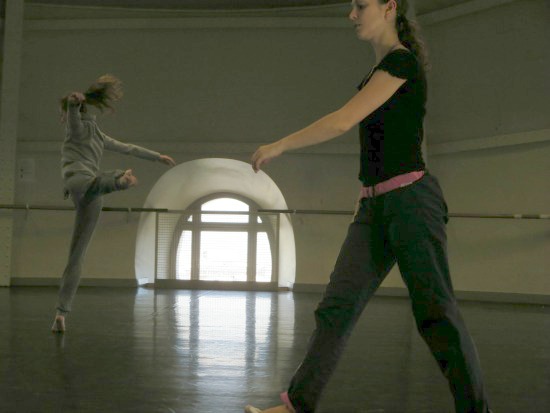
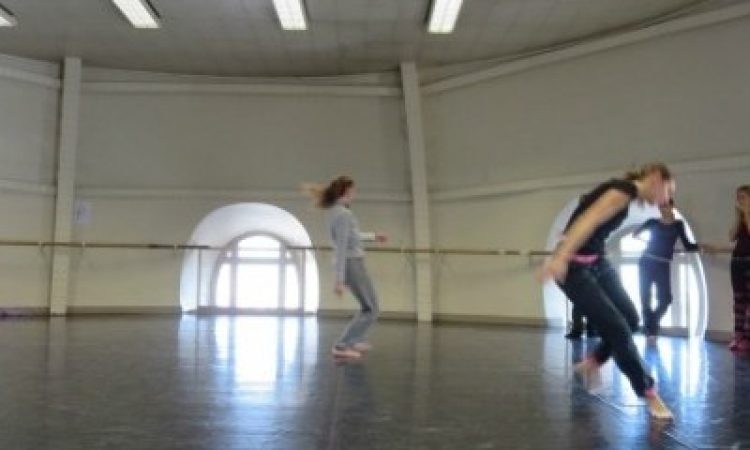
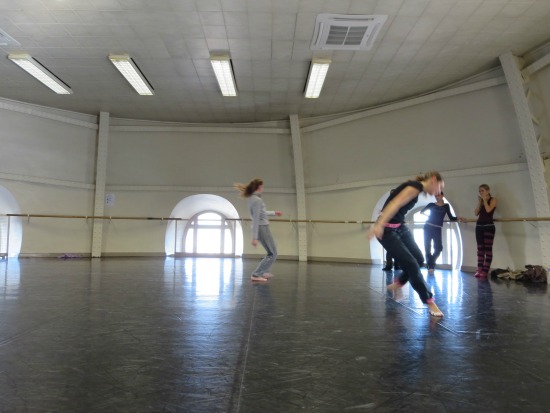
Here are the dancers earlier this week in Chauvire, one of the two round studios. (They don’t show the spatial demands I mention earlier, but do show kinesthetic delight.*)
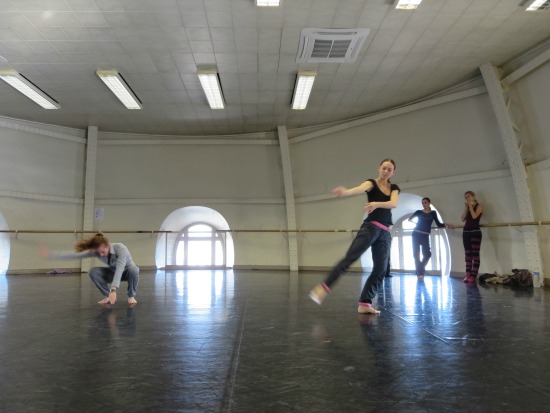
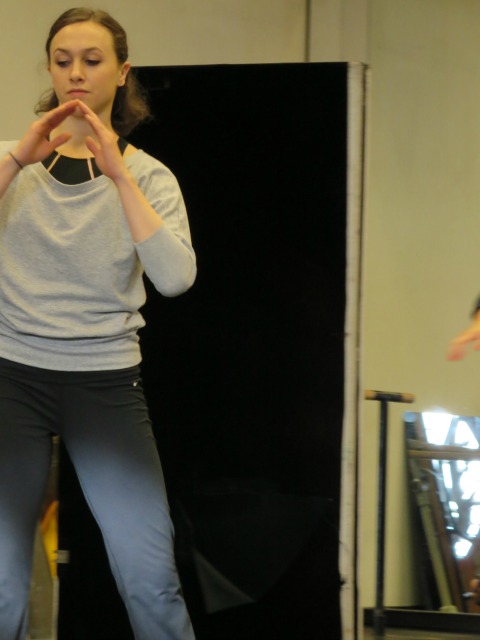
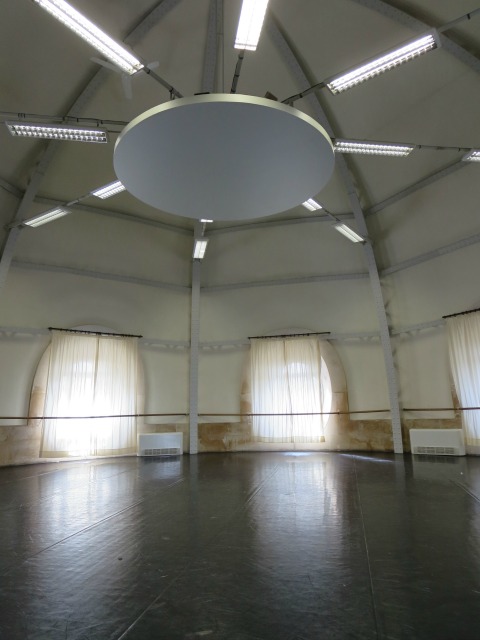
And this is the other round studio, Zambelli.
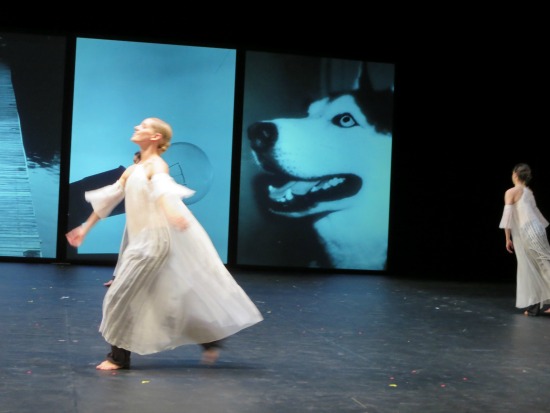
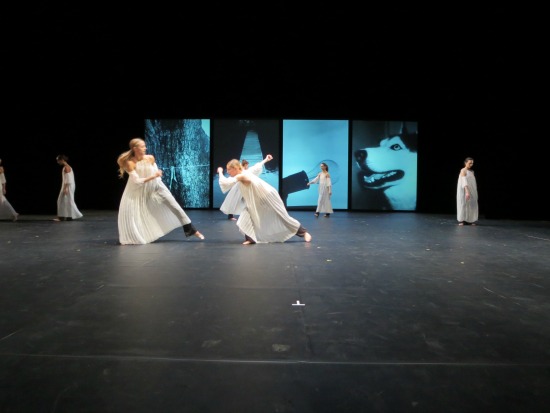
Here they are getting ready for the first run on the Opera stage.

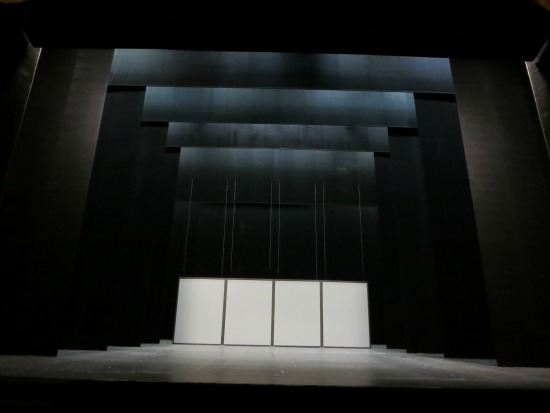
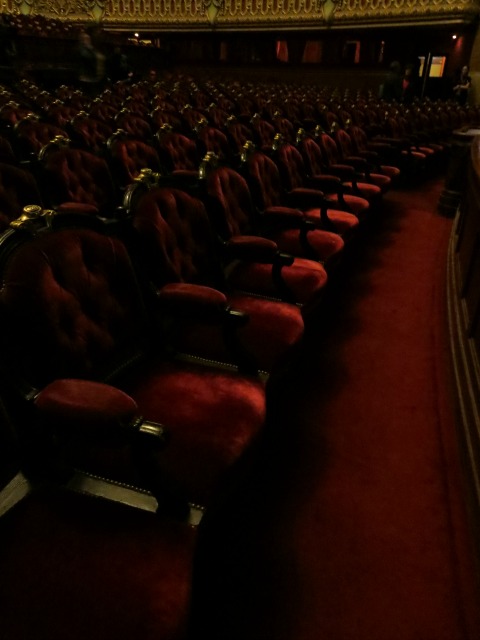
After everyone left, I took some pix of the empty theater. The tech guy working with the slides confided to me that this is how he loves the theater best. What is it about those moments? Such potential…
* * * * * * *
*Thanks to Barbara Dilley for this term.

The set and costumes pictured are by Robert Rauschenberg.  Dancers pictured are: Caroline Bance, Letizia Galloni, Christelle Granier, Juliette Hilaire, Laurence Laffon, Caroline Robert,  Gwenaelle Vautier, Severine Westermann.
All photos by Lisa Kraus.

Two previous posts in this series are here and here.

Share this article

Lisa Kraus

Lisa Kraus’s career has included performing with the Trisha Brown Dance Company, choreographing and performing for her own company and as an independent, teaching at universities and arts centers, presenting the work of other artists as Coordinator of the Bryn Mawr College Performing Arts Series, and writing reviews, features and essays on dance for internet and print publication. She co-founded thINKingDANCE and was its director and editor-in-chief from 2011-2014.

PARTNER CONTENT

Keep Reading

On Language Learning

Emilee Lord

A reading of Ways to Move: Black Insurgent Grammars by Jonathan González

Green-toned book cover featuring the silhouette of a forest and leaping figure with the title “Ways to Move: Black Insurgent Grammars by Jonathan González” on the right, and poetic text on the left reading: “i want to be with you in the ways with you of vertigo seas,” “i want to be with you in the ways with you of smashing monuments,” and “i want to be with you in the ways with you of these lonely trees.”
Photo: Courtesy of Jonathan González and Ugly Duckling Presse

Zooming Out and Weighing In

Jennifer Passios

Thirty-three writers shape Contact Improvisation’s next chapter.

A flat image of the front cover of "Resistance and Support: CI @ 50" appears centered on a dark maroon background. From top to bottom, the cover descends through sunset – muted burnt orange, carrot, creamsicle, golden rod, pale yellow, into a black and white photo of two dancers partnering in the ocean. One dancer is on his ass in the water. The other stands, both knees bent, reaching out for her comrade in the waves. They hold hands at the wrists, arms fully extended. The title “Resistance and Support,” each word on its own line, spans the top third of the cover page in a burgundy, serif font. Below, the subtitle “CI @ 50” slants in smaller white italics. The text “EDITED BY: Ann Cooper Albright,” back to the burgundy with no italics, sits about one thumbs width above the dancers in the ocean.
Photo: Courtesy of Ann Cooper Albright, includes photo by Lasse Lychnell