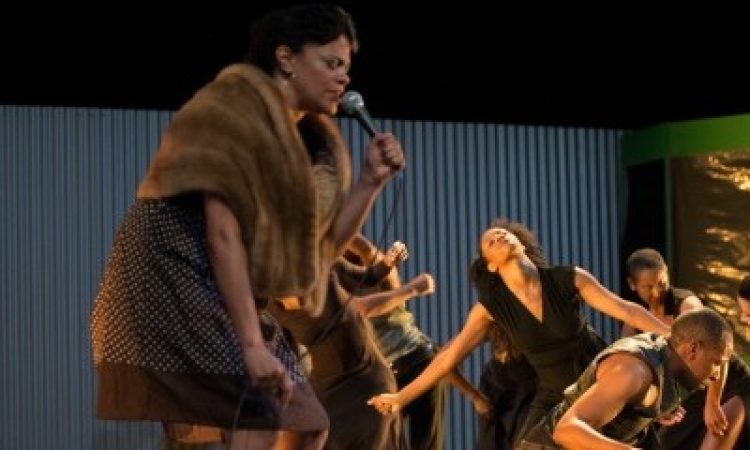
From the moment I enter the theater, an invitation to sit onstage dissolves the fourth wall. One third of the audience is seated stage left, perpendicular to rest of the seats. Charles O. Anderson slinks onstage during the curtain speech, wringing his hands as the cast emerges in dress pants and button down shirts, flared dresses with polka dots or flowers at the collar, hair swooped up. They are casually leaning against the side wall with no wings, exposed as they chat and laugh inaudibly. Anderson remains pensive, brows cinched together in furrows that he retains for the duration of the piece.
He begins a solo to a blues song sung by a man who is down and out while a trio of female performers sit in chairs onstage watching him. Their smiles fade as they see the anguish in his movement. The entire audience remains lit as we watch the women watch Anderson. We are all implicated in the action.
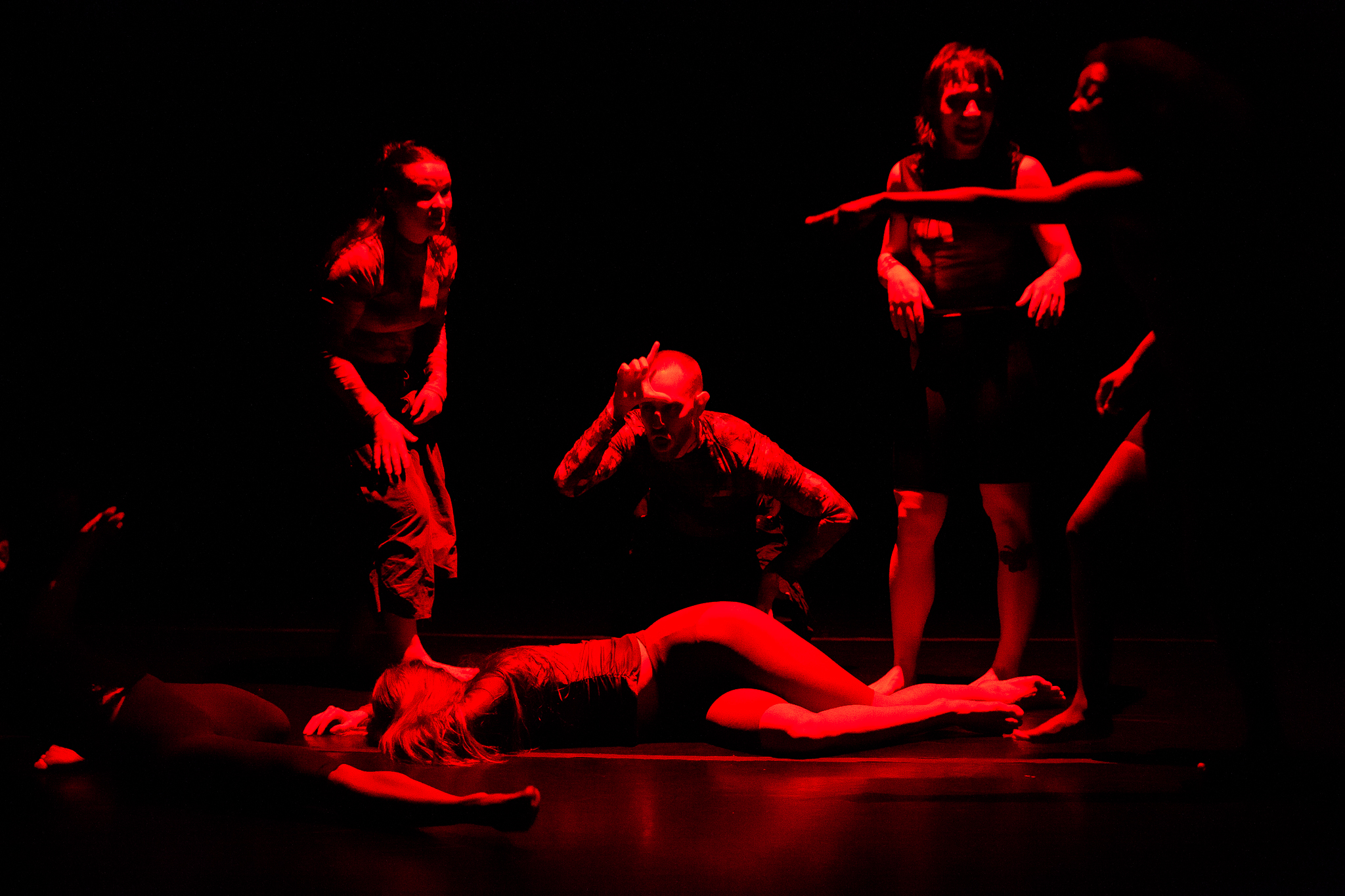
Based on James Baldwin’s,1962 novel, Another Country, Anderson’s Restless Natives is haunted by a solo figure who represents Rufus, a black man who commits suicide in the beginning of the story, leaving the others to contend with his death. Although Rufus’ death is a suicide, one common interpretation of the book is that it is a murder because he has internalized the hate directed at him from the racist society in which he lives.
In this funereal juke joint where even the most ecstatic dancing is infused with sorrow, the dancers pound the floor with rhythmic urgency. They roll their shoulders and spread their arms like wings. They undulate and look toward the ground. They unfurl, extend their spines and look up, pleadingly.
Anderson’s relationship to the other performers remains ghost-like. He sees them and they see him, but his distance endures. His distinction is most successful when either he is still, witnessing the dancers move or when they circle him and hold space as he moves. He is a haunt, a memory that they cannot touch.
Anderson’s presence is less palpable when he moves in unison with the others, just slightly askew. He becomes subsumed by the rest of the cast, and my eye loses track of him. His only dissimilarity in these sections is the tension in his face that none of the other performers have.
Restless Natives is dovetailed by poetry, performed live by Ursula Rucker, as a character she introduces as “Blue.” She tells us that this Juke Joint is called “Home.” Through Blue’s direct address, the spilling of the audience onto the stage and the periodic raising of the house lights, the space is imbued with the feeling that anyone could stand up and make a testimonial.
At the end of one poem an audience member snaps his fingers with approval. Another pair in front of me quietly argue about whether or not to respond to the action onstage. The ambiguity of stage and audience boundary is a point of tension that enlivens the space.
In a final poem, Blue asks if we are in a post-racial society. To ask the question whether race is dead assumes that it was ever alive, she says. It wasn’t ever alive. It’s a machine.
The piece ends abruptly. Lights come up to full. Anderson takes a microphone and launches into a Q and A before we are given a chance to acknowledge the performers. He asks for answers, not questions. He permits people to leave if they must, but no one leaves. The conversation is almost as long as the dance and feels like an extension of the performance.
Anderson speaks about his mission to embrace the traditions of narrative and emotional expression in African American dance. He appears seasoned at speaking to audiences about his interests and goals as an African American choreographer. I am reminded of a statement in Jawole Willa Jo Zollar’s essay Listen, Our History is Shouting at Us: A Choreographer Confronts Racism in Dance: “‘What is white art?’… White art means the privilege of never having to answer the question.”
A former student of Anderson’s ponders for several minutes whether or not there could ever be a post-racial society. Anderson, an educator at heart, patiently listens as the young man works through his ideas. Rucker supports the speaker by saying the piece is about creating the space for people to work through these questions. She poses a larger question: whether there will ever be a post-hate society.
At the end of the discussion, the performers re-formalize themselves, place their hands on their chests, sweep their arms out and bow. It is a relief when they finally allow us closure through applause, an opportunity to honor their robust and resonant performance.
Restless Natives, Charles O. Anderson, Conwell Dance Theater, Reflection:Response Series at Boyer College of Music and Dance, Temple University, October 25th & 26th. http://charlesoanderson.com/