In the seven pieces that make up Kun-Yang Lin/Dancers FALL Reflections, a celebration of the company’s fifth year in Philadelphia, we do see reflections… of light glinting off of scantily clad bodies, glittering sequins, movement phrases mirroring across the stage. These glossy elements, coupled with virtuosic technique, make it difficult to tell if Lin is reflecting on anything that is more than skin deep.
The concert opens with Moon Dance, a twenty-year-old piece danced flawlessly by Liu Mo. With fluttering claps of his hands, and fast twitch movement of the arms juxtaposed with muscular fluidity, Mo’s solo welcomes the audience into the space. His strong presence, eye contact and easefulness in flying leaps and leg extensions—including a 180-degree penché, a full vertical split balanced on one leg, that drew gasps from the audience—make us feel like we are in capable hands.
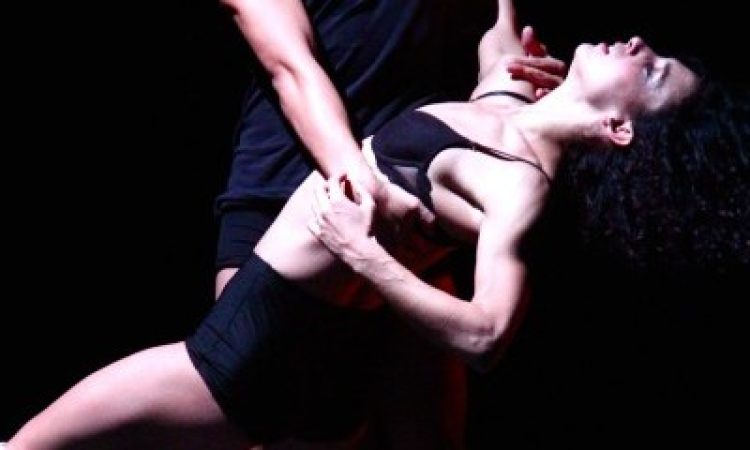
The mood shifts drastically with Run Silent, Run Deep, the most angst-filled piece on the program. The piece did cause me some anguish; I cringed as the dancers (the muscular Evalina Carbonell and Vuthy Ou, seeming rather vacant) threw themselves loudly to the floor and slapped each other’s bare skin. Though Lin uses poetry by Edna St. Vincent Millay in an attempt to illuminate the movement, the tormented partnering progresses without apparent motivation. If the piece had been cast with two male dancers and a live actor delivering the text, as the program states that it was originally in New York in the early 90s, both the dramatized relationship and the red tie that both performers wear for a brief time might have made more sense.
A new work by longtime company member Olive Prince, to dust, closes the first half of the performance. As if advertising a line of new Fall colors, the dancers strut around the stage, burst into attitude turns and tilts, pose provocatively, toss their hair and coyly show their profiles, all while wearing muted rust and silver tones with heavy lipstick. They relate to each other superficially, like people too self-absorbed to connect, so that when they do break into unison, jutting their hips or gesturing with two fingers, it seems a casual accident. Toward the end, a potential meaning of the title is suggested—as the dancers contend with sudden onslaughts of rigor mortis, contorting into beautiful and strange positions. The piece closes with couples folding to the floor from three impressive overhead lifts.
Of Lin’s four other remounts, two were capably danced but forgettable solos. The Song that Can’t be Sung, a duet that was originally performed at the Dancers Respond to AIDS Concert 1999 in New York City, offered another gorgeous effort by Mo and the young Brian Cordova (a student in his sophomore year at Temple). Lin’s choreography avoids commenting directly on the AIDS crisis, but the dancing is lovely, with its gentle lifts and sweeping locomotion.
The final piece SHALL WE…? is an upbeat celebration of vernacular dance set in a Buenos Aires nightclub. The dancers take to the Tango quite easily—Jessica Warchal-King and Vuthy Ou (in a very impressive performance this time) really seem to be having fun—but they do not take as readily to the speaking and acting that is asked of them in this piece. In contrast, when veteran performer Rhonda Moore enters, she blows the audience away with her projection and her personality. The six sections are individually entertaining, but altogether, the piece comes off as a chaotic cultural and stylistic mash-up.
I left feeling as though the evening as a whole, much like this last piece, was less than the sum of its parts. It is clear, from this retrospective, that KYL/D is dedicated to training technically skilled dancers for this particular work. The company has also been successful in building an audience of theatergoers who come to be entertained and support the company with regularly sold out performances. In Executive Director Rev. Ken Metzner’s program note, he expresses gratitude for being able to continue to do this work in Philadelphia. In five years, the company has certainly carved out a niche here, and was able to distract me from any lack of substance with accomplished shimmer.
FALL Reflections, Kun-Yang Lin/Dancers, November 7-9, Painted Bride Arts Center