[Bindler reviews her partner Curt Haworth’s work, Onliest.]
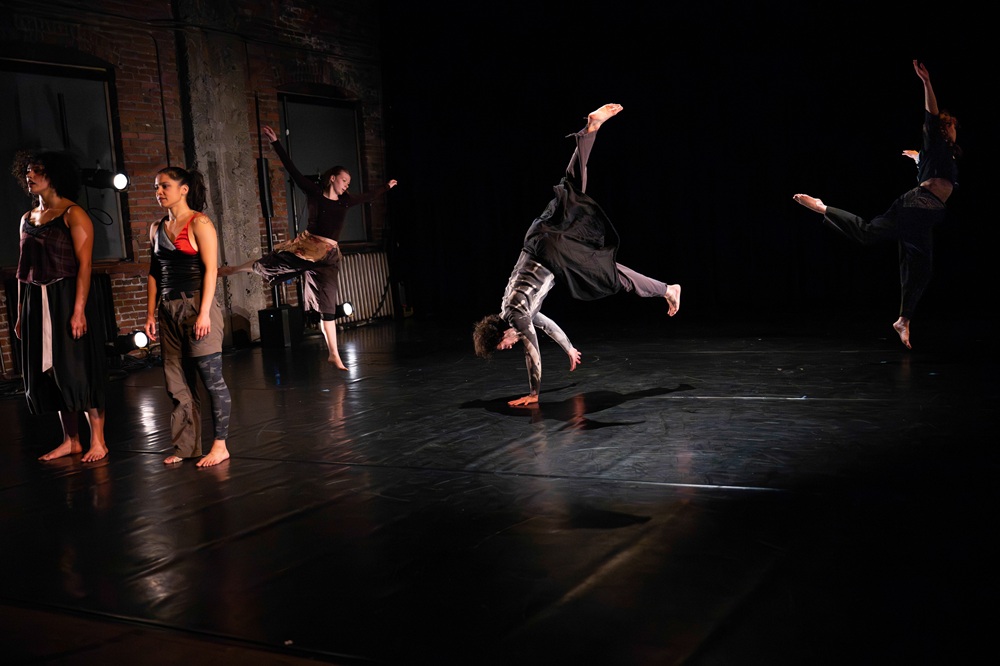
The performers are alone, even when they dance together. From my vantage point in the theater in the round, much of the piece is backlit. Their solitude and haunting coronas of light imbue everything I see with an aching sense of isolation. Onliest, created by Curt Haworth, is a site-specific work that enmeshes itself in the Mount Vernon Dance Space. The performers emerge from stairwells and ceiling. They climb the walls and windows. The room is stripped bare of artifice as they operate the technical elements unconcealed: light board, set design, video projectors and musical instruments.
Julius Masri, a multi-instrumentalist who plays electronics, percussion and objects, invests his sounds and his body in the performance. Haworth rolls over him as he taps the floor. The brawny Leanne Grieger carries both Masri and his drumkit offstage. He thrusts his sound-making materials into the space, rolling metallic balls that sing on the floor as they careen toward the performers or the audience. In one section he is enclosed in a red, woven square of screens that he beats and swipes as a beam of cold light shafts from underneath him, illuminating the ceiling and casting a giant shadow of his swift body.
John Luna, a dancer and video artist, projects moving images on every surface of the room. He switches on the ceiling fans. They swirl, breeze and glow with shining images of sparse, winter tree branches. He hands us an iPhone to pass along that plays a looped video of dancers orbiting around each other. They disappear behind one another and re-emerge as different people. The precise editing makes the transmutations appear supernatural. The ephemerality of the moment is heightened because my attention is divided: simultaneous to the video loop, Haworth and Greiger perform a twisted-limbed, unison duet. I know I will never fully grasp the wholeness and complexity of the moment.
Luna flares an image of snowflakes on a wall with a ledge. Bethany Formica materializes above the flurry. She sways the hanging light fixture that brightens as she speaks about emptying her wallet into the ocean: “and finally my license, my own face looking at me as it retreated below the waves. I turned around and walked away– a new person– free.” The projection zooms in to reveal that it is not snow, but spinning, glimmering credit cards falling from the sky.
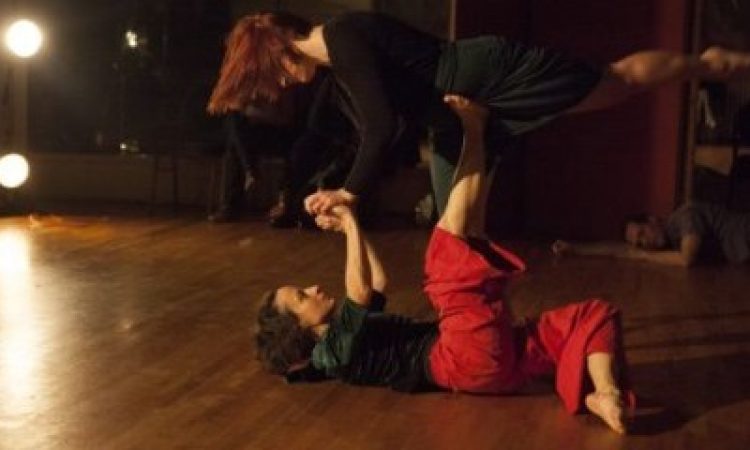
The seven dancers crescendo, cathartically spoking and flying through the space to Masri’s amplified noise rumbling in the floors. They settle into stillness. Formica and Greiger rise to perform a sinuous denouement where they push and pull one another like twins fighting for territory in the confines of a tight, muscular womb, or like sleeping lovers fighting for territory in bed.
After the bows the majority of the audience remains in the space for almost as long as the performance and the only thing that draws the last of us out is the promise of more conversation over drinks at the Belgian. I am reminded of an evening I spent at Yoshito Ohno’s studio in the hills of Yokohama, Japan. After his Butoh class, his assistant served us green tea and mochi. Everyone stayed for two hours and I wondered out loud why the dancers didn’t want to leave. Ohno replied with a smile: “Because we are all so lonely.”
Onliest, Curt Haworth Movement and Performance, Mount Vernon Dance Space, November 22-24.