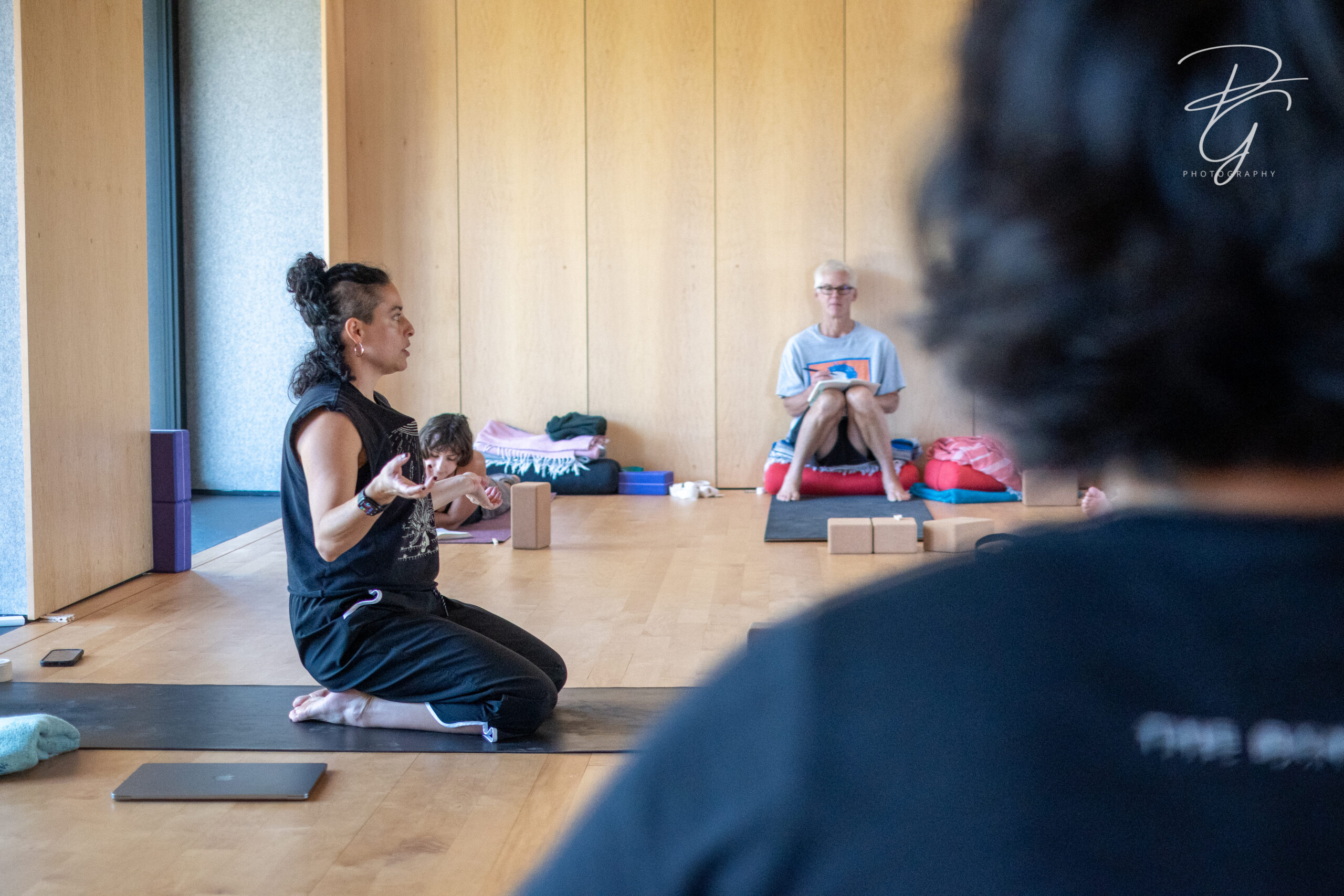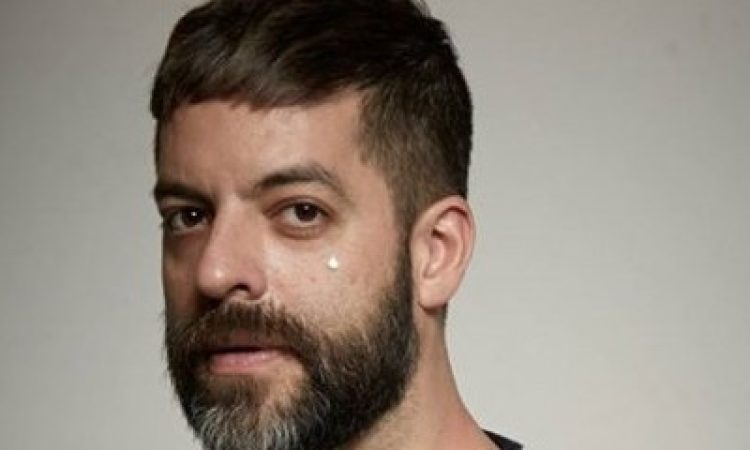
Miguel Gutierrez joined thINKingDANCE for a talk about his relationship to writing. He spoke for two hours about his development as an artist and how his writing practice has played a role in that journey.
He discussed his writing as a performance practice—reviews, grants, program notes, text for performance and newsletters—all thrusting his voice into the public sphere. He became most electrified when speaking about writing for an audience of one: when he is unsatisfied with reviews of his friends’ work, he spills out long letters to them, brimming with provocation, celebration, challenge and love.
As he read a letter he wrote to a friend imploring him to make the lighting more ugly, I was reminded of the unexpected blessing of Jonathan Stein’s unfavorable review of my dance, Pia Mater, that catalyzed meaty responses from 12 commentators plus a letter to the editor. Controversy is exciting, and I was happy to have my dance placed in the center of a thought-provoking debate. It was also a gift to have many diverse, lasting impressions of a performance that was lost forever due to problems with the video.
In the workshop, Miguel discussed the role of the dance writer as an archivist, with an additional responsibility to draw circles around artists who influence one another. An issue that recurred for Gutierrez, like a refrain: “I don’t see enough context in dance writing.”
As the daughter of a History professor, this speaks to me, and I admit I have a bias toward critical work that broadens audiences’ perspectives. Some may insist on responding to what they perceive in the moment with a dance, but I wonder what the reader misses by not knowing about the evolution of an idea, the genealogy of an artist, the politics and geology of the place where the artist is from.
As a counterpoint, Lisa Bardarson described her writing practice as a meditation: she attempts to relinquish the watcher. She spoke about how history can bear down on us, dilute personal experience and shackle us with a sense of duty.
Perhaps each writer’s approach to providing context is linked to how s/he sees the role of languaging dance. Is it to understand the dance more deeply? Are we simply recounting what happened? Are we writing an embodied history? Are we drawing connections between disparate movements? Are we devising manifestos?
Gutierrez posed a poignant question: How can one craft a poetic response to a poetic experience? He defined a successful piece of dance writing as one that ebbs and flows between the microscopic and the telescopic—the details in the moment and the external conditions that allow the dance to manifest. He waved his hands together like two mirrored sine waves, drifting toward and away from one another.I find this idea compelling—to strive for discursive and expansive writing, while sustaining the sublime simplicity of the dance in the moment.