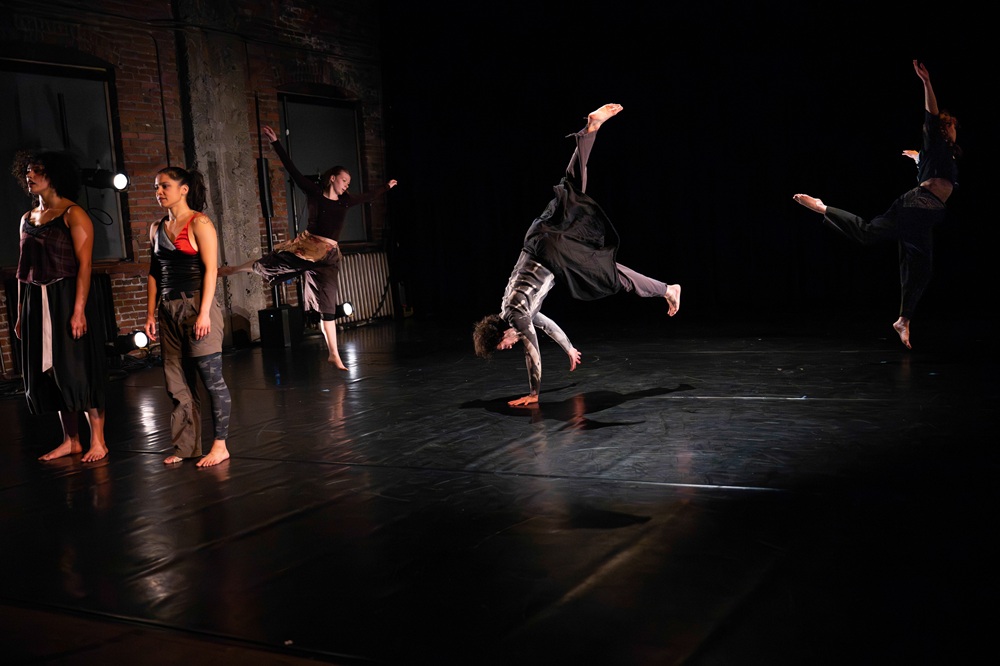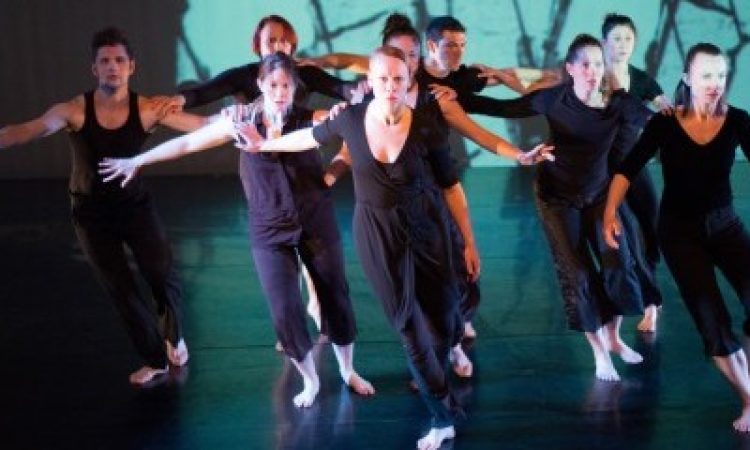
Pictured above and on the homepage, Group Motion in earlier works.
As a warm-up to their January season at the Arts Bank (January 16-18, 2014), Group Motion dancers performed seven excerpts from the work they have been creating with guest artist Susan Rethorst. The dancing was followed by a panel discussion open to audience questions, making this “Informance” truly informative. The good-sized crowd—mostly Philadelphia modern dancers, choreographers, and teachers—made for a friendly, thoughtful audience. Lights stayed up the entire show, the dancers were in practice clothes, Rethorst announced “black out” or “lights up” to stop one scene and introduce another, and the only music used was for the first dance excerpt, shown as the audience filtered into the Performance Garage.
As we headed toward the seats, we were greeted by the dancers moving planks along a wall off stage left, while a video of dancer Gregory Holt played against both wall and planks. Each shift of the boards reflected Holt’s image differently, foregrounding body parts, atomizing his movement.
Then pulsing Rolling Stones music began and Holt, in the flesh, took center stage, rocking out, channeling Mick Jagger in face, form, and frenzy. Things quieted down after that. Rethorst explained that we would be seeing works in progress by the five dancers—Holt, Lindsay Browning, Ellie Goudie-Averill , David Konyk, and Lesya Popil. She stepped aside, and the dancers took the floor.
Two of them dragged two others toward center stage, on either side of Popil, standing in dramatic profile, her arms angled outward and upward from her shoulders. The other dancers, prone on the floor, converged around her, whispered conspiratorially, then pulled back. Popil moved, slowly, through subtle articulations of hands, head, face, and weight-shifts. Konyk approached her, arched her backward over his arm and lowered her to the floor. She allowed him to shift her limbs about with a push or pull of his foot or arms, before he circled her with walks crescendoing to runs and exited. Blackout.
This material reappeared in various spacings, pathways, and guises throughout the remaining excerpts: dramatic postures, dragging, coyly secretive whispering, and subtly articulated gestures constituted the movement lexicon. There were occasional surprises: Browning’s flirty Blanche-DuBois character, an exit that resulted in Holt pinning Goudie-Averill to the offstage wall on which we’d earlier seen the video, dancers tickling and poking one another (the latter evolved throughout other scenes into rubbing and pushing).
After the dancing, Lois Welk, Executive Director of DanceUP, led the rich panel discussion with choreographer Rethorst, Group Motion Artistic Director Manfred Fischbeck, Rethorst’s longtime dancer and friend Vicky Shick, New York’s Danspace Executive Director Judy Hussie-Taylor, and Philadelphia dancer-presenter-writer Megan Bridge, who has worked with both Fishbeck and Rethorst. Themes included Rethorst’s and Fishbeck’s training and early influences, the nature of each one’s creative process, and the diverse experiences of dancers who work with them.
I found particularly interesting the Group Motion dancers’ comments about changes in their own work as movers and dance makers over the course of the Rethorst rehearsals. They began the residency with a choreographic intensive last summer, which gave Rethorst an opportunity to expose the dancers to her process and for them to reveal their minds and movement to her. From this rich loam Rethorst nurtured the phrases, interactions, and sequences taking shape for the Arts Bank premiere. Telling was Goudie-Averill’s comment that, as a dancer, she usually knows how to prepare herself for the dance styles she anticipates in a work—ballet, classic modern dance, postmodernist movement, improvisation. But with Rethorst, she had to be “more like a person and less like a dancer”—calmer, less ready to be someone’s canvas. Yet Rethorst’s directorial hand was roundly acknowledged: she chooses, she shapes, she organizes the movement. Indeed, in her quiet voice, she called herself a “dictator” more than once in the course of the discussion. Yet it emerged that she draws her decisions about movement from her understanding of who her dancers are, of how they move and think and move some more.
Refreshments, informal conversation, and copies of Rethorst’s recent book, A Choreographic Mind: Autobodygraphical Writings, for autographing and for sale, concluded the evening.
perceiving the ‘just this’-ness… Informance. Susan Rethorst/Group Motion presented by Philadelphia Dance Projects at the Performance Garage, December 5, 2013, http://canarypromo.com/pressrelease/SusanRethorst2014, and dancers’ blog at http://groupmotion.org/tag/susan-rethorst/