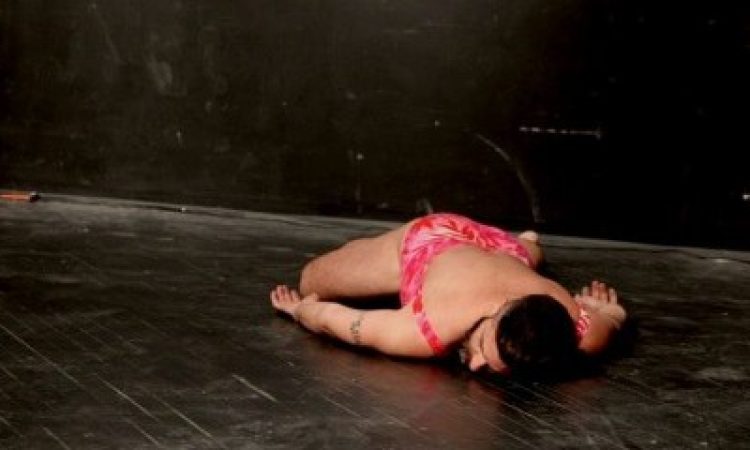
Thank you for everything. Your insistence on creating your own image in the pink ladies one piece bathing suit, your accessibility, your ferocity, your vulnerability, your many mad skills: choreography, singing, creating music, ranting with pinpoint accuracy and the breadth of your life you share through your body. Thank you for warming up the space, greeting us with a kiss and keeping the lights up. Yes, I wanted to be part of that moment with you and everyone else. I went along with the suggestion you sent me and did not write down a thing during the performance. So now I doubt myself… Did you say your work in progress is called Age and Beauty? My current age messes with my memory.
Philadelphia poet CA Conrad greeted us sweetly as well. A spidery creature, in velvet hat with sparkly pin on the brow, he spun poetry and stories that traversed worlds. His description of the time before ultrasound testing for pregnant women — when parents conversed with their fetus unfettered by gender — gave me more than reflection. I realized how someone growing up gay or trans-gendered might be sensitive to the possibilities of this dreamy time but those whispered conversations create big expectations and affect everyone. His poems bespoke trials of endurance, like when he asked random men on the street about the exact nature of their semen; compelling people to interact proved equal parts perilous but rewarding. You two made a fine pair — poet and performer bringing the pot to a boil in live performance.
You created a comfy, informal space, but the moment you made a gesture, there was no doubt about your performative skills. You became larger than life in the most natural way, filling the space with show, showiness, display — strutting your stuff in gorgeous precision! The rhythm tracks came at us over and over, a disco/samba enticement to the dance floor. You swept around the space on the balls of your feet, arms in a high V, circling wrists. It felt like joy and power, freedom, sexuality, masculine and feminine beauty. I loved the repetition of strutting, striding with arm variations that compelled our attention and set us up for the variations: with feet wide you sequenced through the torso, a sensual accounting of fleshy presence; holding your crotch you performed a perfect humping motion, beguiling us watchers.
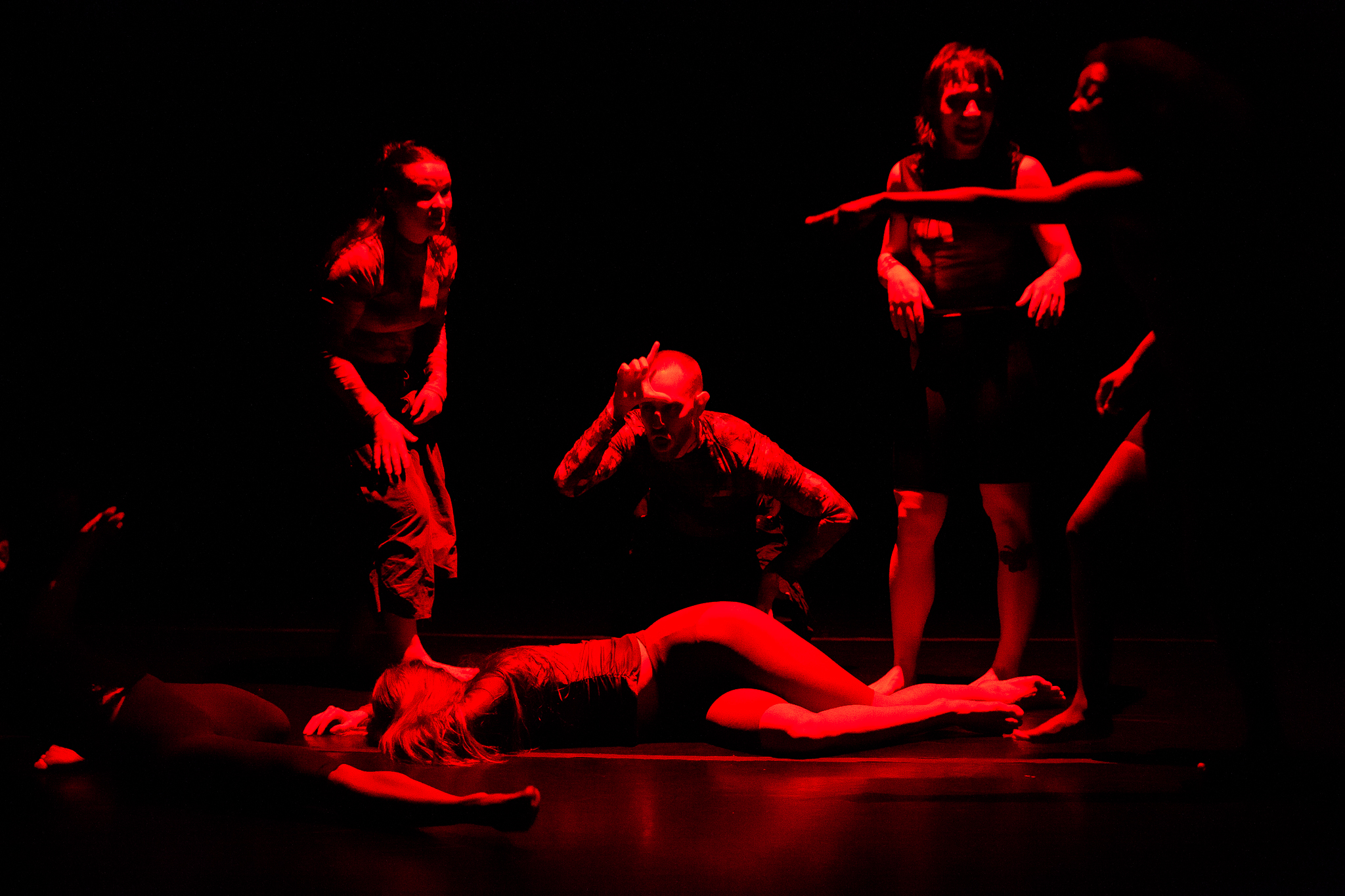
And the flip side – coming out of a section of gut-busting, controlled strutting, you sat, then it seemed as though the room threw you about into a backwards stumbling roll. Someone gasped; the transition was sudden, as though the floor was pulled out from under and you lost it. Askew and adrift, you pushed off the walls with a foot here and there, trying to get purchase on gravity. Was this tilted struggle the underbelly to your controlled display, a painful fight to create that powerful beauty? Or was it a rambling descent into doubt and conflict and the moments when the body fails?
Your soliloquy on not getting the poem written was poetry itself, calling out the frustrating contradictions specific to this twenty-first century madness we call modern life, specific to the challenge of being a dead-on experimental artist whose fields are not rewarded financially in a society that requires and validates through the wallet. Thank you for tackling the big stuff, for giving us an angst-filled rant loaded with conflict, for taking us into the darker sides of our psyches.
Your “We are the Dancers” song/speech owned and redefined that role. Your swaggering challenge, “We are the dancers, do you want to fuck us?” questioned: who owns the body in performance? Is the dancer physicalizing the audience’s fantasies? You acknowledged and rebelled against this relationship. For me, the beauty lay in your insistence on asserting your intelligence within the role of dancer and your scrappy insistence on continuing.
P. Graham
p.s. Thanks to Marissa for bringing you here and to both you and CA for being the ferocious and gentle warriors that you are, for caring enough about the injustices of the world to bring them forward in your art, for crow-barring open our hearts just a little bit wider.COUNTER/ACTS: CA Conrad and Miguel Gutierrez, Paraqueeratrical, Curated by Marissa Perel, AUX Performance Space, December 11, http://voxpopuligallery.org/calendar-event/counteracts-december-11/