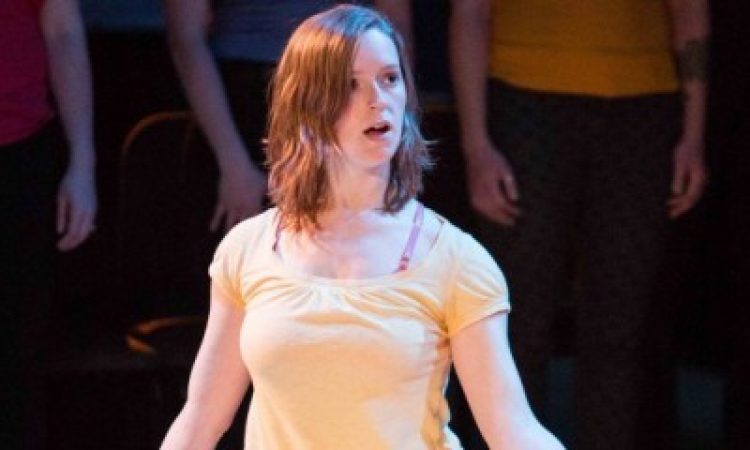
Kalila Kingsford Smith, continuing her series on the “business” of dance, interviews Sara Nye, performer with Real Live People (In) Motion, Program Associate of Enchantment Theatre Company and Program Manager for The Philadelphia Dance Academy.
What were your goals and expectations when you moved to Philly to begin your career as a performer?
When I moved here after college, I wanted to dance for everybody. I thought I was going to audition all the time and put on my own shows. There were so many options, but I didn’t quite know how to get to them. Scott McPheeters, who also went to Dickinson, was a great resource for me because he had already been here for a couple of years. He taught me basic things like getting on the Listserv—which is really helpful, especially for someone who has just come into the city. Every day you’re getting updates about auditions and classes and opportunities.
That first year, I was in THREE different shows in the Fringe Festival. I thought, “This is awesome. This is how it’s going to be every year! People are going to see me and reach out and become my next project!” But of course it’s a much slower and more piecemeal process than I expected. It was awesome doing that whole glop of experiences. It made me feel like I was tasting what success is.
But then it was just dry spell after dry spell—the work was not as consistent as I expected. The transition from a very supportive, cushy, liberal arts college to the real world is very difficult. In college, you have advisors telling you what student organizations do the things you are interested in, and there’s structure in that system. That was very different from what it’s like in the “real world.” I didn’t have anybody pushing me anymore. I had to start believing in my own potential in order to achieve what I wished. I’m still trying to do that.
What is your biggest challenge as a dance professional here in Philly?
My need for security. I freelanced for a while, but I need a more stable paycheck in my life. My response to that challenge was to reach out to another world I had experience in—the admin world. Although technically I am still a freelance contractor, it feels more stable to also be an administrator.
Were you prepared for taking on the business side of being a dancer?
Not really. I owe a lot to a teacher in my senior year of college who had just come from the actual world of dance. I told her that I planned to move to Philly to become a dancer, and she said, “If you decide to do that, it’s going to be really tough. Sometimes you might not be able to make ends meet, and you’ll have to ask for money, or you’ll have to get a supplementary job.” She just laid the cards out, and I appreciated her honesty. It doesn’t always pan out the way you’d like. And all the pieces have to be balanced—if I’m getting less money than I’d want, but I enjoy the people and the project I’m working on, then I’m okay with the whole package. But if I don’t feel whole-heartedly attached to the work, I know I shouldn’t do it, especially if the compensation is not what I think I’m worth. As I get older I’m more ready to recognize when I’m not interested in a project anymore and think, “I need to stop doing this.”
Because creating and performing dance is not my primary source of income, the business of dance, for me, is about time. Time is really valuable to me since I have so little of it to spend creatively. I’ve worked with some people that I felt didn’t value my time, and I didn’t appreciate that. On the flip side, whenever I work with someone who does, I cultivate those relationships and tell them why I like working with them.
How have your goals changed as your professional career has evolved?
I moved here because I wanted to perform. I also wanted to continue choreographing after I graduated, but that didn’t happen as much. When I started doing administrative work, I realized I enjoyed it. I love being able to support arts creation in different ways. Currently, I’m interested in learning about design software. A direct consequence of working with arts organizations is that certain things—like updating websites—sometimes take longer than they need to. Sometimes you have to step forward to make it happen, so that led me to want to start designing marketing materials and websites. Being good at other things and wanting to improve at those things helps me feel balanced since I’m not performing as much as I would like to. It makes me see the true worth in all parts of my career.
What advice would you give yourself as a person just starting out her career?
Just go and do. Absorb as much as you possibly can while it’s still new and scary, because it will always be new and scary, even when you’re settled. Do things and get involved in communities that are similar to the one you want to be involved in but connected in some way. If you become interested in design and fine art, seek out those people as well as dance people, because you might see a connection there that no one else sees, and that might be cutting edge. Just be a sponge.
For this series about the “business” of dance, TD writer Kalila Kingsford Smith interviews emerging, mid-career and established local dance artists about how their individual careers have taken shape. Read the introductory article of the series and an interview with Amy Smith of Headlong Dance Theatre. If you would like to share your story as a part of this series, please contact Kalila at kalilakingsfordsmith@gmail.com.