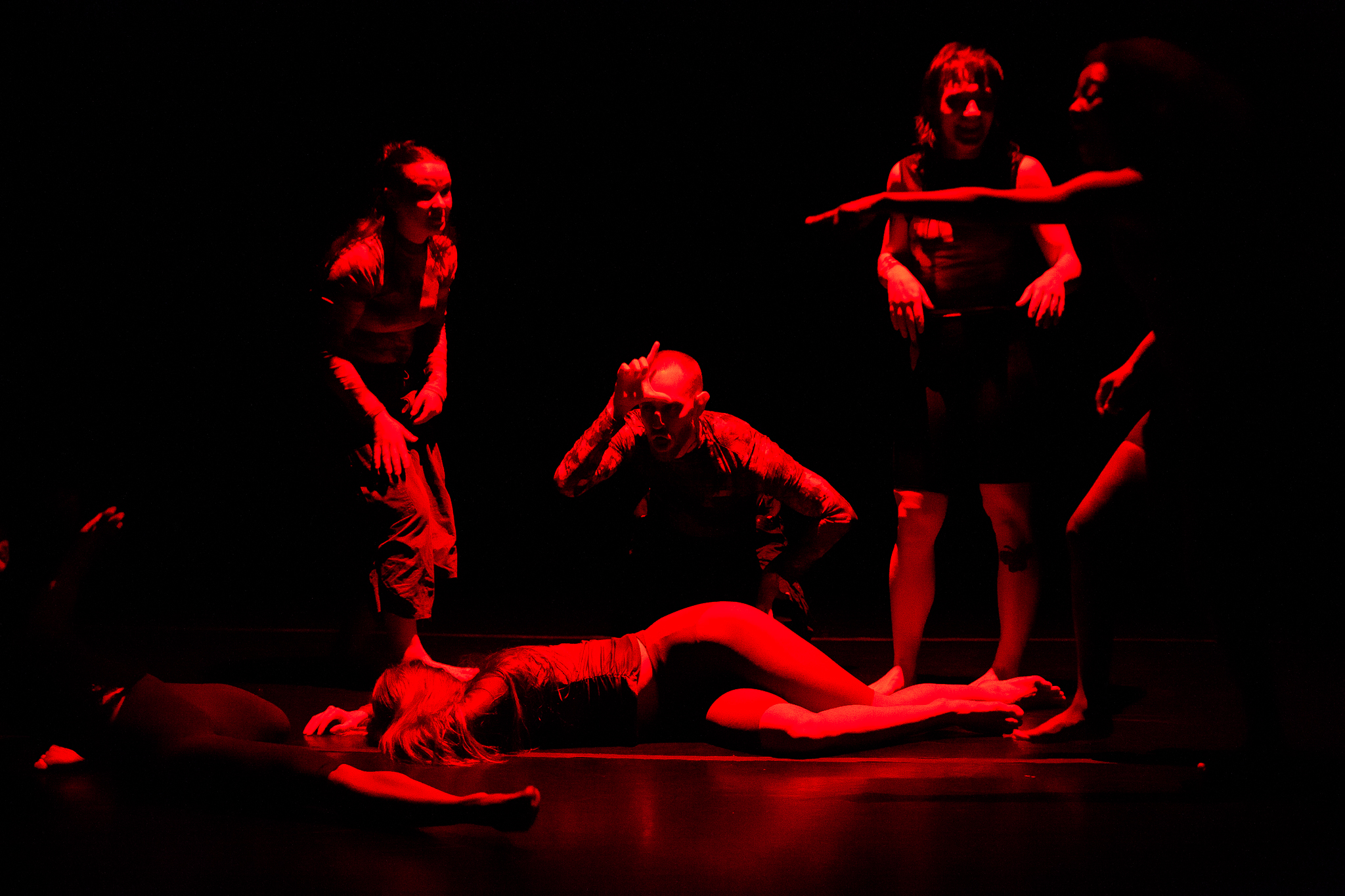
“Ho! Hey! Welcome! This is a story of Harry!” He defied the gods for honor and love. In this full-company work, Les Ballets Jazz de Montréal (BJM) expresses a tale of struggle. With a mix of dance, voice, and comedy, Barak Marshall’s Harry took the audience on a roller coaster of emotion. Viewers grooved to Israeli pop music one moment and were saddened by heartwrenching strings the next. You can’t help but relate to the work’s title character, a man dressed in a simple button-down and pants who gleefully waves to the audience on his introduction. Yet, immediately, we are struck with Harry’s death, marked by the bursting of a red balloon and his funeral. At this funeral, the men are romantic, stating that life is for love, hope, and honor. The women are pessimistic, arguing that life brings only cruelty and death, and that one must be rational, realistic, and ruthless: “Love is stupid.”
The scenes unfold out of chronological order and the funeral occurs within multiple contexts. Once again living, the affable protagonist carries a pot, hesitantly staring at a line of women holding different sized lids. The woman bearing the lid that matches his pot will be his true love. As Harry proceeds to disappoint many women at their mismatches, a girl in a blue dress is restrained, kicking and hollering, from Harry. Of course, when she and he finally meet, her lid is a perfect fit. But the chorus chases the couple around the stage shaking red balloons at them threateningly. In finding his true love, Harry angered the gods. In the next instant, Zeus begins a war at Hera’s command: running, marching, popping. Glitter flies, men fall, girls cry, a flag waves. Battles are fought and won. Yet Harry overcomes existential and physical obstacles, experiences common to the entire human race.
BJM exceeds physical expectations. Each of the four works presented, all Philly premieres, were executed meticulously, with incredible fluidity and flexibility. In Cayetano Soto’s Zero In On and Fuel, the dancers wore flesh-toned and white-colored costumes that allowed the audience an opportunity to admire the enormous power of their bodies.
In contrast, Benjamin Millepied’s Closer was soft and graceful. Floating across the stage in a pas de deux, the white-clad dancers reminded me of summer love: gentle, intimate, warm. In a repeated phrase, the woman crouched in front of her partner with fists extended to the sky. He held her wrists and twisted her up into an embrace, his head resting on her chest as she arched deeply backward.
Pre-show, Louis Robitaille, company director since 1998, greeted the audience with gratitude for the opportunity to perform in Philadelphia, the company’s first visit to the city since its founding in 1972. It was refreshing to be face-to-face with the company’s artistic director, rather than listening to a generic introduction by a theater staff member. Though Robitaille did not present any of his own work on the program, the impressive selection of dances drew cheers and standing ovations from the audience, celebrating the dancers’ boundless energy and the works’ expressions of human capacity and experience. Clearly, the performers forged strong connections with the audience. BJM can be sure that Philly will welcome them back with open arms.
Les Ballets Jazz de Montréal, Zellerbach Theater, Annenberg Center for the Performing Arts, 3680 Walnut Street, Philadelphia, PA 19104, January 16-18, 2014.