A week has passed since I departed from the World Dance Alliance Global Summit (WDAGS) 2014 held in Angers, France. What remains with me as standouts from those intense days of encounter, experience, excitement and exhaustion?
First, the general shape of the event. Hundreds of attendees congregated for a heady mixture of master classes, choreolabs, dance showings, concerts, presentations, panels and pecha kuchas. Students, teachers, performers, presenters, scholars, archivists, administrators, activists—of every age and many approaches, from Europe, Africa, the Middle East, Asia, Australia, New Zealand, and North, Central and South America. I think that covers it, but hardly encompasses the richness of encounters as old friends mingled with newfound colleagues and lines of passionate (or casual) interest suddenly intersected in the course of conversation, meals, post-show chats, panel Q & A sessions and elsewhere. Performance-related events (master classes, choreolabs, dance parties, showings and concerts) took place in the bright, airy and lively Centre national de danse contemporaine (CNDC), created in 1978 and initially under the direction of Alwin Nikolais, and now, after a series of other leaders, thriving under director Robert Swinston, formerly of the Merce Cunningham Dance Company (MCDC). Presentations and keynotes were held at the University of Angers, a walk of about 25 minutes from the CNDC, and a less lovely environment than the dance center, although it served.
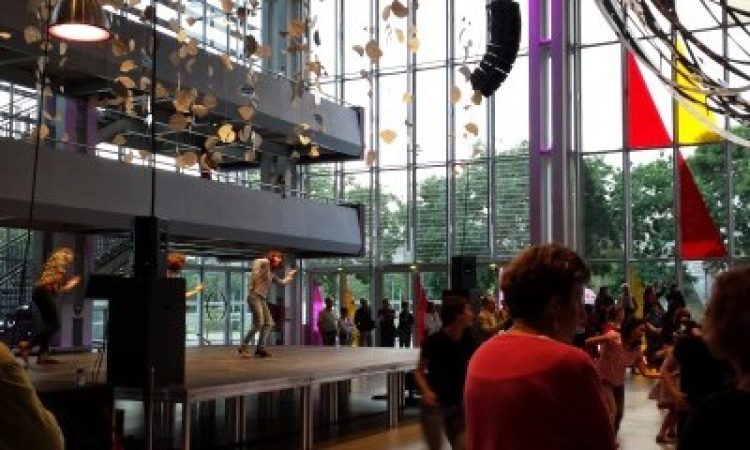
The separation of sites forced choices: to dance or to listen, to watch dancing or to watch slides and lecturers. The hoards of students from many parts of the world, whose supportive administrations lifted them to this gathering, mostly hung out at the CNDC, while their teachers and the scholars who write the books they read in college classes tended to congregate at the university. Late afternoons and evenings, though, brought us all together at the CNDC for somewhat informal concerts of emerging and recent work, either in the “smaller” theater or in the stunning glass-enclosed and highly danceable lobby, while special performance events were held later in the evenings at the CNDC’s larger theater. Every space in the building was beautiful, particularly the performance areas enlivened by the colorful fabric installation, “Un air de danse,” by Jackie Matisse, which responded to the passage of wind, dancers and people milling about.
So, again, what stands out? The opening keynote session featured addresses by a contrasting cast of characters—the elegant Germaine Acogny, Director of the École des Sables in Senegal, a former colleague of Maurice Béjart, and considered “the mother of Contemporary African Dance” (WDAGS program); the quietly matter-of-fact Robert Swinston, who eloquently expressed his memories of “the timeless oral tradition of the physical learning that is dance,” describing his experiences grappling with Cunningham’s repertory first as a new company member, then as a senior dancer, and now as legacy-bearer; and the extemporizing Olivier Dubois, bad-boy Director of Ballet du Nord, who addressed “killing his father, becoming his father,” “eating history and giving it back to himself,” and wrenching dance classics out of museums by means of study, doubting, questions.
Of the scholarly panels I attended, I found the pecha kuchas, presented mostly by younger scholars and graduate students, especially inspiring. These short takes from around the world on dance education, dancers in migration, dance and architecture, somatic approaches, traditional and folk dance and so on were just right for our racing brains in this overly stimulating environment. The surprising connections among the five or six presentations at each session inspired lively exchange and discussion among the presenters and listeners. These appetizing bites gave promise that the future of dance research is bright.
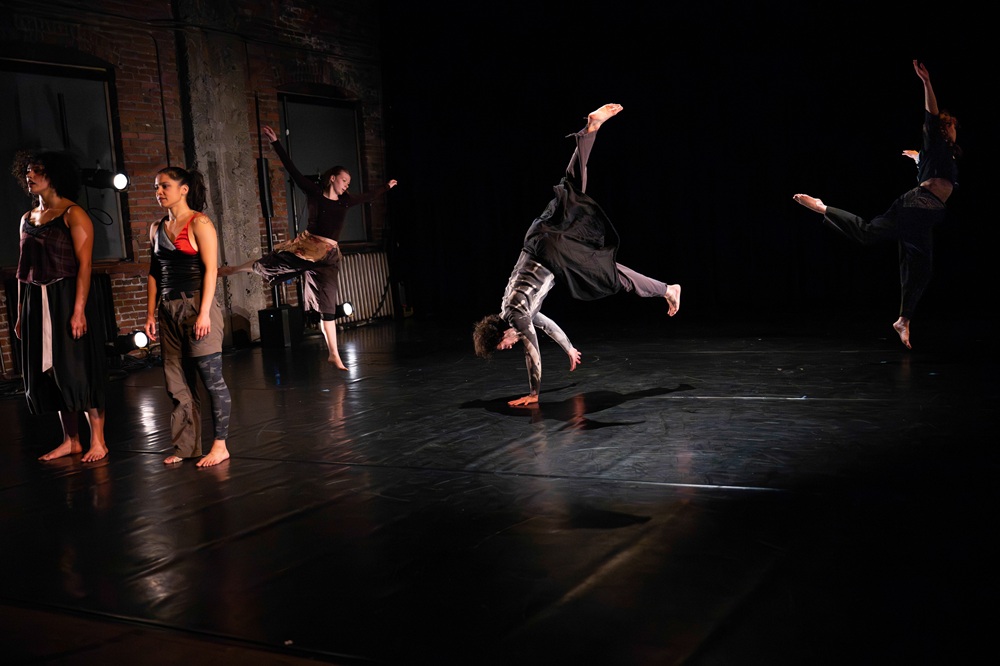
In the performances, I noted the surprising sameness of modern/postmodern dance technique in works presented by artists from Asia to America. The works featured dancers with lots of physical skill, an overriding atmosphere of interpersonal angst, and, often, electronic music. A few dances broke this mold, notably Chankethya Chey’s My Mother and I, in which the performer-choreographer’s crystalline Cambodian classical technique, infused with dramatic weight and spoken text, transformed her into a timeless figure of struggle and emergence. I also appreciated Kim McCarthy’s modern ballet work …till the end… for a large group of students at the Western Australian Academy of Performing Arts. It’s hard to make student dancers look good in ballet at all—let alone en pointe—as McCarthy did. Swinston presented two works: CNDC students danced his Shadowplay at the summit’s opening reception, filling the spacious lobby with a delightful combination of Cunninghamesque moves and convivial folk dance patterns; and, in the center’s main theater, Event, performed by a group of professional dancers new to Cunningham’s work, and utterly committed to presenting the material Swinston had chosen from 1970s and ’80s MCDC repertory with crisp, energetic clarity.
Most fun and surprising of the week’s performance programs was the Bal Moderne held in the CNDC’s lobby, where four professional choreographers (Maria Clara Villalobos, Sidi Larbi Cherkaoui, Gabor Varga and Zsuzsa Rozsavolgyi) led dancers of every age and ability, from summit attendees to townies, in learning and performing popular dances created specially for this event in a big celebratory party. The place rocked.

Bal moderne (photo: Lynn Matluck Brooks)
Yet the special magic of gatherings like the WDAGS is not capturable in an essay. I’m thinking of the beautiful walks past Angers’ medieval château, which was also visible, across the river, through the glass-enclosed lobby or the roof garden of the ultra-modern CNDC; the long and unwieldy dinners where new and old friends came and went, sharing news, impressions, stories and contact information; the moments we each slipped away and grabbed some sightseeing in the city or surrounding Loire Valley with its exquisite châteaux; the sense of satiation one has after immersing body and soul in a warm and roiling bath of dance, dance, dance—dance studied, dance performed, dance learned, dance investigated, dance questioned and dance danced.

CNDC rooftop (photo: Lynn Matluck Brooks)

Château de Villandry (photo: Lynn Matluck Brooks)
World Dance Alliance Global Summit 2014, Angers, France, July 5-11.