No rehearsals. No director. No set. A different actor reads the script cold for the first time at each performance. Will you participate? Will you be manipulated? Will you listen? Will you really listen?—White Rabbit Red Rabbit
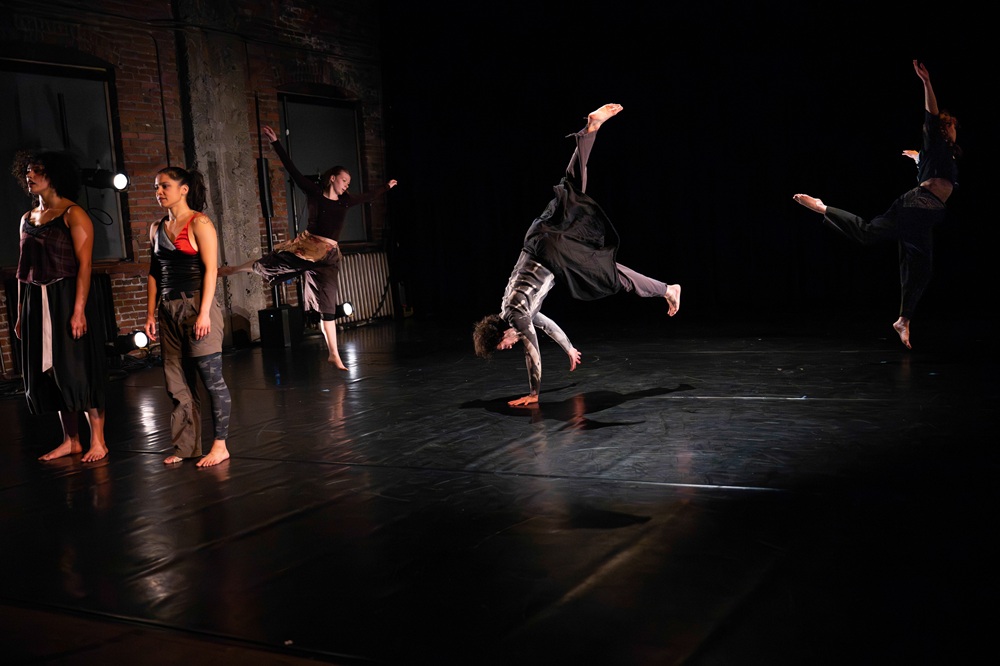
This FringeArts show fosters the growing interest in audience interaction with performance. Viewers create their own journeys and see the consequences of their decisions evoking empowerment and sometimes doubt.
In his 50-minute script, opened onstage from a sealed envelope, Iranian writer Nassim Soleimanpour spoke directly to the solo actor (Leonard C. Haas, this night) and to the audience. He related “facts” about himself, such as his inability to leave Iran due to avoiding military service, and also interrogated the audience. In a sense, he met the audience onstage. The writer defined the actor through scripted, and possibly unscripted, choices. In the audience, we couldn’t determine the difference.
Haas (not pictured above) told a story: A white rabbit pays a bear $1 for his circus ticket, only to have his ears policed. He must cover them with a red hat to avoid disturbing the view of others. The white-now-red rabbit obliges.
Another story: Five rabbits notice a carrot on a ladder. They race and, while one animal is victorious, the others are punished; they in turn alienate the victor. This “experiment” is enacted on-stage by audience participants with the cunning victor applauded by many but also regarded enviously by the losers. Other rabbits without firsthand experience re-enact the animosity towards the red rabbit, creating an allegory of blindly following accepted tradition and values.
The show was a continuum of audience interaction. At its start, audience member #5 was prompted to pour what Haas described as “poison” into one of two glasses of water. Towards the conclusion, the audience advised the actor whether to drink and which glass to choose. How much was his decision influenced by the audience? Did he know some audience members never closed their eyes as directed when he was to change the position of the glasses? Was he willing to risk his life for a performance? Did he have a death wish to drink the poisoned glass?
The audience exited, leaving Haas lying still on the stage. As Soleimanpour had said earlier in the evening, “Knowing is not the point…what matters is not knowing.” His message was clear: hop into the unknown, and fearlessly defy social norms and cultural expectations. Inform your own decisions. White Rabbit Red Rabbit has no correct execution. Rather, it invites trust in the unscripted–free will and spontaneity in a controlled environment.
White Rabbit Red Rabbit, Nassim Soleimanpour, Christ Church Neighborhood House, Sept 6-8 and 10-13, and FringeArts, Sept 18-21, www.fringearts.com