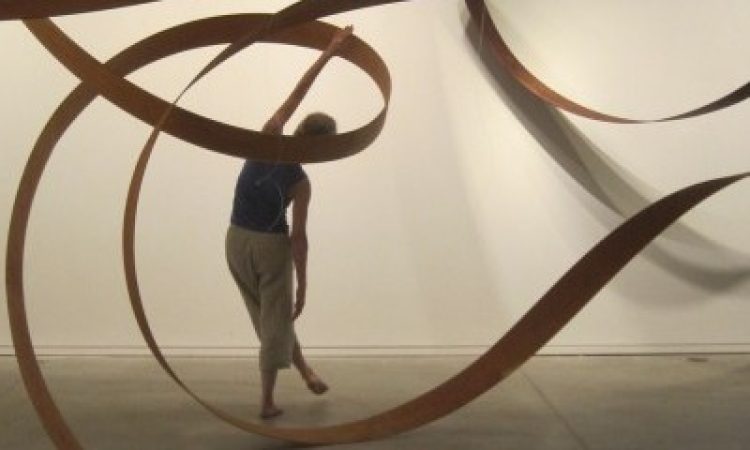
The choreography begins before the show as the audience wanders among the swoops and loops of Jeremy Holmes’ site-specific sculpture, “Convergence,” at Drexel’s Leonard Pearlstein Gallery. Swirling and swinging through the sizable space, the wooden strips invite us to wander, circle, and move around the vast möbius strip that awaits the entrance of the dancers. Audience members—babes in carriages, kids of all ages, moms, dads, grandparents, college students, and others—settle where we will, on stools or cushions, to await the dimming of lights. One at a time, dancers JungWoong Kim, David Konyk, Leah Stein (the work’s choreographer), and Michele Tantoco enter, but each viewer sees this dancer, a part of that one, maybe another not at all, from our varied perspectives in the space. The four performers cluck and chuck, call and whisper odd sounds, like mysterious beasties in a wood or jungle. Nature is awakening, signaling to those alive to its rhythms. The dancers swish and curve around, over, up, down, alongside, back, and under the wooden loops, making their own patterns of positive and negative form, and occasionally setting the wooden loops in gentle motion. Where to look? The uninhibited—children—crawl around a bit, peeking here and there; the older folks crane necks to see where this dancer has crept off to, where another is unfolding a mysterious, quiet phrase.
On cue, we all rise to put an ear to one or another part of the sculpture’s wooden flow. Dancers scratch on the wood, tap it, rap it, and soon the audience joins into this gentle symphony, while listening at changing spots along the wood. Better than a sea shell. We settle into new places along the gallery’s walls, as the four dancers gently hug invisible trees, naming them—ash, walnut, cherry, oak, maple. The dancers strew themselves throughout the gallery, then cluster variously. One slips out and returns on roller blades to fly tranquilly around the möbius, occasionally guided by another dancer. Then, Stein’s quietly rhythmic score encourages them all to full-bodied dancing, sometimes together, or in twos or threes. At last, scooching on their backs to line up along one side of the space, they rise to a linear group hug, from which each emerges to find a separate resting place—half embracing and half stretching along their chosen loop of wood.
A day in this peaceable kingdom has passed. I wish I lived there.
Leah Stein Dance Company Presents Splice, Leonard Pearlstein Gallery, 3401 Filbert Street, Philadelphia, September 18, 19, 21, and 22. http://fringearts.com/event/splice-12/