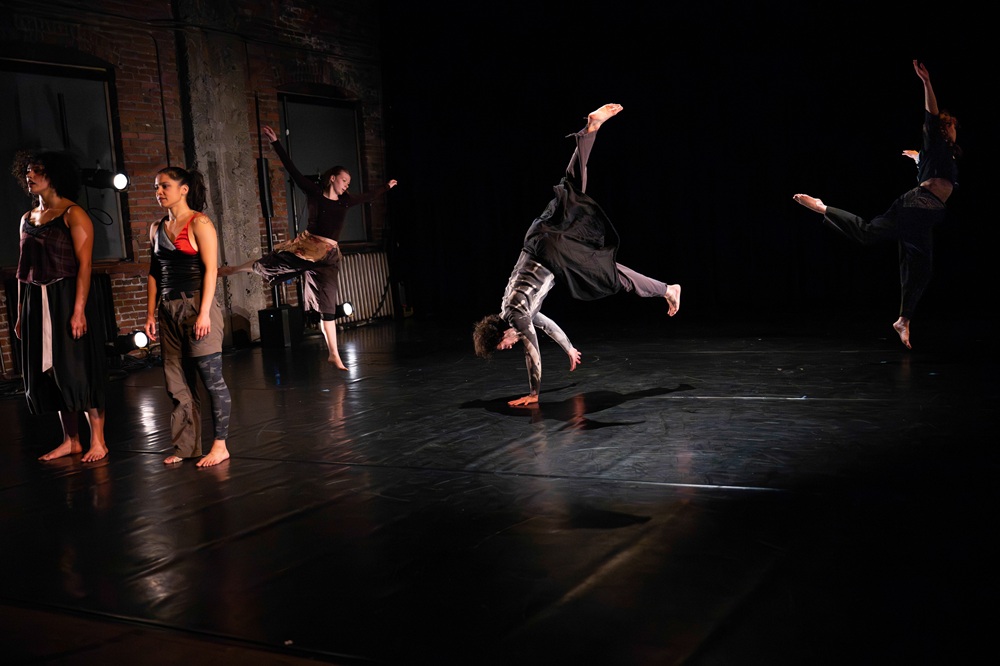
Mermaids have been swimming in the Philly dance zeitgeist for a few years now. In 2012 there were Eun Jung Choi’s swim-capped mermaids in Holy Cabinet and Merian Soto’s solitary beached mermaid in the SoMoS Summer tent. More recent iterations include the imagery within Tatyana Tenembaum’s Thunder and the subject-matter of Elizabeth Weinstein and Anna Kroll’s River Mermaids (and, arguably, Grace Mi-He Lee and Leslie Elkins’ silver-haired mermaid-ish “narwhals”).
With all of this floating in our collective subconscious, it seems the time was ripe for the world-famous Weeki Wachee Mermaids to make their Northeast-area debut at the Adventure Aquarium. They have been performing in the Weeki Wachee Springs in Spring Hill, Florida for more than 60 years–before Disney’s The Little Mermaid debuted, even. But their visit to Camden’s Adventure Aquarium marks the first time the mermaids have taken a local “stage”—and the first time they have performed in salt water and with accompanying aquatic animals: sharks, stingrays, and sea turtles.
Having heard for years about the popularity of the Florida shows, I was curious how it would be to see the mermaids first-hand in the greater Philly area. Apparently, I was not alone: Kim Horishny, Director of Guest Experience and Exhibits, reported an influx of visitors during the Weeki Wachee “residency.” I was excited when I arrived and felt the palpable buzz midday on a Friday in the aquarium—hoards of families lined up to wait for the performance. “Everyone in line has turned into mermaids–they’ve lost use of their legs!” I commented to my husband. Family after family with small children had resorted to eating snacks—yogurt, pretzels, and the like–on the floor of the aquarium’s “Shipwrecked” exhibit while waiting for a seat in the “Ocean Realm” auditorium where the Weeki Wachee were to perform in duets periodically throughout the day.
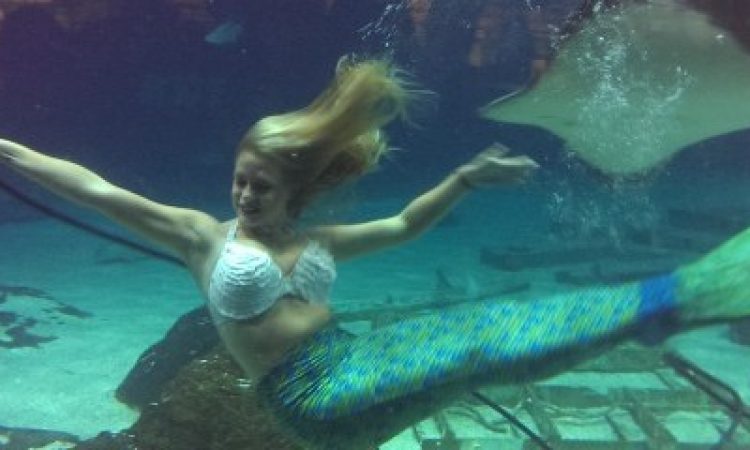
As a member of the press, I was whisked away “backstage,” for what I learned was secretly called “Operation Splash Down.” I passed coolers full of frozen fish, away from the waiting families, and out onto the stairs of a packed auditorium. Little girls dressed like Ariel and toddlers waving tridents clamored down the stadium seating and tapped on the glass of the gigantic tank as blue runners and hammerhead sharks swam past. After an announcement over a loudspeaker announcing “Mermaid Taylor” and “Mermaid Danielle,” two smiling women swam forward with breathing tubes in hand. In shiny green tails and white ruffle-scaled bikini tops, they faced the audience, smiles beaming and hands waving. The audience went nuts—clapping, screaming, gasping. These women were used to it, flashing pearly whites, batting (waterproof) mascara-ed lashes, hair rippling upward in underwater currents. A swarm of children rushed the “stage,” and throughout the performance, a rotating cast of children banged on the glass, beamed at the dancers, smiled and posed for photos with their parents.
Vaguely-latin techno-pop music filled the space, and the mermaids quit posing to begin their choreography. Sucking periodically from condensed oxygen tubes (not unlike a hookah’s hose), they blew kisses, then bubbles, which they fanned with a sweep of the arm into hearts around their faces. Legs limited by their weighted fins, their choreography included sweeping port-de-bras, hip shaking, and many a backflip. They stayed symmetrical throughout. At one point, the duet linked, gripping waists, and paused in a clear “photo” moment: free arms reaching up to the surface, wrists flexed, donning giant smiles. Later, they swam holding on to each other’s tail fins to create a full circle.
The music changed—the Beach Boys came on, more rhythmic techno, each song-change punctuated by the same instrumental photo-op soundtrack as before—and the choreography remained similar. More port-de-bras, more posing, their pathway occasionally interrupted by a passing stingray. From time to time, they lip-synced the lyrics. Were these performers or superstars? Dancers or models or synchronized swimmers? Some strange hybrid of all of the above?
The audience’s reaction was unlike any I’ve seen at a concert dance event, even among wildly popular companies and choreographers. Enthusiastic standing ovations, spontaneous exaltations…sure. But never before have I seen this level of response to concert dance, if not accompanied as backup to a pop-music sensation singing in the foreground. In fact, the aquarium staff had to bribe the audience to leave with a surprise dive further along in the “Ocean Realm” exhibit path by a third mermaid, Christie, whom I discovered later in sweats and Crocs.
“Are you one of the mermaids?”
“Yes—a lost mermaid!” Graciously, she answered my questions in an unofficial interview as we mounted some stairs—yes, the saltwater burns their eyes, but only upon exiting the water. The music is pumped into the tanks via underwater speakers. They don’t necessarily have dance or synchronized swimming training prior to being cast–the Weeki Wachee look for performers they can “mold” into the mermaids, and everyone gets their scuba certification before performing.
Unlike many superstars, she was personable, down-to-earth. But I can’t shake the thought that there may be something to this siren song of mermaids in the Philly Dance community: the popularity of these mavens-of-the-deep can’t be denied. What if we could reach this level of stardom?Weeki Wachee Mermaids, Adventure Aquarium, November 1-9, 2014