The Koresh Dance Company recently presented their 24th season celebration at the Suzanne Roberts Theatre. ev.o.lu.tion, which premiered in 2009, was raw and provocative, offering layers of complexity and flavor. Artistic Director Ronen Koresh’s stellar company of ten dancers pounded the stage with a power that leapt into the house of the theater.
The curtain rose to reveal a line of dancers in black double-breasted jackets and black pants. Dancer Asya Zlatina crawled onto the stage as if she were a preying mantis with arms flailing, snatching her prey from the air. In her crouching position, her body rippled.
The sound of anguish escaped from her body. A scream? A moan? I couldn’t tell. She stood. She clapped. Collapsing back to the floor, she continued to vocalize. She sat with her legs spread open as she slapped her body to initiate the movement of pulling her knee toward her chest. She continued to crawl.
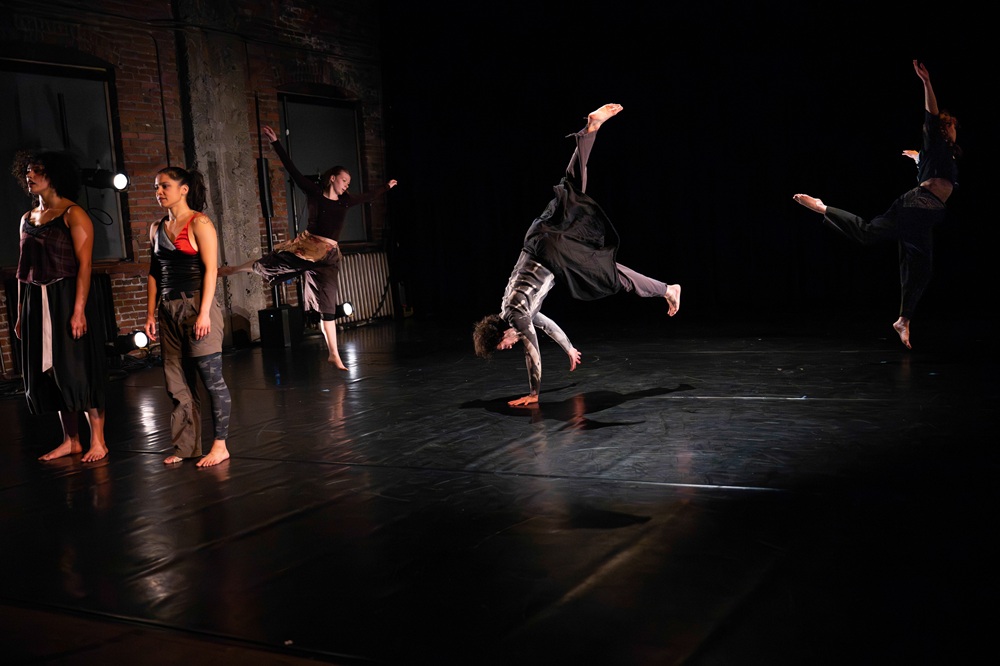
From the shadowy lights created by designer Peter Jakubowski, a dancer fell from the line backwards into the dark abyss upstage. One by one they continued this effect until one male dancer from the line was left standing. He walked over to the female praying mantis as she continued the vocalizing and slapping motif.
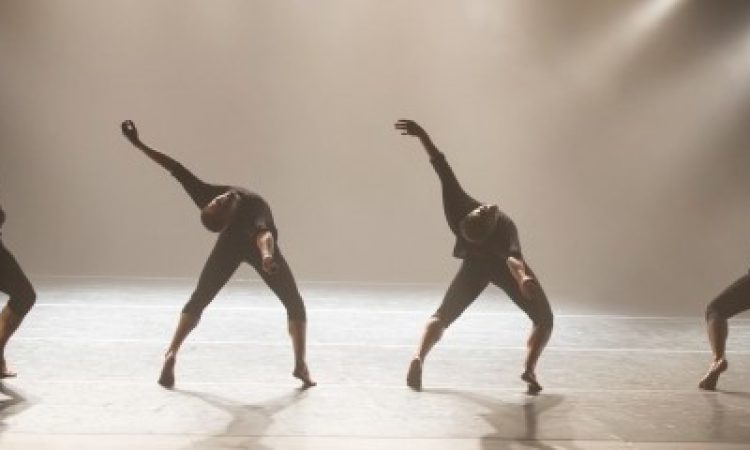
In the work’s many vignettes—solos, quartets, and quintet—the dancers percussively stomped legs and thrust arms while vocalizing relentlessly.
During the opening night reception before the show, Marketing Director Kate Aid described how she sat across the lobby while the company rehearsed and noticed that the lights in the studio were turned off. All she could hear was the bass from the blaring music. She explained that Koresh was deliberate about having the perfectly tempered environment in which to rehearse ev.o.lu.tion and how that kind of rehearsal environment intensifies the dancers’ investment and heightens their physical contribution to the work.
This investment paid off as we saw the product of that rehearsal process revealed. The dancers wailed with rage, moving in unison, and pointing at invisible enigmatic adversaries throughout the remainder of the piece. They walked with furrowed brows, lifted chests and stern gazes. They resembled a well-trained army marching off to war: precise, focused, armored and ready.
Composers Fariborz Lachini, Daniel Bernard Roumain, Pete Namlook, Franz Peter Schubert, Reid Willis, John Vosbikian, Greg Smith, and Ekho aided in building this physical feast. With musical genres ranging from electronic and experimental sonic to neo-classical and new age, the music served as a harmonious buffet for the journey in ev.o.lu.tion.
In keeping with the title of the ballet, the numerous costumes, designed by Brittany Ann Cormack, added to the theme of progression. The ladies donned flesh colored bras and shorts reminiscent of diapers while the men wore similar shorts and were bare chested. In this garb, the dancers had a primal disposition, moving with the low, squat-like swagger of an ape; but as they added more layers, their bodies slowly become more erect and the movement vocabulary shifted to reflect a classical sensibility. The men added t-shirts, while the women wore dresses that could have been mistaken for lingerie. ev.o.lu.tion was fully realized when the dancers revisited the double-breasted jackets and black pants from the opening tableau—an attempt to answer the questions Koresh posed to the audience prior to show, “Have we changed? Have we evolved? In the end, are we not the same?” The suits were eventually taken off, ending the piece in the diaper-like attire.
The many small vignettes could have easily been excessive but appeared in waves, breaking up the large group sections and cleansing the palette. The two-act ballet showcased Koresh’s superb alliance of classically trained dancers performing a fusion of earthy athleticism, rhythmic body slapping and vocalization.
The uniformity of the ten dancers trained in Koresh’s unique aesthetic—a hybrid of classical ballet, contemporary modern and Israeli folk dance—made this experience satisfying. As the audience sprung to their feet in thunderous applause, I was convinced that the many layers synthesized, giving me the perfect bite.
ev.o.lu.tion, Koresh Dance Company, Suzanne Roberts Theatre, November 13-15, www.koreshdance.org