In this piece Nicole Bindler reviews Kibbutz Contemporary Dance Company’s (KCDC) performance at the Annenberg Center for the Performing Arts. In a thINKingDANCE companion piece, she reports on the protest outside of the concert and interviews local artists and activists to investigate the questions surrounding the cultural boycott of Israel.
A radiant globe hangs upstage. If At All transpires entirely under moonlight. A soloist in a black hooded, sleeveless tunic stretches her spine into the endless night-time of the dance. She sinks her bare legs into a deep second position, extending her forefingers and thumbs like two guns pointed to the floor. Then she flashes the V of her second and third fingers at the audience, a fleeting peace sign.
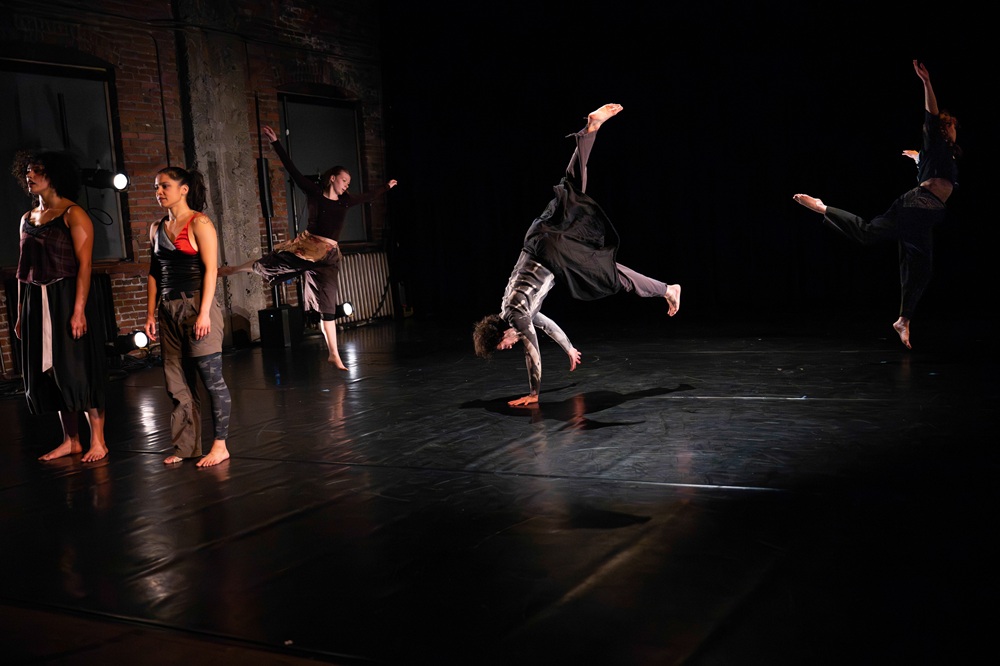
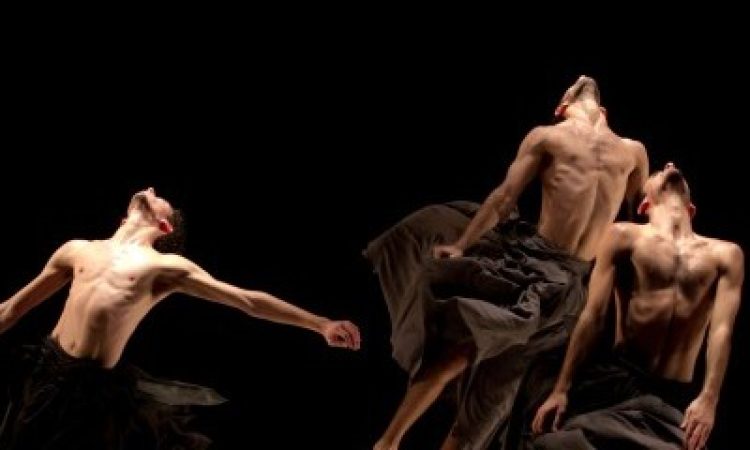
If At All is a breathless, unrelenting pursuit of endurance. The dancers fly, fall and partner almost continuously. The dark lighting and somber music sustain a melancholic mood. There is no laughter, not even a smile and certainly no repose for these dancers. But there is a pleasure to this pain. The women sweep their buttocks toward the audience. Dancers grasp each other seductively. The layering of the sinuous muscularity of the dance with the mournful music amalgamates into a sensual sorrow, like the feeling of watching a very beautiful woman cry in an erotic French film.
A voice-over says that men are more able to transcend the body because women are so connected to their bodies. Eight women and eight men are segregated in the first half of the dance except for one pack of men who toss and manipulate a woman wearing only underwear. This image confounds me. I struggle to understand why the choreographer, Rami Be’er, delineates such a stark gender binary in the audio and portrays bewildering violence towards a woman by a group of men.
Illuminated squares provide the women private spaces in which they dance alone, but in proximity. They articulate their joints with delicacy, like long-legged cranes preening, posing and brooding to a cello and electronic soundscape. They change squares by leaping over the dark spaces between. They sit in their squares of light, cloistered and solitary.
These islands evoke the region from which the KCDC comes. There are many untraversable places in Israel, Palestine and the surrounding countries. Certain land is accessible or not depending on one’s ethnicity or nationality. I wonder how much of the demarcation of boundaries in this dance is informed by the walls and borders in and around Be’er’s country.
Under the perpetual moon, two men partner ferociously. They dive and tumble over one another like big cats. Finally men and women interact with one another. Their partnering, viscous with occasional limbs puncturing the space, is imbued with sadness by a barely audible voice-over that repeats: “I will always remember this as our last, lost chance.”
The costumes change inexplicably from black fabric to corsets and plaid skirts for all. Sixteen dancers waltz in unison as the music shifts to explosions, sirens and screams. The dancers do not seem intimidated by the terrorist soundtrack. The juxtaposition of the frightening sound with the dancers’ robust and alluring bodies is strange and haunting.
Dancers shake their hands and gaze upward, pleadingly and trancelike in ecstatic lament. The mantra, “I will always remember this as our last, lost chance,” conjures up deep sorrow, regret and a time-bending sensation that the voluptuary dance we’re witnessing is a memory. With the exception of the brief surge of terror in the sound score, If At All remains opaque about the origins of all this luscious sadness.
If At All, Kibbutz Contemporary Dance Company, Dance Celebration, Annenberg Center for the Performing Arts, November 13-15.