Antigona is full of breathtaking, powerful moments. A collaboration between Soledad Barrio & Noche Flamenca and theater director Lee Breuer, the production is based on Sophocles’ heroine Antigone, who is sentenced to be buried alive in a cave after fulfilling the sacred duty of burying her brother, who died a rebel. The story is told equally through the music, the song, and the dance, as is traditional in the flamenco form. In this interpretation of the Greek tragedy, the chorus wears masks, obscuring the performers’ identities and yet intensifying the expression of each emotion. As in an opera, translations are projected onto a scrim upstage to help convey the narrative to those who don’t understand Spanish. However, I hardly glance at them; my eyes never stray from the dancers, and I understand without reading the text the raw emotion within la canción.
Our first vision of this Spanish/Greek universe is black silk pouring down towards the stage, silk held in place by a man standing on a tall platform obscured by the darkness. He ripples the fabric in time with the strumming of the guitar, catching the light like glimmers on a river. Slowly we see shapes pressing into the silk, the crouched bodies of the chorus emerging from the darkness one arm at a time. Then we see the masks—blindingly white against the black river—demons that crawl, reach, and writhe in a clump of faces. Typically, one wouldn’t see movement so close to the ground in a flamenco production, but I am enthralled by the eeriness of this image.
Soledad Barrio dances the title role and captivates with every gesture, every stomp of the foot, and every stillness. She lifts her long billowy skirt to reveal pattering feet that move so fast they blur in my vision. Those in the audience who are familiar with the form shout olé and brava towards the stage, especially when Barrio’s rhythm is pure and fast and her gestures—even with the smallest finger—are accented by the cajón.
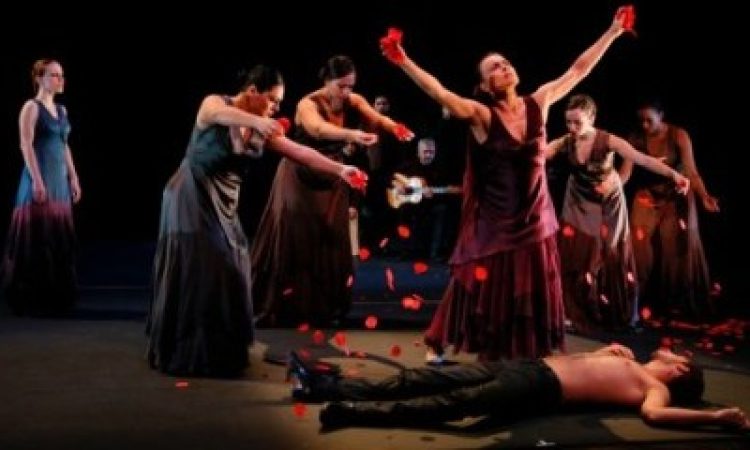
Antigona and her sister Ismene, played by Marina Elana, grieve over the loss of their brother. They, along with a chorus of four dancers, stomp in rhythm and circle their wrists with an accelerating passion. They sweep their arms upwards, bent at the elbow, then unfurl their articulating fingers and arch backwards, offering their hearts to the gods. Their movements, at first in canon, meet in unison as a single voice of grief. A wave of shivers passes through me, and my goose bumps remain until the end of the production.
Then, Barrio slowly walks forward from upstage center and gestures to the performers onstage. The audience is silent. Taking hands, they bow their heads. The audience erupts in applause and bravas. I sit silent for a moment more, breathless from the power and simplicity of this finish.
Though I know little about the flamenco form, I am moved to tears by the sorrow expressed in the singers’ voices, the ferocity with which the dancers strike the floor, and the tension they hold between their fingers. The values expressed in this Greek tragedy—that the love of family is valued even more than life itself—are rare in this modern age of self-promotion and desire to succeed. I appreciate the parallels between this story and the history of flamenco, which—as expressed in Noche Flamenca’s mission statement—arises from “ancestral cultural repression and racial expulsion.” The emotion and the dynamism of the dancing transcend any language barrier to reach that pure place of sorrow and tragedy. No other form I have seen captures so well the essence of tragedy as I experienced it at Barrio’s performance of Antigona.
Antigona, Soledad Barrio & Noche Flamenca, Annenberg Center, November 20-22 www.soledadbarrioandnocheflamenca.com