*
Mama, may I have more Kleinkunst?
That sounds dirty.
It means small art, Mama. It’s more than a century old. In other countries.
It’s foreign?
In America it’s called cabaret.
Like Liza Minelli?
No… I mean yes, but no.
*
The emcees in Goodhart Hall are clowns. (Aren’t they always?) Jo Vito Ramirez is Pretzel (a shy boy, soccer-bodied) and Rebecca Fedele is Barbara (bossy, with an affect of meh).
*
The night is cold. The theater is warm. I sit at the front on a curved bench. Those in front of me sit on pillows. The performances range. Roam. I sense a theme perhaps: vulnerability. In a cabaret, sentimentality and the stage itself are maybe always themes. Who is up there now? Why are they? What genre is this? You have twelve minutes or less to make me care… about anything.
*
But people come to care (both readings intended). The bar is low—except when there is a bar (there is none at Bryn Mawr)—because then the performers must compete with camaraderie and commingling. But there are no clinking glasses or buzzing voices to contend with in this blackbox. Instead, easy laughter. And volunteers, up quicker for onstage shenanigans than any I’ve ever seen.
*
No overt politics or farce (staples of kleinkunst) here. But what of nudity (another staple)? Of course. And puppetry, another lowbrow tradition made high by the rarefied air of any live performance in a space more intimate than arena.
*
Puppets, really? Not really. Yet… yes. Of a sort. Rucyl, a sound artist, strings her voice on wires of reverb among found sound and beats. Her introverted posture and big hair sway above her MacBook like wild grasses in a night clearing, the apple glowing like a moon. In the sonic field, I yearn for something to explode. A star. The sky. Or her voice—up into it—like a bottle rocket, like a firework dahlia. No such shattering. A dozen minutes is each act’s limit, but I would happily wait an hour or more for such sublime release. I long for the strings to be cut, the human voice soaring or falling to earth as it would were it unmachined.
*
What about burlesque? Yes. Only without much skin (that came later). Cynthia Hopkins strips her monologue of excess. No real costume, nearly no movement. Her failure-tale: given a chance to attend an artist’s retreat, she finds herself blocked by newish sobriety. Her inability to produce a screenplay seeds another type of production—a narrative punctuated with song fragments (crooned in alt-country nostalgia to tinny piano on a self-started tape recorder).
Facing a blank page only to arrive at self is many a poet’s fondest dream. Hopkins’ unadorned performance moves me towards a more empathetic epiphany. Ostensibly the subject of her self-exposure, Hopkins’ alcoholism is mere subtext. How she transmutes her nothingness (and pain) into art: the true libretto.
*
What makes transformation possible? A red nose offers clowns the fiction needed to be honest. In Rucyl’s cyborg song, technology may unlock a door through which the voice enters—perhaps only through cloaked effect willing to be present at all. The confessional is Hopkins’ route. (And I wonder how difficult it is to repeatedly recount a moment of emergence… doesn’t the damaged cocoon pre-speak its moth?)
Kleinkunst are windows. Brief gaps in the wall, juxtaposed against one another, gaining poignancy from the ubiquity of this human desperation: to be seen, known. No immense projects are on display tonight, only the unvarnished need that draws performers fleetingly onto stage and audiences around it. I’ve come to watch the small fires that once lit all stages, casting shadows around the hall like bats. This modest form (live cut-up, 4D collage) recalls to me my own darknesses, reminds me darkness can have wings.
*
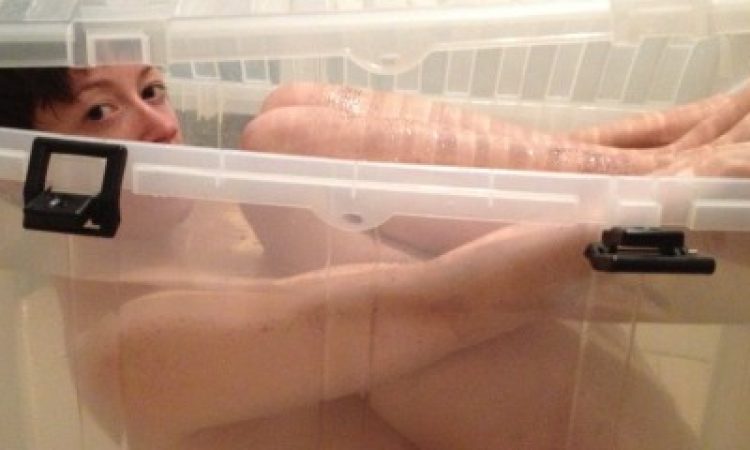
Naked Annie Wilson invites eager-to-be-onstage students onto the stage. She erects behind herself a Greek chorus and then submerges herself, thrice, in a storage bin of water and glitter—as if held under by an invisible killer. The faces of the chorus mirror the larger audience’s prurience and concern. She emerges in drowned-cat-phoenix to dance and then enact (re-enact) a brief scene. She speaks to the tech crew and the audience as anyone would speak. As if her body was not a public threat. Another volunteer is needed to perform a random meeting between strangers, she explains. A woman with green hair emerges to play Wilson. Wilson, naked except for the water-glitter-stagelights, plays another woman. The chorus, as instructed by Wilson, makes haunting sounds. They are entranced by her. Who isn’t? The hug between the women is real. The shirt, wet.
*
I’m certain I took home glitter. It was everywhere. No doubt I’ll find it later—next week or the week after—haunting my face as it hovers over the sink searching itself for error. It will be like a long unnoticed freckle, a trifling memory of being struck (and marked) by winter sun.
Wintry Mix, Bryn Mawr College Performing Arts Series featuring (on Friday): Chris Davis, Camilla Dely, Judy Dennis & Jules Feiffer, Miguel Gutierrez, Cynthia Hopkins, Jo Vito Ramirez, Rucyl, Annie Wilson (with a different line-up Saturday), Goodhart Hall, January 30-31.